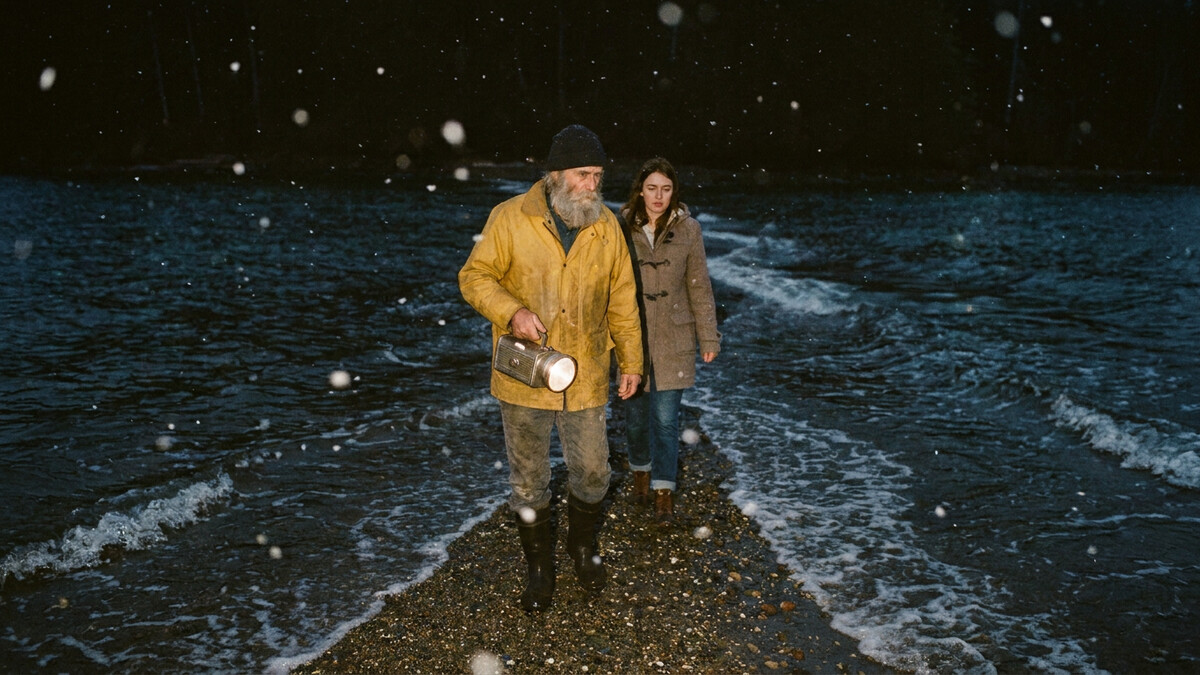
Tad did not move. He did not duck. He sat very still in the dark behind the glass and let the flashlight beam slide over the window and go on.
Then he looked at his watch.
One-sixteen. Low water had been at eleven-forty. The tide had been coming back for an hour and a half.
He did the arithmetic the way his grandfather had taught him, the way every boy in Pound Cove learned it on the dock. The rule of twelfths. In the first hour after low water, the tide comes back one-twelfth of the way. In the second hour, two-twelfths.
On the Ram Island Bar, at one-sixteen in the morning on a December night, there would be maybe a foot and a half of water over the gravel spine. Less over the mud on the near side.
A skiff with two men and a twenty-five horse outboard drew about a foot and a half.
Tad smiled for the first time all night.
"Maddie," he said quietly. "Wake up, dear. Don't turn on the light."
She was awake in an instant, clutching the laptop.
"They're here?"
"They're coming," Tad said. "Get your phone. Call the Maine Marine Patrol. Not the sheriff. The Marine Patrol. Tell them two men in a skiff with no lights are coming across the Ram Island Bar at half tide, and they're about to need help. Tell them Tad Coombs said so. They'll know."
"Need help?"
"Just call, dear."
Through the binoculars, Tad watched the skiff come on.
It was coming fast now. Too fast. Curt Haskell was at the tiller. Tad could tell by the way the boat moved, hard and impatient, the way the man fished. He was not looking at the water. He was looking at the cabin.
He was heading straight across the bar.
Not around it, the long way, by the deep channel on the east side, the way any Pound Cove fisherman would have gone at half tide. Straight across. The short way.
Curt Haskell was from Rhode Island. He had fished Pound Cove for five years. But the harbor had never been friendly enough to tell him about the bar.
Tad heard it before he saw it. A grinding crunch, like a shovel in gravel. Then the high whine of an outboard motor with its propeller suddenly in the air.
Then a man's voice, shouting.
The skiff had hit the gravel spine at full throttle. It had stopped dead, and the man in the bow, the one with the flashlight, had gone over the front into the water.
Not deep water. Two feet. But December water in Maine, at thirty-nine degrees, with the snow coming down.
And not over the gravel. Over the mud.
Tad was out the door before he thought about it, with a coil of rope over his shoulder and the big flashlight in his hand, limping down the rocks to the shore.
He could see them now in the beam. The skiff tipped on the bar, its engine dead. Curt Haskell standing in it, white-faced, yelling. And twenty feet away, on the mud side, a man stuck in the black ooze up to his thighs, thrashing, with the cold tide pouring in around him.
It was Gordon Leavitt.
Fifty-nine years old, town manager for twenty-two years, Little League coach, in a good wool coat, stuck in the Ram Island mud in the dark like a fence post.
"Stop moving," Tad shouted. "Gordon. Stop fighting it. You'll only go deeper."
He waded out along the gravel spine as far as he could go. The water came up to his knees. Then his thighs. His bad knee screamed. He did not care.
He threw the rope. It fell short. He pulled it back and threw again.
Gordon caught it.
"Lie back," Tad yelled. "Flat. On your back. Spread your weight out. Let the water float you up. Then I'll pull."
Gordon did it. Tad dug his boots into the gravel and pulled, slowly, steadily, the way you pull a heavy boat up a ramp, not jerking, letting the mud let go by itself. It took a long time. The mud made a sound like a giant boot coming out of a puddle. Then Gordon Leavitt came free and slid across the surface on his back, and Tad hauled him up onto the gravel spine, and the two of them lay there in a foot of icy water, gasping.
Behind them, Curt Haskell had climbed out of the skiff and was standing on the bar, not moving.
"Get him to the cabin," Tad said to Curt. "The stove's lit. Or he's going to die of cold. Do you understand me?"
Curt understood him.
The Maine Marine Patrol boat came around the east side of the island at two o'clock, by the deep channel, with its blue lights flashing across the water.
They found four people in the fish camp. Tad Coombs, soaked to the waist, feeding the woodstove. Maddie Pelletier, holding a laptop in a garbage bag. Curt Haskell, sitting on the floor in the corner with his head in his hands. And Gordon Leavitt, on the cot under both of Tad's wool blankets, shaking and gray and alive.
The officer looked at the four of them for a long time.
"Mr. Coombs," he said. "Would you like to explain what's going on?"
"I'd like her to," Tad said, nodding at Maddie. "She's the one who did the work."
The state auditor came on Monday morning at nine o'clock, as scheduled. Maddie Pelletier was in the town office waiting with her laptop and six years of copied records.
Gordon Leavitt resigned that afternoon. He had already confessed to the Marine Patrol officer on the cot in the fish camp, before the boat even got him back to the harbor. He said he had only meant to scare Maddie. He said he did not know why he got in the boat. He said he had been town manager for twenty-two years at half the salary of the next town over, and somewhere along the way he had started to feel the harbor owed him.
Then he said, "That old man pulled me out of the mud. After what I tried to do. Why would he do that?"
The officer told Tad about it later.
"What did you tell him?" Tad asked.
"I told him I didn't know," the officer said. "Why did you?"
Tad thought about it.
"Because it's my harbor too," he said. "And I'm not going to let a man drown in it. Not even Gordon."
Gil Pelletier came home from Portland in January. The first thing he did was walk down Harbor Hill to Tad's kitchen door with a pie his wife had made, and stand on the step for a long time without saying anything.
"She's a good girl, Gil," Tad said. "Smarter than you and me together."
"I know it," Gil said. "But you're the one who took her to the island."
That spring, the town meeting voted on a new item in the warrant. It passed without a single no vote.
There would be a sign on the shore at the foot of Harbor Hill, at the start of the Ram Island Bar, on a post Tad Coombs welded himself from an old boat rail.
DANGER. THIS BAR DRIES AT LOW WATER. DO NOT CROSS BY BOAT AT HALF TIDE. IF IN DOUBT, ASK TAD.