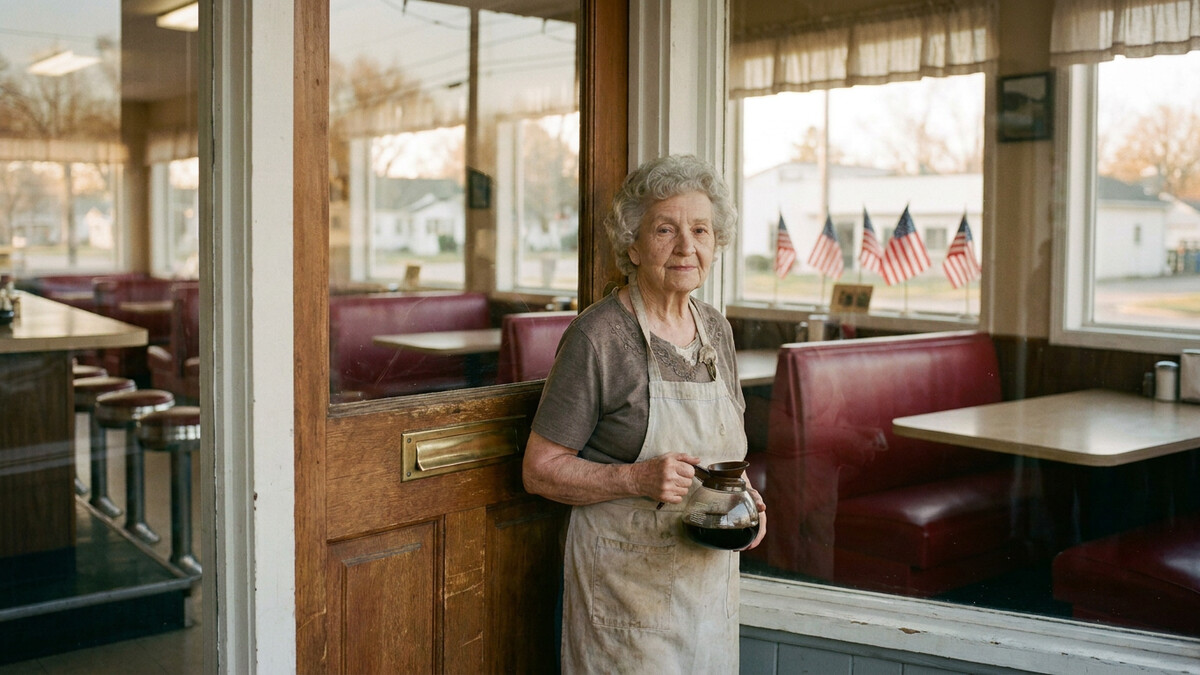
For fifty-four years, a plain white envelope full of cash had come to Dot's Corner Diner on the tenth of November, and this year, on the morning of Veterans Day, Dot Kessler stood at the mail slot with her coffeepot and realized it was not coming.
She checked the slot twice. She checked the floor under it. She asked Tyler if he had picked up the mail.
"Just the electric bill, Grandma," Tyler said. "And a seed catalog for somebody named Harlan."
Dot set the coffeepot down on the counter.
"Hon," she said. "We've got a problem."
The envelope had first come in 1972. Dot had not owned the diner then. She had been a waitress for old Mr. Pettibone, who owned it before her, and she had been the one who opened it.
Inside were forty dollars in tens and a note, printed in block capitals on a plain index card.
FOR THE VETERANS' BREAKFAST. EVERY MAN AND WOMAN WHO SERVED EATS FREE ON NOVEMBER 11. THANK YOU.
No name. No return address.
It had come every year since. When Dot bought the diner in 1978, it kept coming. The amount went up as breakfast went up. Forty dollars became eighty, then two hundred, then five hundred. Last year, it had been nine hundred and sixty dollars, in fifties and twenties, which was enough to feed every veteran in Pine Hollow eggs, bacon, toast, and as much coffee as their doctors would allow.
The note never changed. Same block capitals. Same index card. Same three sentences.
And always, every year, the stamp in the upper right corner of the envelope was set perfectly straight, exactly a quarter inch from the top and a quarter inch from the side, as if somebody had measured it with a ruler.
Dot was seventy-one. She had spent fifty-four years trying not to figure out who sent it.
That was the deal, as far as she was concerned. Somebody wanted to do a good thing without being thanked. She had seen enough people in her life who wanted to be thanked for everything. She was not going to ruin it for the one who did not.
She had kept every note in her old cigar box behind the napkins. Fifty-four index cards, rubber-banded together.
But she had never, not once, gone looking.
By seven-thirty, the veterans were starting to come in.
Lloyd Hersh, seventy-nine, commander of VFW Post 4417, in his garrison cap. Marcus Bell and Danny Ortiz, the younger ones, in their work jackets. Pete Yoder and Ray Yoder, who had both served in the sixties and argued about which one had the worse drill sergeant. Pastor Sam Greer, the post chaplain, who had been a Marine for twelve years and still stood like one.
They sat at the counter and the booths. Dot poured coffee. Not one of them ordered. On Veterans Day at Dot's, you did not have to order. The eggs just came.
Dot went into the kitchen and stood there a minute, looking at the bacon.
"Grandma," Tyler said quietly behind her. "I can cover it. It's fine. I'll put it on the register."
"It's not the money, hon," Dot said. "I'd feed them for free. You know I would."
"Then what is it?"
Dot turned around.
"Fifty-four years," she said. "Through the blizzard of '78. Through the glass works closing. Through the year I had pneumonia and the year the furnace quit. That envelope has never once been late."
She wiped her hands on her apron.
"Something's wrong with whoever sends it."
She fed them. Of course she fed them. Sixty-two veterans came through between seven and noon, and every one of them ate free, and not one of them knew there was anything different.
But all morning, between plates, Dot was thinking.
She had promised herself she would never go looking. She had kept that promise for fifty-four years. But a promise to leave a person alone was not the same as a promise to leave them alone when they were in trouble.
At one o'clock, when the rush was over, she sat down in the corner booth with her cigar box and took out the fifty-four index cards.
She laid them out on the table in rows.
Then she took out last year's envelope, which she had tucked in the box with the card, the way she kept all of them.
She laid it on the table beside the cards.
The stamp. A quarter inch from the top. A quarter inch from the side. Perfectly straight.
And the postmark. Marietta, Ohio. November 9.
She called Tyler over.
"Hon, you know how to look things up. Who in this town would know how to put a stamp on that straight?"
Tyler looked at the envelope. "Anybody with a ruler?"
"Folks don't use a ruler on a stamp," Dot said. "Except one kind of person. A person who did it for a living, ten thousand times a day, for thirty years, and couldn't stand to see it done crooked."
She thought of a voice at the Liars' Table. A complaint she had heard a hundred times over the years, usually on Tuesdays, over pie.
People today slap a stamp on any old way. Crooked as a dog's hind leg. When I was carrying mail, I'd have sent it back.
Dot sat very still.
"Tyler," she said. "Where's Floyd?"
Tyler blinked. "Floyd Eckert? I don't know. He wasn't at the Liars' Table this morning. Harlan said he hadn't seen him since Sunday."
Floyd Eckert was eighty-four. He had carried the rural mail in Calder County for thirty-one years. He came to the Liars' Table every morning at six-thirty with his walker and his tie, and he had never, in Dot's memory, missed a day.
Not once. Not in fifty-four years.
Not even on Veterans Day.
She realized, with a cold feeling in her stomach, that she had never once seen Floyd Eckert eat the free breakfast.
She called his house on Maple Street. It rang twelve times.
She called Harlan. Harlan said Floyd had seemed tired on Sunday, but Floyd was always tired. He was eighty-four.
She called the sheriff's office. Earl Whitaker was in Columbus at a meeting. The deputy said he would have somebody drive by.
Dot hung up the phone. She looked at the fifty-four index cards on the table, and the straight stamp on last year's envelope.
Then she took off her apron, folded it over the back of the booth, and picked up her car keys.
"Tyler, you've got the diner," she said.
"Grandma, where are you going?"
"Maple Street," Dot said. "And if he's not there, the hospital in Marietta. And if he's not there, I'm calling every hospital in Ohio."
She was halfway out the door when the phone behind the counter rang.
Tyler answered it. Dot watched his face change.
"Grandma," he said slowly, holding out the phone. "It's the hospital in Marietta. They've got a patient asking for you. They said he's been asking for you since Sunday night."