Floyd Eckert was in a bed on the fourth floor of the hospital in Marietta, by the window, with an oxygen tube under his nose and his good Sunday tie folded on the nightstand beside his glasses.
He looked very small. Dot had never once thought of Floyd as small. He was a big, slow, stubborn man with a walker and opinions. But in the hospital bed, under the white blanket, he looked like an old letter that had been left out in the rain.
He opened his eyes when she came in.
"Dorothy," he said. He was the only man in town who called her that. "You took your time."
"You didn't call me till Sunday night, Floyd," Dot said. "And I just found out a half hour ago."
She pulled the chair up close to the bed and sat down.
"Your heart?"
"That's what they tell me. I fell down in the kitchen Sunday. Lay there half a day before the mailman found me." He almost smiled. "Rural carrier. Kid named Josh. He saw the mail piling up in the box and knew something was wrong. I trained him right."
They sat for a while without saying anything. A nurse came in and checked the oxygen and went out again.
Then Floyd said, without looking at her, "Did they eat?"
Dot did not answer right away.
"Sixty-two of them," she said. "Eggs, bacon, toast. Lloyd had three cups of coffee. Pete and Ray argued about drill sergeants for an hour."
Floyd closed his eyes.
"I meant to mail it Saturday," he said. "I had it all ready. In the drawer. I just didn't get to Marietta."
"I know you didn't," Dot said. "The stamp told me."
His eyes opened.
"Fifty-four years, Floyd," Dot said softly. "Quarter inch from the top. Quarter inch from the side. Did you think I wouldn't notice?"
"I thought you'd never look," Floyd said. "You promised. I heard you tell Harold Pettibone in 1972. You said, I don't want to know. Let them be."
"I kept my promise," Dot said. "Until you got sick."
He told her why, finally. In a slow, thin voice, with the oxygen hissing.
In 1964, Floyd Eckert had been twenty-two years old and wanted to be a Marine more than he had ever wanted anything. So did his two best friends from Pine Hollow High School, Gene Sorensen and a boy named Carl Pike. The three of them drove to Columbus together on a Monday morning to enlist.
Gene and Carl passed the physical. Floyd did not.
"Heart murmur," Floyd said. "The doctor listened to my chest for about thirty seconds and stamped me 4-F. Said I'd never pass. Said I should go home and find a nice desk job." He looked at the ceiling. "So I did. I came home and carried mail for thirty-one years. And Gene and Carl went to Vietnam."
Dot waited.
"Carl came home in 1966 with no legs. He died in 1971. Gene came home in 1968 and never said one word about it, to anybody, for the rest of his life. He died in 1990." Floyd's voice cracked. "And I carried mail. In my nice truck. With my nice heart murmur."
"Floyd. That wasn't your fault."
"I know it wasn't," he said. "But it was my luck. And I didn't want to keep all of it."
He turned his head on the pillow and looked at her.
"So in 1972, the year after Carl died, I took forty dollars out of my paycheck and put it in an envelope. I figured, I couldn't go. But I could feed the ones who did. Every year. For as long as I lived."
Dot did not say anything for a long time.
She was thinking about fifty-four Veterans Days. Fifty-four years of Floyd Eckert sitting at the Liars' Table every morning at six-thirty. Except one.
"You never once ate the breakfast," she said.
"It wasn't mine," Floyd said simply. "I didn't earn it."
She reached over and took his big, spotted, old mail carrier's hand in both of hers, and held it.
"Hon," she said. "You've earned more breakfasts than any man in that diner."
Floyd closed his eyes. A tear ran down into the gray stubble on his cheek. He did not wipe it. Neither did she.
"Don't tell them," he said. "Dorothy. Please. Promise me you won't tell them."
Dot looked at him for a long time.
"I won't tell them who," she said. "That's all I'll promise."
Floyd came home from the hospital in Marietta on the first of December, with a new pacemaker, a new walker with tennis balls on the feet, and strict orders to stay home and rest, which he ignored by the third.
On his first morning back at the Liars' Table, he found something at his place at the counter that had not been there before.
A plate. Two eggs, over easy. Bacon. Toast. And a cup of coffee, black.
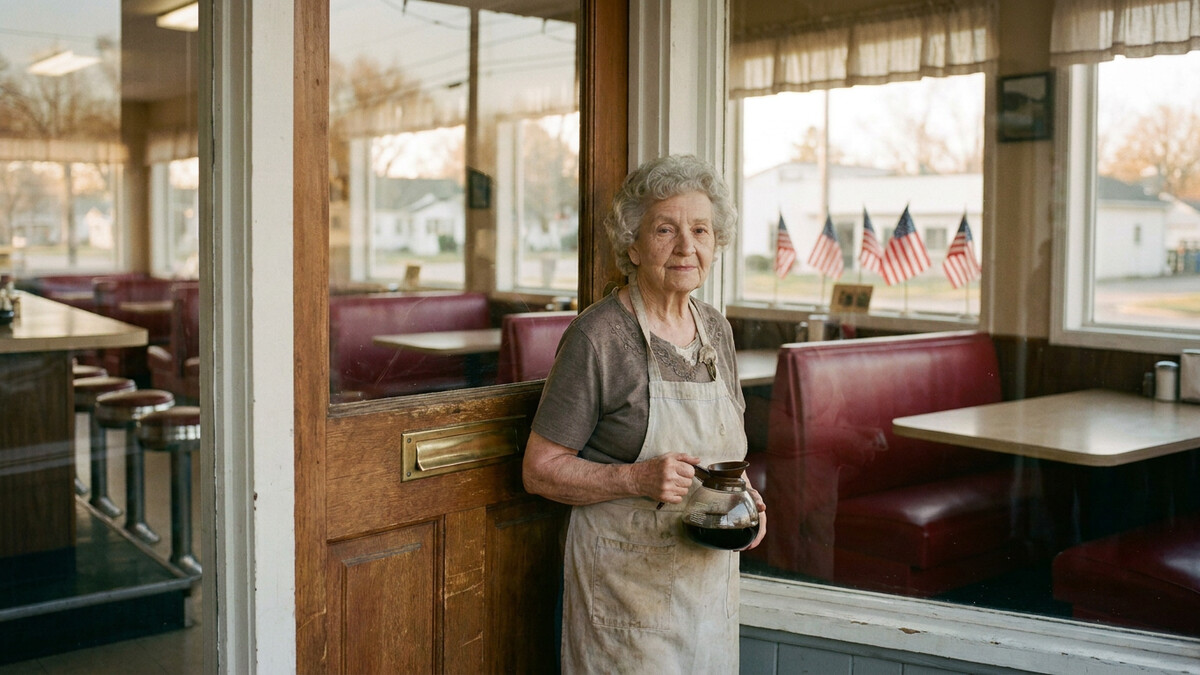
He looked at it. Then he looked at Dot, behind the counter with her coffeepot.
"I didn't order this," he said.
"It's on the house, hon," Dot said. "Somebody paid for it."
"Who?"
Dot leaned across the counter, so only Floyd could hear.
"Every man and woman who served in this town," she said. "Lloyd took up a collection at the post. Sixty-two veterans. They don't know who they're paying back. I told them it was for a man who fed them for fifty-four years and never once sat down to eat with them." She straightened up. "They all put in. Every one of them. Lloyd says there's enough there for a year of breakfasts."
Floyd Eckert stared at the plate.
Down the counter, Lloyd Hersh, Pete Yoder, and Pastor Sam were very carefully not looking at him.
He ate it. Slowly, every bite, with his tie tucked into his shirt so he would not get egg on it.
When he was done, he pushed the plate back across the counter and wiped his mouth with his napkin and did not say anything for a long time.
Then he reached into his jacket pocket and took out a plain white envelope. He laid it on the counter in front of Dot.
It was addressed to Dot's Corner Diner, in block capitals.
The stamp in the upper right corner was perfectly straight. A quarter inch from the top. A quarter inch from the side.
"For next year," Floyd said. "In case I'm late again."
Dot picked up the envelope. She did not open it.
She put it in the cigar box behind the napkins, on top of fifty-four index cards. Then she closed the lid, poured Floyd Eckert another cup of coffee, and went back to work.