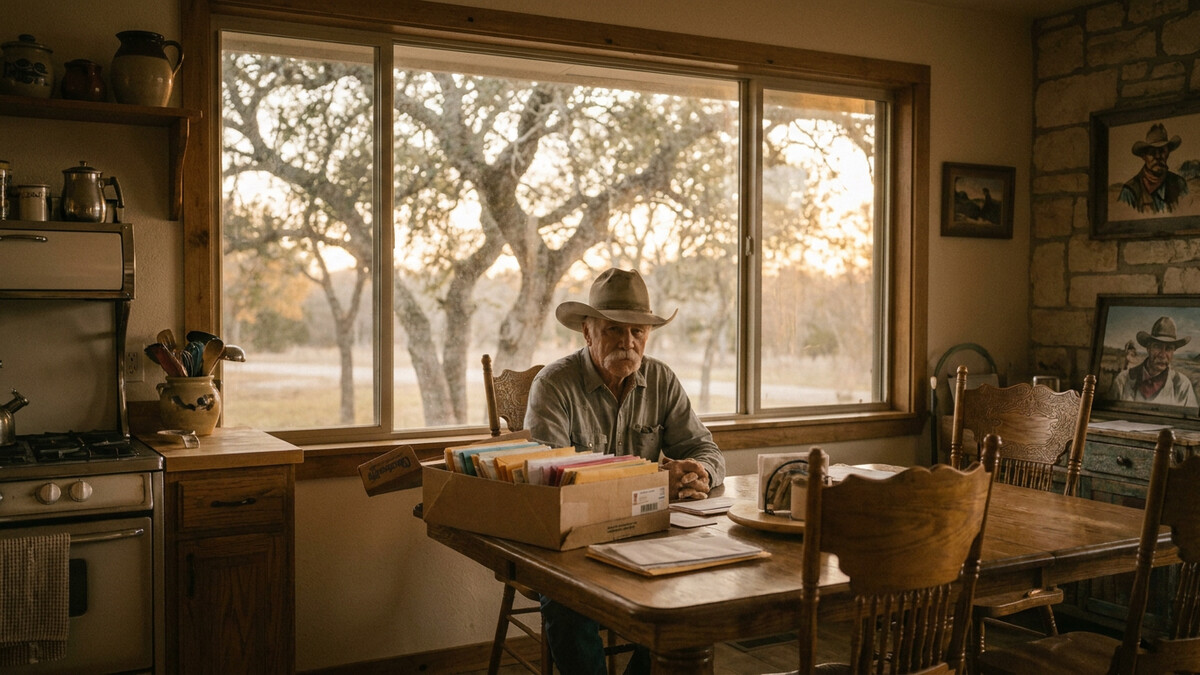
Boyd Tatum had raised his old rodeo rival's daughter for twenty-two years, and three weeks before her Christmas wedding, Josie sat down across from him at the kitchen table and said, "Daddy Boyd, I want my mother to come."
Boyd set down his fork.
"Your mother," he said.
"Lacey," Josie said. "I want to send her an invitation. I want her there."
Outside the kitchen window, the December light was going gold over the live oaks and the limestone hills. One of the horses whinnied in the pen. Boyd looked at the window for a long time.
"Your mother," he said again, "gave you away when you were four years old."
Boyd was seventy-four. He had roped calves on the pro rodeo circuit for eighteen years, from 1970 to 1988, and for most of those years his toughest rival had been a red-haired cowboy from Abilene named Rusty Cade.
They had not liked each other. Rusty was faster and louder and better looking, and he won more often than Boyd thought he deserved. Boyd was steadier and quieter, and he won more often than Rusty thought he deserved. For eighteen years, they had beaten each other by tenths of a second in arenas from Cheyenne to Fort Worth.
Then they retired, and somewhere along the way, without either of them ever saying so, they became friends.
In 2004, Rusty was killed on a two-lane highway outside Junction, coming home from a team roping in San Angelo. A cattle truck crossed the center line. Rusty was fifty-one.
He left behind a four-year-old daughter named Josie, and her mother, Lacey, who was twenty-two and already sick with pills.
Rusty had written it down. Boyd never knew why. Maybe he had known something was coming. Maybe he had just known Lacey.
In his will, there was one line about the girl. If anything happens to me and Lacey can't care for Josie, I want Boyd Tatum to raise her. He's the most stubborn honest man I know.
Lacey had signed the guardianship papers in a lawyer's office in Kerrville three months after the funeral. She was shaking. Her arms were thin. She did not look at Boyd once.
She had kissed Josie on the forehead and walked out the door.
Boyd and his wife, Ardith, had taken the little girl home to the ranch outside Live Oak Crossing, Texas. Ardith had died in 2015. Boyd had raised Josie the rest of the way by himself.
Josie was twenty-six now. A vet tech in Fredericksburg and the best barrel racer in three counties. She was getting married on Christmas Eve, in the little stone Methodist church in town, to a good young man who shod horses.
She called Boyd "Daddy Boyd." She had since she was five.
"She's been sober for ten years, Daddy Boyd," Josie said. "She works at the Dixie Freeze on the highway. I've seen her. I've driven past a hundred times." Her voice wavered. "I went in last week. She was working the window. She looked at me and dropped a whole tray of milkshakes."
Boyd did not say anything.
"I just want her to see me get married," Josie said. "That's all. Just to see it."
"Josie, honey." Boyd rubbed his face. "That woman left you. She signed you over like a horse at a sale. She never came to a single birthday. Not one Christmas. Not one barrel race. Twenty-two years. And she lives eleven miles away."
"Maybe she was ashamed."
"Maybe she was," Boyd said. "I'm not saying she's evil, honey. I'm saying I can't make myself forgive her. I've tried."
He drove into town on Thursday to pick up feed. On the way home, without meaning to, he slowed down passing the Dixie Freeze on the highway.
She was there in the window. Lacey Cade. Forty-four years old now. Her hair was still red, cut short, with gray in it. She was handing a paper sack to a man in a pickup, smiling a tired smile.
Boyd did not stop.
But that night, he could not sleep. He got up at two in the morning and went down to the barn in his robe and boots, the way he did when something was bothering him.
The old mare was standing in the end stall. She was thirty years old, a bay with a white star, gray around the muzzle now, swaybacked and slow. Her name was Sugar. She had been Lacey's barrel horse once, before Josie was born. When Lacey signed the papers, the mare had come to the ranch with the little girl.
Josie had learned to ride on that mare. She had won her first barrel race on that mare at nine years old.
Boyd stood at the stall and rubbed the old horse's neck.
"Your girl's getting married," he told her. "And she wants her mama there."
The mare blew softly into his hand.
The next morning, Josie came out to the ranch early to work her barrel horse before her shift.
Boyd was in the house. He heard her truck. He heard her go into the barn. A while later, he heard her truck again, and he looked out the window and saw her coming back up the hill toward the house, walking fast.
She had something in her hands.
She came into the kitchen without knocking and set it on the table in front of him.
It was a shoebox. An old Justin boot box, the lid held on with a rubber band. Boyd knew it the second he saw it. He had kept it in the bottom drawer of the desk in the tack room for twenty years, under the vaccination records, where he was the only one who ever looked.
Josie had needed a vaccination record for her new horse.
She took the rubber band off. Inside, packed tight, were envelopes. Pink and blue and yellow and white. Birthday cards. Christmas cards. Every one of them addressed to Josie Cade, in care of Boyd Tatum, in a woman's shaky handwriting.
Every one of them unopened.
"Twenty-two birthdays, Daddy Boyd," Josie said. Her voice was very quiet. Her eyes were full. "Twenty-two Christmases. She never once missed."
Boyd could not look at her.
"You told me she never wrote," Josie said. "You told me she never cared."
She picked up the box and held it against her chest.
"Who are you, Daddy Boyd?" she whispered. "Because I don't think I know."
Then she walked out of the kitchen, got in her truck, and drove away down the hill, and Boyd Tatum sat alone at his table with his hands flat on the wood.