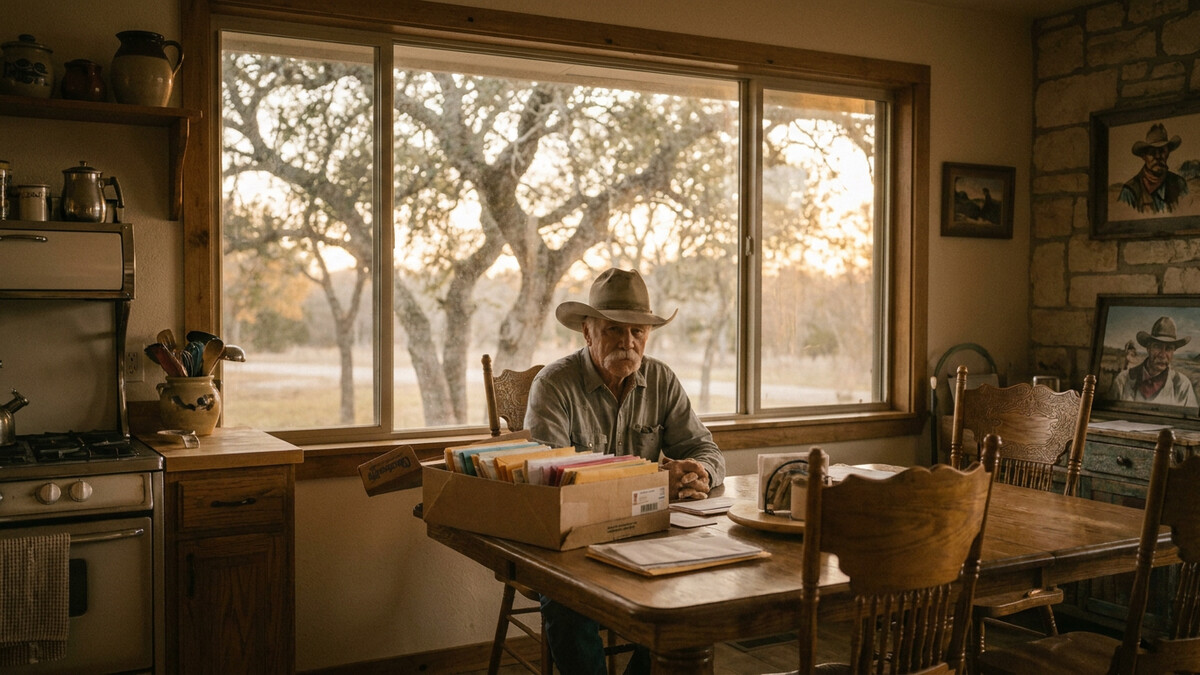
Boyd sat at the kitchen table until noon.
He did not eat. He did not go out to the horses. He sat with his hands on the table and looked at the empty place where the shoebox had been.
He had told himself a lot of things over twenty-two years.
The first cards had come in 2004 and 2005, when Lacey was still using. He had told himself that a card from a woman on pills would only confuse a four-year-old. That was true.
Then the cards kept coming, and Lacey got sober, and Josie got older, and he kept putting them in the box. He told himself he would give them to her when she was eighteen. When she was eighteen, he told himself she was busy with college. When she was twenty-one, he told himself it was too late to explain.
The truth was simpler. He had known it all along.
He had been afraid. Afraid that if Josie opened one card, she would want her mother. And if she wanted her mother, she might not want him.
He was seventy-four years old, and he had been afraid of losing a little girl for twenty-two years.
At one o'clock, he got up, put on his good hat, and drove to town.
He parked at the Dixie Freeze on the highway. It was a slow afternoon. One car at the drive-through. Lacey Cade was wiping down the counter inside.
She looked up when the bell over the door rang. She saw him. She went very still.
"Mr. Tatum," she said.
"Lacey," Boyd said. He took off his hat. "Can you take a break? I need to talk to you. And I need to say I'm sorry."
They sat at a picnic table out back, by the dumpsters, under a live oak. She had a cup of coffee she did not drink. He had his hat in his hands.
He told her about the shoebox. All of it. Twenty-two years of cards in the bottom drawer of the tack room desk, unopened. He did not make excuses. He did not have any.
Lacey listened without saying a word. When he finished, she stared at the coffee cup for a long time.
"I thought she didn't want them," she said finally. "I thought you gave them to her, and she didn't want to write back. I thought that's what I deserved."
"It wasn't her," Boyd said. "It was me."
Lacey nodded slowly. She wiped her eyes with the back of her wrist.
"I left her, Mr. Tatum," she said. "I know that. I signed the papers. I was twenty-two and I couldn't take care of myself, let alone a baby. Rusty was dead, and I was high, and you were the only person he ever said was honest." She looked up at him. "I gave her to you because I knew you'd be good to her. And you were. I watched. I saw her at the rodeos. I saw her win on Sugar. I never came up to her because I didn't think I had the right."
"You had the right," Boyd said. "I took it from you. That's on me."
They sat there for a while. A truck went by on the highway. A grackle landed on the dumpster lid and looked at them.
"Is Sugar still alive?" Lacey asked.
"She's thirty. In the end stall."
Lacey's face changed.
"Can I see her?"
Boyd thought about it. Then he put his hat back on.
"Get in the truck," he said.
They drove out to the ranch in silence.
He walked her down to the barn. Lacey stopped in the aisle, ten feet from the end stall, and stood there with her hands in her apron pockets, not moving.
The old mare was dozing, her lower lip drooping, one hind foot cocked.
Lacey did not say anything. She just stood there.
Then Sugar lifted her head.
Boyd had worked with horses for sixty years. He had seen a lot of things. He had seen a horse go wild at the smell of a man who had beaten it once, years before. He had seen a horse walk through fire for a cowboy it trusted.
He had never seen anything like what that old mare did.
She swung her head toward the aisle. Her ears went straight forward. Her nostrils flared, once, twice, taking in the air. And then she let out a sound Boyd had never heard her make in twenty-two years. A long, low, rumbling nicker, deep in her chest, the sound a mare makes to her own foal.
She came to the front of the stall and stretched her old neck over the door toward Lacey Cade, as far as it would go.
Lacey walked the last ten feet. She put her face against the mare's neck and wrapped both arms around her and began to cry.
Boyd stood in the aisle and watched.
A horse does not lie, Rusty used to say. You can lie to a man. You can lie to a woman. You can lie to yourself your whole life. But a horse knows exactly who you are.
That old mare had not seen Lacey in twenty-two years. And she remembered her. And she was glad.
Boyd took off his hat.
He drove to Fredericksburg that evening and knocked on Josie's door.
She opened it. Her eyes were red. The shoebox was on the kitchen table behind her, with the cards spread out in rows, all open now.
"I went to see your mother," Boyd said. "I told her what I did. I told her I was sorry."
Josie stared at him.
"Then I took her to see Sugar," he said. His voice gave out for a moment. "Honey, that old horse knew her. After twenty-two years. She knew her the second she walked in the barn."
Josie put her hand over her mouth.
"I was wrong to keep those cards," Boyd said. "I was scared I'd lose you. That's not an excuse. It's just the truth." He held out an envelope. Cream-colored, heavy paper, with her name and the date of the wedding on the front. "This is the invitation. I'd like you to give it to her yourself. And I'd like to walk you down the aisle, if you'll still let me."
Josie looked at the envelope. Then at him.
Then she stepped out on the porch and put her arms around his neck, the way she had when she was five years old, and held on.
On Christmas Eve, in the little stone Methodist church in Live Oak Crossing, Boyd Tatum walked Josie Cade down the aisle in his good black suit and his best hat, which he took off at the door.
In the third pew on the bride's side, in a plain blue dress, sat a woman with short red hair going gray. She had come early and sat alone. She cried through the whole service.
At the reception, in the church fellowship hall, Josie danced the first dance with her husband, and the second with Boyd.
The third song came on. Boyd looked across the room.
Then he walked over to the third pew, where Lacey Cade was sitting by herself with a cup of punch, and held out his hand.
"I think she'd like to dance with her mother," he said.