The McCrary family Bible had five pages missing from the middle, torn out so close to the binding that only ragged stubs were left, and the young woman who brought it to Mavis Tipton's door said they had been missing since 1932.
"The year my great-great-aunt disappeared," Brooke McCrary said. "Lottie. Not one person in the family will say her name. My grandpa said she ran off with a traveling preacher and broke her mama's heart, and that's all he'd ever say."
Mavis took the Bible in both hands. It was heavy, the leather cracked, the gold letters on the spine worn away to nothing.
"Why bring it to me, honey?"
"Because you knew Granny Pearl," Brooke said. "Lottie's mother. You're the only one left who did."
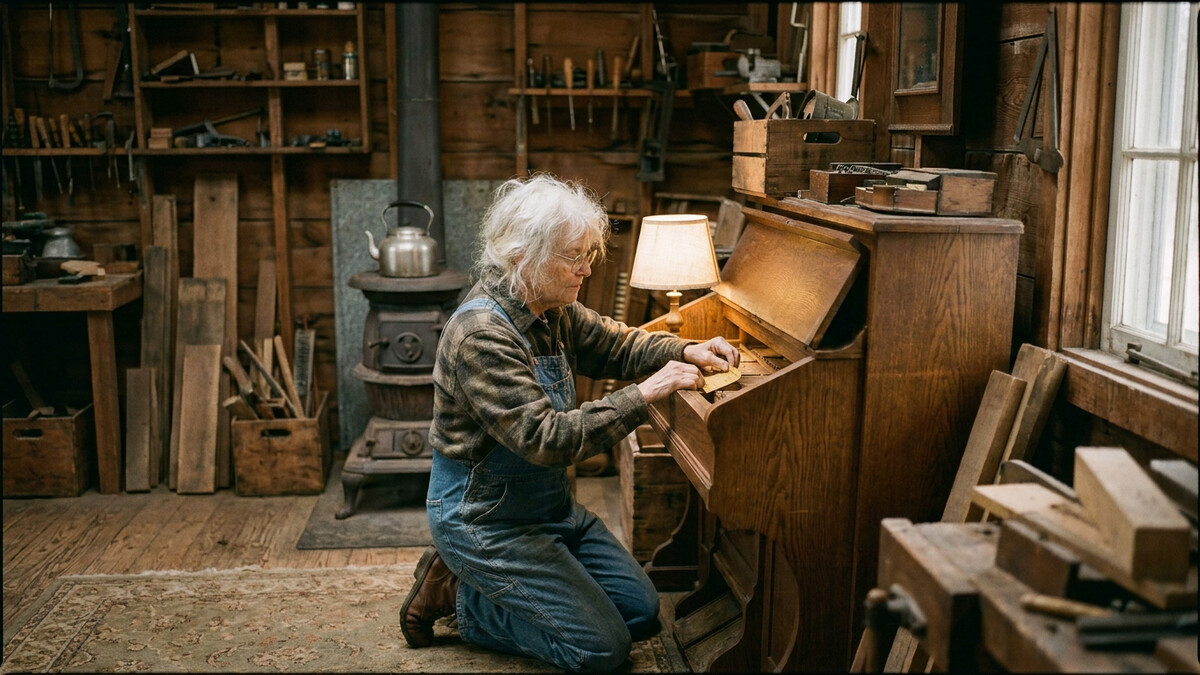
Mavis was seventy-nine. She had played the organ at Laurel Fork Baptist Church in the hills of East Tennessee for fifty-one years, and for most of those years she had also repaired old pump organs in the shed behind her house, the way her father had before her.
She knew reed organs the way a mechanic knows engines. The bellows and the reeds and the stops. The leather and the felt and the little brass springs. She could tell you an Estey from a Mason and Hamlin from across a church by the sound of a single low C.
She had known Pearl McCrary when Mavis was a girl. Granny Pearl had been the Laurel Fork organist before her. A small, quiet woman in a black dress who played every hymn in the Broadman hymnal from memory, pumping the pedals of the old Estey with her high-button shoes until she was almost ninety.
Mavis had taken over the organ when Granny Pearl died, in 1975.
She had never once heard her say the name Lottie.
Brooke was thirty and taught fifth grade in Knoxville. She had gotten interested in the family history after her grandmother died, and she had spent a year filling in the McCrary family tree. Every branch was full, back to 1790, except one.
Lottie Mae McCrary. Born March 2, 1913. And then nothing.
No marriage. No death. No grave in the churchyard. Just five torn pages in the family Bible and a story about a traveling preacher that no record could prove.
"I looked for her in every record I could find," Brooke said. "Census. Marriage licenses. Death certificates. Every state in the South. There's no Lottie McCrary anywhere after 1930."
"Maybe she changed her name," Mavis said.
"That's what I think. But to what?"
Mavis did not know. She told Brooke she would think about it, and she did, for a week. Then she put it aside, because it was December, and a Baptist organist in December has very little time for anything but Christmas.
And because the old Estey had come home.
It was Granny Pearl's organ. The one from the church. In 1976, when the church bought an electric organ, the old Estey had been carried down to the basement and covered with a sheet and forgotten. Last month, the church had finally cleaned out the basement, and the deacons had asked Mavis if she wanted the old thing before they hauled it to the dump.
She had wanted it very badly.
It sat now in her shed, an oak case taller than she was, with carved panels and a little mirror on top, its keys yellow as old teeth. When she pumped the pedals, it wheezed like an old man climbing stairs.
The bellows leaked. That was the trouble. Fifty years in a damp church basement had dried out the rubber cloth and cracked the seams.
She would have to take it apart.
She started on a Tuesday afternoon, with the woodstove going in the shed and the radio playing gospel music low.
She took off the back panel first. Then she unscrewed the reed board and lifted it out, carefully, laying it on a blanket on her workbench. Then she reached down into the bottom of the case for the bellows, the big wooden-and-cloth lungs of the organ that the pedals pumped.
She knew exactly what she would find. Cracked cloth. Dried-out leather valves. Mouse droppings. Maybe a hymnal page or two that had fallen in through the stop rail over the years.
Old organ repairmen had a habit, years ago, of patching small leaks in a bellows with whatever was handy. Pieces of cloth. Bits of leather. Paper, glued down with hide glue. Mavis's father had done it himself, in a pinch, and then scolded himself for it.
She ran her fingers along the underside of the big reservoir bellows.
There was a patch. Stiff, flat, glued down hard across a seam at the back corner. Paper, by the feel of it. Several layers.
She brought the lamp close.
It was not hymnal paper. It was thicker. Old, cream-colored, with a printed border of tiny vines along the edge. She had seen that border before. She had held it in her hands a week ago.
It was a page from the McCrary family Bible.
Mavis sat back on her heels on the shed floor.
She thought about Granny Pearl, small and quiet in her black dress, pumping the pedals of this organ every Sunday for forty-three years. She thought about how Pearl would have known every inch of it. How she would have opened the back panel herself, the way all old organists did, to fix a sticking key or a stuck stop.
Mavis got her thinnest putty knife and a pan of warm water. She worked very slowly, the way she worked loose an old leather valve, softening the hide glue a little at a time.
It took her two hours.
At the end of it, there were five thin, stained, folded pages lying on a clean towel on her workbench. Bible pages, with the printed vine border, and the heading FAMILY RECORD across the top of the first one.
They were covered in handwriting. Granny Pearl's handwriting. Mavis knew it from fifty years of penciled notes in the margins of the church hymnals.
At the bottom of the last page, in that small, careful hand, was one line, written in ink that had gone brown.
Lottie is not dead, whatever her father says. Listen for her on Saturday nights.