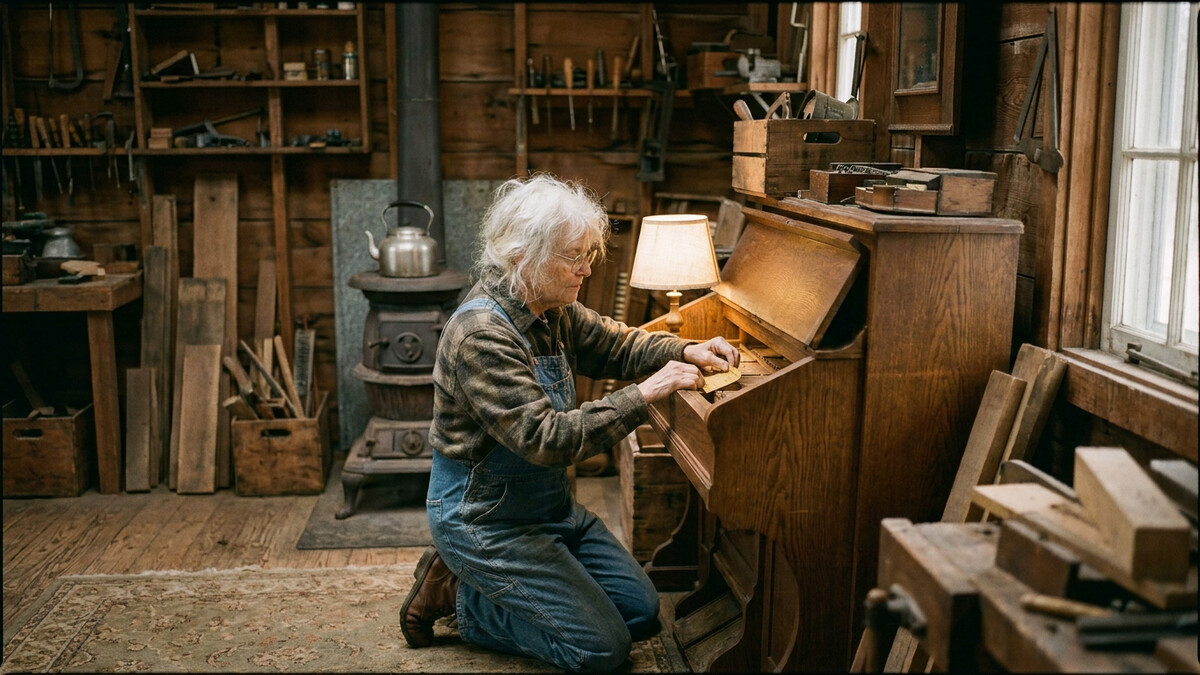
Brooke drove up from Knoxville that same night, in the dark, on the winding road along the Clinch River. She came into the shed still in her coat and stood at the workbench with her hand over her mouth, looking at the five pages on the towel.
"She hid them in the organ," she said.
"She did," Mavis said. "And then she sat on top of them every Sunday for forty-three years and played 'Amazing Grace.'"
They read the pages together under the lamp.
The first four were what a family record page always is. Births, marriages, deaths. McCrarys going back to the Civil War. But in the middle of the fourth page, in Granny Pearl's hand, the entries changed. They were longer. They were not the kind of thing you write in a Bible.
April 1932. Lottie sang at the schoolhouse. Her voice is the finest I ever heard. A man from Knoxville was there and said she should be on the radio.
May 1932. Her father forbids it. He says radio singing is the devil's work. He says no daughter of his will sing for money.
June 1932. Lottie gone in the night. She left a note. She has gone to Knoxville. Her father tore her out of the Bible and burned the pages in the stove.
And then, below that, smaller.
He did not burn them. I took them from the stove before they caught. I will keep them where he will never look.
Mavis and Brooke looked at each other.
"Where he would never look," Brooke said slowly. "Inside the church organ."
"Her husband didn't play," Mavis said. "And a man like that would never have touched a woman's organ. Not in 1932."
The fifth page had only a few lines.
1936. A letter came. No return address. Lottie is singing on the Knoxville radio on Saturday nights. She says she is happy and married to a good man who plays fiddle. She sings under another name so her father will not be shamed. I listen when he is asleep. I keep the radio low.
And then the last line. Lottie is not dead, whatever her father says. Listen for her on Saturday nights.
There was no name. No stage name. Nothing.
Brooke sat down on the shed stool and put her face in her hands.
"We're so close," she said. "And she didn't write it down."
Mavis did not answer right away.
She was looking at the old Estey organ, standing in pieces in the corner, its reed board on the blanket.
"Honey," she said. "Granny Pearl didn't write it down. But I bet she played it."
Brooke looked up.
"Every organist has one song she plays more than the others," Mavis said. "When the church is empty. Before the service, while folks are coming in. Granny Pearl's was the same song every Sunday for forty years. I heard it a thousand times as a girl. It wasn't in the Broadman. It wasn't in any hymnal. I always thought it was an old mountain song she'd made into a hymn."
She went to the organ. She did not need the reed board in to remember. She sat at the old bench and put her hands on the cold yellow keys and hummed it. A slow, sweet tune, in three-quarter time, rising up at the end like a question.
"She called it 'The Starling,'" Mavis said. "I asked her once. She said it was a song about a little bird that flew away."
They found it in three days.
Brooke spent a whole Saturday at the McClung Collection, the old history library in Knoxville. She went through boxes of old radio programs and newspaper listings from the 1930s. Mavis sat at her kitchen table in Laurel Fork with the telephone and a pencil, calling every old record collector she had ever bought an organ part from.
It was one of the collectors who found it. An old man in Bristol named Delbert Rose who had a basement full of 78 rpm records.
"Lottie Starling," he said on the phone. "With the Clinch River Ramblers. Sang on the Knoxville radio from 1936 into the 1950s. Made about a dozen records. I've got two of them." He paused. "She was good, ma'am. She was real good. Folks around here still ask about her."
"Do you have one called 'The Starling'?"
There was a long pause.
"That was her theme song," Delbert Rose said. "She opened every show with it."
Lottie Starling had died in 1991 in a little town outside Knoxville, at seventy-eight. Brooke found her obituary in the old newspaper files. Beloved wife of the late Clarence Starling, fiddler. Mother of two. Grandmother of five. A gospel and country singer for more than forty years.
It did not mention the McCrarys. It did not mention Laurel Fork. It did not mention her mother.
But her grave was in a cemetery forty minutes from Laurel Fork Baptist Church. Brooke drove there on a Sunday afternoon and stood in front of it for a long time.
Lottie Mae Starling. 1913 to 1991. She sang.
Mavis finished repairing the old Estey in January. She replaced the cloth on the bellows with new rubber cloth, the right way, and the leather valves, and the felt. She cleaned every reed with a soft brush.
The five Bible pages she did not glue back. Brooke had them pressed between glass in a frame.
On the first Sunday in February, the deacons carried the old Estey back up from Mavis's shed and set it in the front of Laurel Fork Baptist Church, beside the electric organ, where it had stood for fifty years.
Brooke McCrary came. So did two of Lottie Starling's grandchildren, who had driven over from Knoxville after Brooke tracked them down. They sat together in the third pew, McCrarys and Starlings, cousins who had never known each other existed.
Before the service, while folks were coming in, Mavis Tipton sat down at the old Estey and began to pump the pedals.
It breathed in. It breathed out. It did not wheeze.
She played "The Starling." Slow and sweet, in three-quarter time, rising up at the end like a question. The way Granny Pearl had played it every Sunday for forty years, sitting on top of her daughter's name.
In the third pew, one of Lottie's grandchildren, an old man in his sixties, began to cry.
Afterward, Brooke opened the family Bible on the pew and turned to the torn stubs in the middle. With a fine-point pen, very carefully, on the inside margin beside the stubs, she wrote one more line.
Lottie Mae McCrary Starling. 1913 to 1991. Listen for her on Saturday nights.