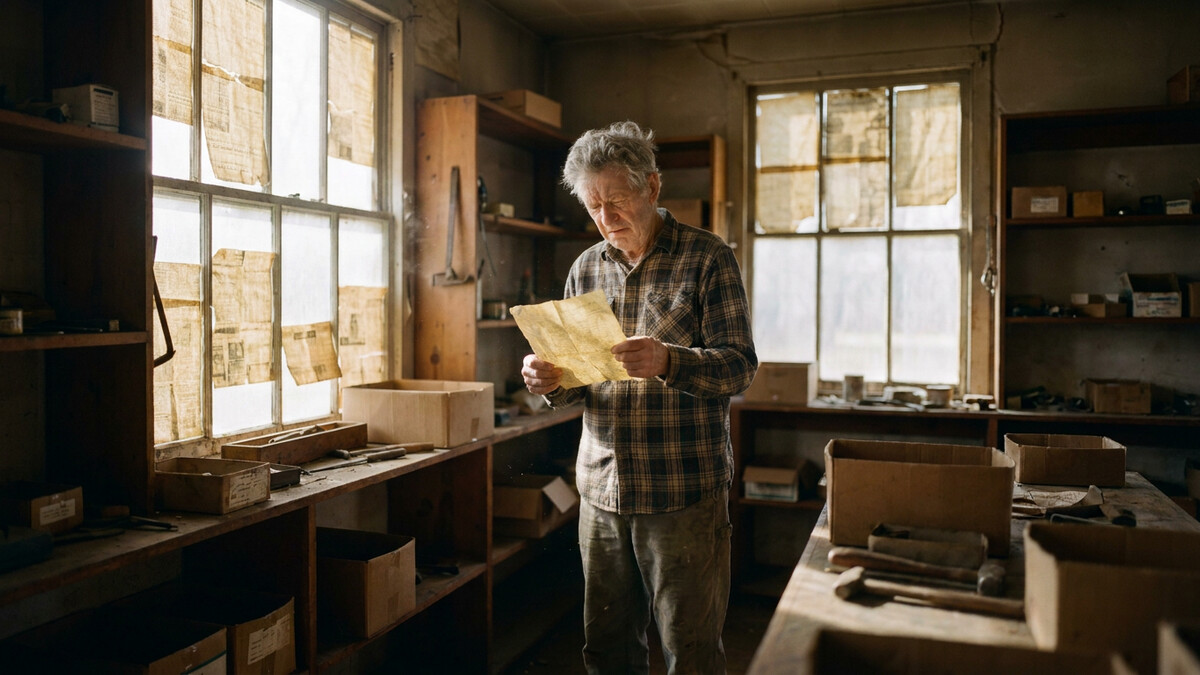
Billy Ray sat down on the old wooden chair by the rolltop desk, very slowly.
"Mr. Tackett?" Carla said. "Are you all right?"
"The mail carrier," Billy Ray said. "It was the mail carrier."
He looked at the ledger again. At the handwriting. At the slanted, squared-off letters he had seen on old route books every morning of his working life.
"Harlan Bates," he said. "He carried Route 2 from 1946 to 1980. He was my mail carrier when I was a boy."
He remembered Harlan Bates.
A tall, quiet man in a gray uniform jacket who drove a green 1950 Chevrolet and leaned across the seat to fill every mailbox out the passenger window, the way the old rural carriers did. He came up Possum Ridge every day at about one o'clock, the very last stop on the route. He honked twice at the bottom of the lane. In winter, when the road was ice, he walked the last quarter mile up with the mail in his bag.
He always had a stick of gum for Billy Ray and his sister. He always asked about their mother.
And in November and December of 1962, he would have walked up to that porch every single day.
He would have seen the Wish Book lying open under a rock. Open to page 296. With a red wagon circled in pencil.
He would have seen an eight-year-old boy hauling water up the hill, two buckets at a time, with bleeding hands.
"Twelve ninety-five," Billy Ray said quietly. "In 1962. A rural carrier made maybe two dollars an hour."
Carla Doss helped him look.
Harlan Bates had died in 1985. His wife had died in 2004. They had one daughter, Juanita Bates Kimes, who was eighty years old and lived in a little house on the north side of Pinnacle Springs, behind the Baptist church.
Billy Ray drove there that afternoon.
She answered the door in a cardigan with a cat in her arms. She was small and white-haired and had her father's long, quiet face.
"Mrs. Kimes," Billy Ray said. "My name is Billy Ray Tackett. I carried Route 2 for thirty-four years after your daddy. And I think I owe him a thank-you."
She let him in. She made coffee. He sat at her kitchen table and told her the whole story. The winter of 1962. The water and the firewood. His mother in bed. The Wish Book on the porch. The red wagon on Christmas morning.
When he finished, Juanita Kimes was quiet for a long time.
Then she got up and went to a closet in the hall. She came back with an old shoebox and set it on the table.
"Daddy never said a word about it," she said. "To anybody. Not even Mama. But after he died, I found this in his dresser."
She opened the box.
Inside were envelopes. Dozens of them. Old receipts. From the Sears catalog store. From the hardware store. From the Western Auto. Each one was folded neatly, and each one had a note on the back in pencil, in the same slanted, squared-off handwriting Billy Ray had just seen in the ledger.
1951. Coat, boy's size 8. Box 31.
1955. Shoes. Box 9. The Ozment girl.
1958. Doll. Box 22.
1962. Wagon. Box 14. For the water.
1970. Bicycle. Box 6.
There were thirty-two of them. One every Christmas from 1949 until 1980, the year Harlan Bates retired.
"I never knew what they were," Juanita said. "I thought they were just old receipts. Daddy kept everything." She looked at Billy Ray. "Every one of those boxes was on Route 2. Wasn't it?"
Billy Ray could not speak. He just nodded.
He sat at her kitchen table for a long time with the shoebox in front of him.
Thirty-one Christmases. A child on Route 2 every year. A gift on the porch before daylight. From Santa. And never once a name.
The same thing Billy Ray had been doing himself for thirty years, without knowing why he had started. Without knowing that a man in a gray uniform jacket had done it first, on the very same road, to him.
"Mrs. Kimes," he said finally. "I have to tell you something. I've been doing the same thing. Since 1996. One child on Route 2, every Christmas. I never told anybody. I didn't even know why I started. I thought I just made it up."
Juanita Kimes looked at him over her coffee cup.
Then she smiled. It was her father's quiet smile.
"Mr. Tackett," she said, "I don't think you made anything up. I think you just kept the route."
On Christmas Eve, Billy Ray Tackett went out to his garage, took the old red steel coaster wagon down off its two nails in the rafters, and sanded the rust off the corners. He painted it again, the same red, the third time in sixty-four years. He put new tape on the handle.
He knew a family on Route 2 that winter. A young mother at the top of a ridge, with two little boys and a well that had frozen and a husband who had gone to work in the oil fields in North Dakota and not come back.
At five-thirty on Christmas morning, before daylight, Billy Ray drove up the ridge in his old pickup with the wagon in the back. He walked the last quarter mile up the icy lane, the way Harlan Bates would have, and set it on the porch.
He tied a tag to the handle with string.
From Santa. For the water.
And under it, very small, in his own mail carrier's hand, he added two more words.
Route 2.