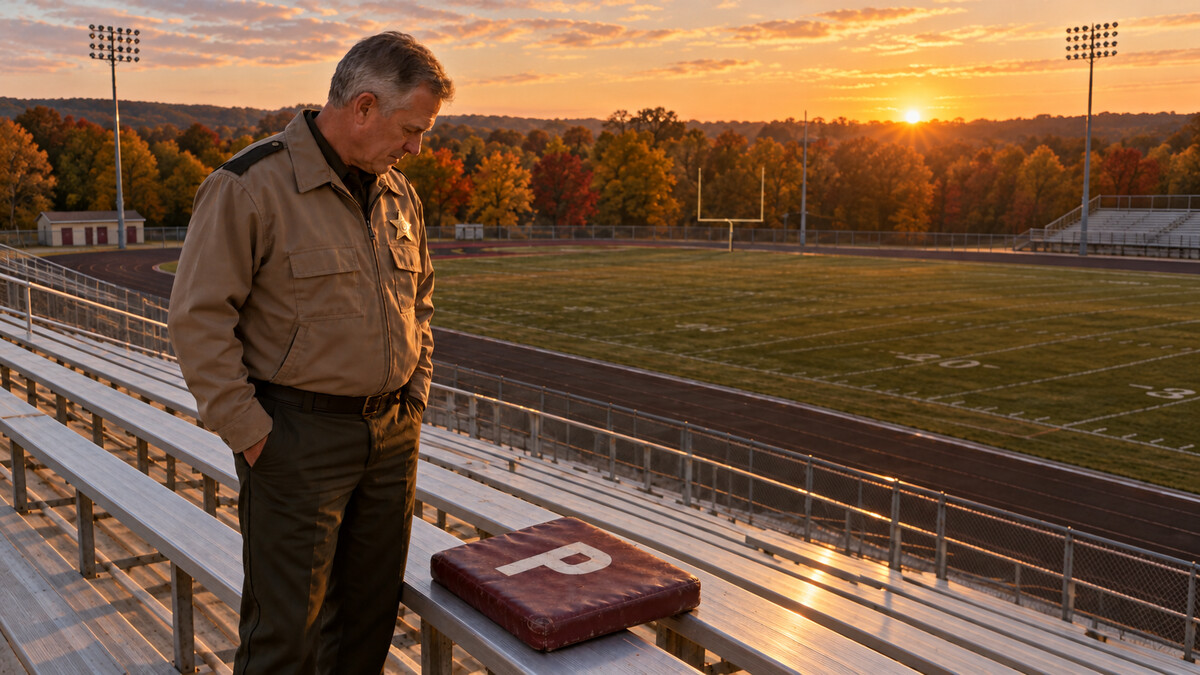
The new athletic director at Pine Hollow High School filed a complaint with the county sheriff on the Tuesday before homecoming, because somebody kept putting a cushion on seat fourteen in row C at Panther Field, and he could not make them stop.
Sheriff Earl Whitaker read the complaint twice in his office with a cup of black coffee. Then he drove out to the football field to have a look.
The athletic director was waiting for him at the bleachers. His name was Brett Kuhn. He was thirty-four, from a big high school outside Columbus.
"Sheriff, I know it sounds silly," he said. "But it's been going on for fifty-eight years. And I need it to stop by Monday."
Earl was sixty-three. He had been county sheriff since 1997.
He climbed the bleachers to row C and looked at seat fourteen.
It was an ordinary seat. But it had a small brass number plate screwed to the back, the old kind, from before the bleachers were replaced in 1994. Somebody had moved it from the old wooden bleachers.
And on the bench, there was a cushion. A faded old stadium cushion, square, with a big letter P stitched on top.
"I've taken it off three times," Brett Kuhn said, climbing up behind him. "Every Friday morning, there's a new one. I roped the seat off last week. Somebody cut the rope."
"Help me understand something," Earl said. "Why does it need to stop by Monday?"
"Because Monday morning, we start tearing out this whole section," Brett said. "The boosters raised the money for new premium seating. We're selling them as season seats to pay for it. Row C is the best row on the fifty." He paused. "And every time I bring it up at the booster meeting, the old-timers get very quiet and tell me seat fourteen isn't for sale."
"Why not?"
"That's what I asked them," Brett said. "Not one of them will tell me."
Earl spent the next two days asking.
He asked at Dot's. Dot was quiet for a while, and then she said, "I think it's the Murphy seat, hon. But I don't know why it's still there."
He asked Ruth Ann Mercer at the library. Ruth Ann brought up the 1968 Pine Hollow High School yearbook. She opened it to the football page and put her finger on a boy in the second row.
Tommy Murphy. Number 22. Senior. Halfback.
"His family lived on Elm Street," Ruth Ann said. "The house that burned in 1961. His father was Frank Murphy. He worked the furnace line at the glass works."
Earl knew the name. Tommy Murphy lived in Phoenix now. He was seventy-five. He came back to Pine Hollow sometimes, for funerals.
"What about the seat?" Earl asked.
Ruth Ann shook her head. "I don't know about the seat."
The booster club treasurer knew a little more.
She was a retired bank teller named Peg Arbogast, who had kept the booster books for thirty years.
Every August since 1990, a check had come in the mail for the season ticket on seat fourteen, row C. Twenty dollars at first. Now sixty. Always from a bank in Phoenix. Always signed T. Murphy.
"And before 1990?" Earl asked.
Peg pulled out an older ledger. "Before 1990, it was paid in cash. Every August. By a Mrs. Helen Murphy, on Elm Street."
"His mother."
"His mother," Peg said. "She passed in 1990. The checks from Phoenix started that same August."
That still did not tell him who put the cushion out every Friday.
Earl solved that one on Thursday night the old way. He parked his Crown Victoria in the dark behind the concession stand at Panther Field with a thermos of coffee and waited.
At five-forty on Friday morning, in the gray before dawn, a pickup truck pulled into the lot beside the field house. An old man got out. He walked slowly to the bleachers with a stadium cushion under his arm, climbed to row C, and laid it on seat fourteen. Then he took a small bottle of glass cleaner out of his coat pocket and polished the brass number plate with his handkerchief.
Earl got out of the car.
"Morning, Gus," he said.
Gus Haney, eighty-two, retired groundskeeper of Panther Field, a regular at the Liars' Table for thirty years, nearly dropped the glass cleaner.
"Earl," he said. "What are you doing out here?"
"Same as you, looks like," Earl said. "Watching the sun come up. Help me understand something, Gus. Who are you putting that cushion out for?"
Gus did not want to tell him. Earl could see that.
But the morning was cold, and after a while he sat down next to seat fourteen and told him.
"Frank Murphy bought that seat in August of 1968," he said. "For Tommy's senior year. Frank worked Friday nights at the glass works. He never once got to see his boy play. Not in four years. But he bought that seat anyway. He said, Gus, someday I'll get a Friday off, and when I do, I want my seat waiting."
"Did he?"
"No," Gus said. "He never did. The glass works never gave him one Friday. Then he had his heart attack at the furnace in 1972." Gus looked at the cushion. "Helen kept paying for it. Every year. She brought a cushion every Friday and set it out herself. When she got too old, she asked me. I was the groundskeeper. It wasn't any trouble."
"And Tommy?"
"Tommy calls me every August," Gus said. "From Phoenix. Every year since his mama passed. He says, Gus, is Daddy's seat still there? And I say, it's still there, Tommy." He shook his head. "I told him about the new seats last week. Then he said, Gus, I'm coming home for homecoming. I've never once sat in that seat. Not in my whole life. I'd like to sit in it one time before they take it out."
Earl looked at the faded cushion.
"When's he coming?"
"His flight lands in Columbus at four today," Gus said. "His grandson's driving him down. Homecoming kicks off at seven."
Earl went back to his office and called Brett Kuhn.
He told him the whole story.
Brett was quiet on the phone for a long time.
"Sheriff," he said finally, "I didn't know. I'm sorry. I'll leave it for tonight. Of course I will."
But at a quarter past two that afternoon, Earl's radio crackled.
A caller at Panther Field. There was a construction crew at the bleachers, with a flatbed truck and a forklift. They were unbolting section C.
Earl was in the Crown Victoria before she finished the sentence.
He pulled into the lot at Panther Field at two twenty-five. Four men in hard hats were standing on the bleachers with power drills. Two whole rows of aluminum bench were already off and stacked on the flatbed. Row C was next.
The brass number plate was lying on the ground in the gravel, and on top of the pile on the flatbed, Earl could see a faded cushion with a big letter P.