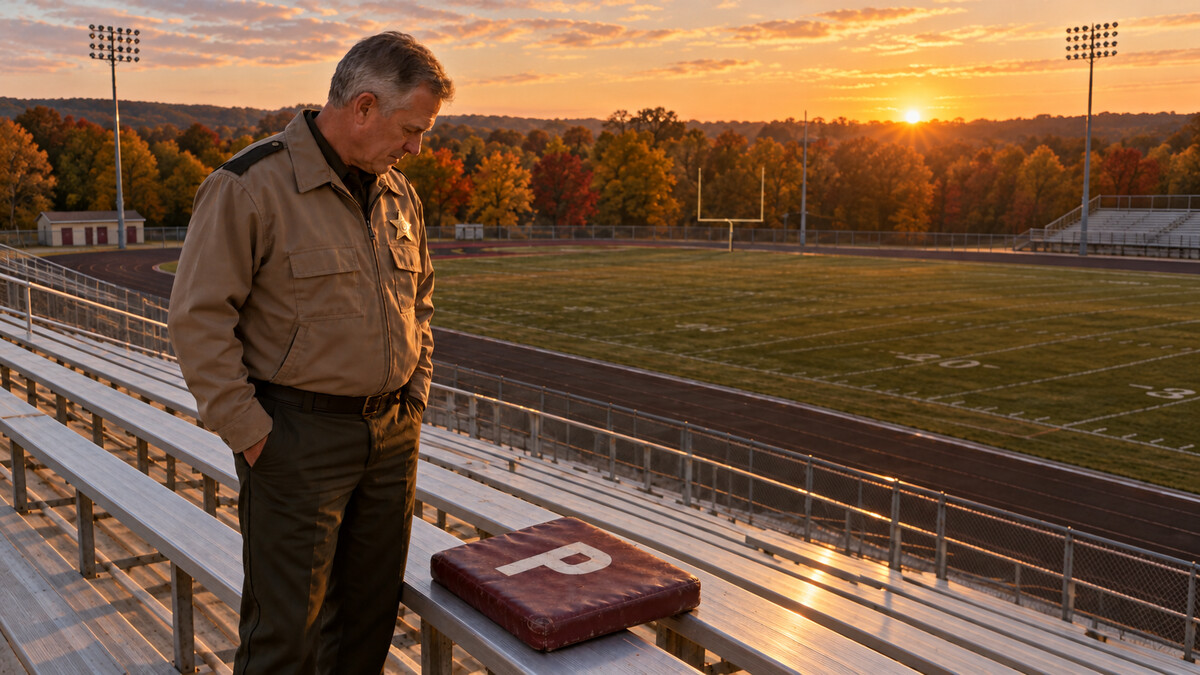
Earl got out of the car and walked over to the foreman, slowly, the way he walked up to every situation, with his hat on and his hands loose.
The foreman was a big, red-faced man with a clipboard, from a contracting company in Zanesville. He looked at the sheriff's badge and stopped his drill.
"Afternoon, Sheriff. Something wrong?"
"Help me understand something," Earl said. "Who told you to start today? I was told this job started Monday."
"It did," the foreman said. "But we finished a job in Cambridge early. The boosters' president called me this morning and said if we could get a head start, go ahead. Save the boosters some money." He looked at his clipboard. "Is there a problem?"
Earl looked up at the bleachers. Row C was still there. Seat fourteen was still there, without its cushion, without its plate.
"Could I see your permit?" Earl asked.
The foreman blinked. "My what?"
"Your building permit. From the county. For the demolition and the new seating." Earl smiled pleasantly. "It's a public school facility. Bleachers are a structure. You can't take one down or put one up without a county permit. I'm sure you've got it."
The foreman looked at his clipboard. He flipped a page. He flipped another one.
"I think the boosters were handling that," he said slowly.
"I think they might not have," Earl said. "Because the permit office closes at noon on Fridays, and I had lunch with the permit clerk today, and she didn't mention it."
That was true. Earl had eaten lunch at Dot's with Joanie from the permit office, the way he did most Fridays. She had talked about her grandson's braces.
The foreman put down his drill.
"Well," he said. "I guess we'll wait till Monday."
"I think that's wise," Earl said.
He walked over to the flatbed, climbed up on the tailgate, and took down the faded cushion with the letter P. Then he picked the brass number plate up out of the gravel and wiped it off on his shirt sleeve.
"Could I borrow one of those drills?" he asked.
By three-thirty, the two rows of bench were back on the bleachers. The foreman's crew had put them back themselves, without being asked twice, once Earl explained to them who the seat was for. The foreman had a father who worked nights at a steel mill in Weirton his whole life. He did not say much. He just put the bolts back in very carefully.
Earl screwed the brass number plate back on the back of seat fourteen himself, with a borrowed drill, crooked, because he was not a carpenter.
Walt Brenner, who had heard about it from Dot, drove out at four with his toolbox, looked at Earl's work, said nothing, took the plate off, and put it back on straight.
Then Earl laid the faded cushion on the bench.
Brett Kuhn came running across the field at four-fifteen. He had heard from the booster president. He was pale.
"Sheriff, I swear, I didn't know they were starting today. I told the boosters to wait. I told them."
"I believe you," Earl said.
Brett looked at row C. At the rows of bench bolted back in place. At the faded cushion on seat fourteen.
He did not say anything for a long time.
"I came here from a school with four thousand students," he said finally. "We had a press box with air conditioning. Not one person there ever saved a seat for anybody." He swallowed. "I think I've been trying to make this place into that place. And I'm not sure it should be."
The homecoming game kicked off at seven.
Panther Field was full, the way it always was for homecoming. The band. The cheerleaders. Half of Pine Hollow in the bleachers with blankets and thermoses.
At six forty-five, a young man in his twenties came up the steps of the bleachers slowly, helping an old man in a windbreaker and a Panthers cap.
The old man was seventy-five. He walked with a cane. He stopped at row C and looked down at seat fourteen for a long time. At the brass number plate. At the faded cushion with the letter P.
Gus Haney was sitting in row C, seat thirteen. He stood up.
"Hello, Tommy," he said.
"Hello, Gus," Tommy Murphy said.
He sat down on his father's seat for the first time in his life.
He did not say anything. He sat with his hands on his cane and looked out at the field, at the white lines and the goalposts and the boys warming up in their jerseys, where he had played halfback in 1968 while his father fed a glass furnace three miles away.
His grandson sat down beside him. So did Gus. So did Earl, in row C, seat fifteen, with his hat in his lap.
When the Panthers ran out onto the field, Tommy Murphy put his hand flat on the bench beside him, on the cushion, and left it there.
The boosters voted the next Tuesday. They would build the new premium seating. But not in row C.
Row C would stay the way it was. And seat fourteen would never be sold. It would be kept for the Murphy family, forever, at no charge.
Brett Kuhn made the motion himself.
He also ordered a small new brass plate, to go under the old one. Walt Brenner put it on straight.
FRANK MURPHY. GLASS WORKS, FURNACE LINE. HIS SEAT IS WAITING.