Part 2
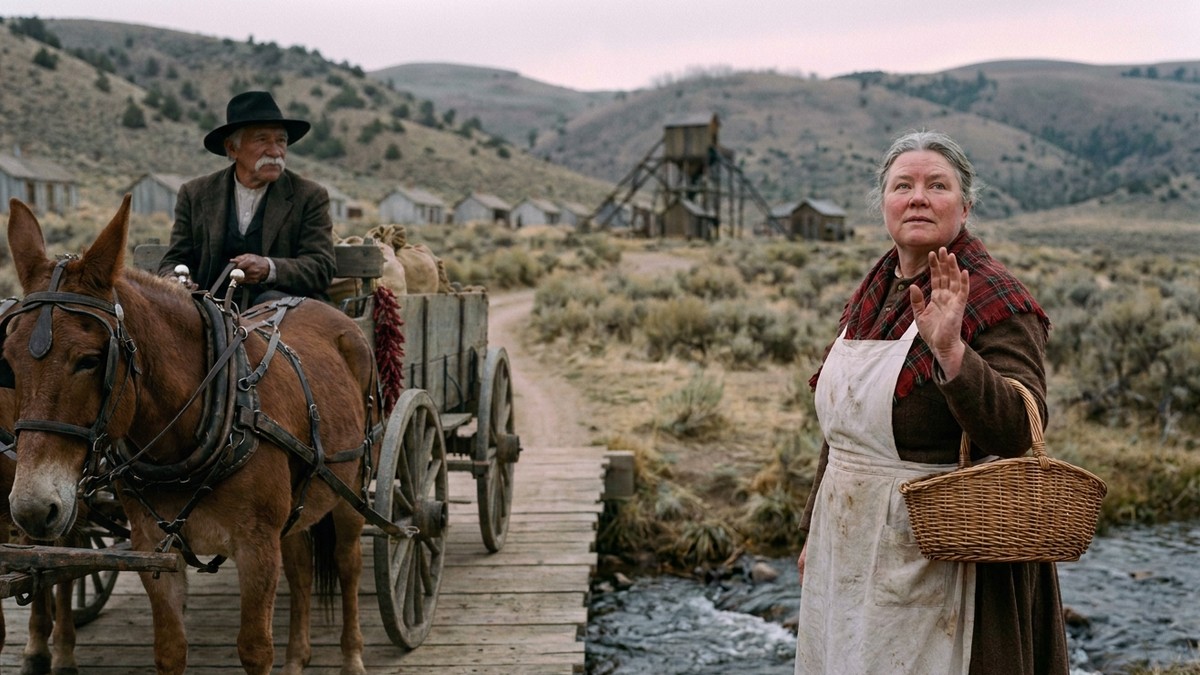
The first Saturday, eleven women came down to the bridge with Effie MacRae, and Don Eusebio Trujillo sold out his wagon in forty minutes.
They came in the gray before dawn, so the store manager would not see them, with baskets and flour sacks and their little hoards of cash. A dollar here, saved from a son's odd jobs. Two dollars there, sent by a sister in Pennsylvania. Mrs. Rees brought a dollar and forty cents in a knotted handkerchief, which was every cent her family had in the world that was not company paper.
Don Eusebio weighed out the beans on his own scale on the tailboard of the wagon, and measured the flour, and counted the eggs, and wrote it all down in a little book, with the Trujillo family's own careful honesty, which went back two hundred years in that valley.
Flour, three dollars a sack. Beans, four cents a pound. Eggs, twenty cents a dozen. Onions and chile, almost nothing.
Mrs. Rees walked back up the hill with a full basket on each arm, crying.
But most of the women in camp had no cash at all. Only scrip.
Effie lay awake two nights over that. On the third night, she went to Mr. Lindsay in his study.
"Mr. Lindsay," she said, "every week you give me twelve dollars in cash, for your groceries."
"I do."
"I want you to let me buy your groceries at the company store from now on. With scrip. The women will give me their scrip, at face value, a dollar for a dollar. I'll take it to the store and buy your flour and your tea and your bacon with it, and the company will take its own paper back, and charge you its wicked prices, which you can afford. And I'll take your twelve dollars in cash down to the bridge on Saturday and give it to the women, in exchange. So they can buy from Don Eusebio."
Mr. Lindsay set down his pipe.
"It'll cost me near double for my groceries," he said.
"It will."
"And if the company asks me why the pit boss has started buying at the store?"
"Tell them you've a cook with expensive tastes."
Mr. Robert Lindsay took off his spectacles and rubbed his eyes. Then he laughed for the first time in months.
"God help me, Effie," he said. "Do it."
The second Saturday, there were forty women at the bridge. Don Eusebio brought two wagons, and his son drove the second.
The third Saturday, there were ninety, and the company store manager came down the hill to watch.
His name was Horace Peck. He was a neat, thin, nervous man of forty-five from Denver, with a gold pencil on a chain, and he stood at the end of the bridge, on the company's side, and wrote down names.
"Mrs. MacRae," he said, when Effie walked past him with her basket. "You understand what you're doing. The company built this camp. Every house in it. The school, the pump, the doctor. The company brought the railroad up the valley. The store is how the company gets its money back. Without it, there'd be no mine, and no work, and no camp at all. I'm not your enemy. I'm only doing the arithmetic."
"I understand the arithmetic, Mr. Peck," said Effie. "Six dollars for a three-dollar sack of flour. I can do that sum in my head."
On Monday, a notice went up on the store door.
Any employee whose family is found trading with outside parties will be considered in breach of the company's interest, and will be discharged.
The camp went very quiet that day.
That evening, Mr. Lindsay came home from the mine and did not take off his boots. He sat at the kitchen table with the notice in his hand. Peck had brought him a list. Twenty-two names. Miners whose wives had been seen at the bridge.
At the top of the list was Evan Rees. And under it, Effie's own two sons.
"He wants me to discharge them," said Mr. Lindsay. "By the end of the week. Or he'll wire Denver that the pit boss is helping his cook run a boycott."
Effie stood by the stove with her arms folded.
"And will you?"
Robert Lindsay picked up his pen. He wrote one line across the bottom of it, in his heavy miner's hand, and signed it, and handed it to her.
I discharge men for bad work, not for where their wives buy beans. The hiring and the discharging below ground are mine, by the company's own rules. Not one of these men will go. R. Lindsay, Pit Boss.
"Take that to Peck in the morning," he said. "And then make me some breakfast. I've a feeling I'll be wiring Denver myself."
He wired Denver himself. He told the general manager plainly that if twenty-two good men were discharged over the store, three hundred would walk out after them, and the Black Diamond would ship no coal in May. And that the farmer's wagon was on the farmer's own land, where the company had no say at all.
The general manager came down from Denver on the train. He went to the store, and to the pit, and to the bridge, on a Saturday morning, and stood and watched a hundred miners' wives buying flour from Don Eusebio Trujillo for three dollars a sack.
On Monday, the notice came down from the store door. On Tuesday, a new price list went up. Flour, three dollars and forty cents. Beans, five cents. Bacon, fourteen.
The women kept going to the bridge anyway, every Saturday, all that summer and for years after. Don Eusebio's son took over the wagons when the old man grew too stiff to drive. The camp called it the Saturday market.
On a Saturday in September, Effie MacRae saw a thin woman in a good bonnet standing at the back of the crowd by the wagon, with a basket and a purse, looking nervous.
It was Mrs. Horace Peck.
Effie went over to her and took her arm.
"You'll want the eggs early, Mrs. Peck," she said. "They go first. Come, I'll show you."
And Mrs. Rees's youngest, who was five now, and whose wrists were not like sticks anymore, ran ahead of them to the wagon.