Part 1
The price of flour at the Black Diamond company store went from three dollars a sack to four in March, and to six in April.
It was the spring of 1884, in a coal camp in the foothills of southern Colorado, west of Trinidad, where the Black Diamond Coal Company owned the mine, the houses, the water, the school, the doctor, the road, and the store. Three hundred men worked the mine. They were Welsh and Irish and Cornish and English, and Hispanos from the old villages on the Purgatoire, and a few Italians just come over. Most of them had families. Every one of them was paid in company scrip.
Scrip was paper money printed by the company. It was good for one thing only. Buying goods at the company store. A miner who wanted real money for his scrip had to sell it to a broker in Trinidad for seventy cents on the dollar.
So everybody bought at the company store. And the company store set the prices.
Effie MacRae had cooked for the pit boss, Mr. Robert Lindsay, for nine years.
She was fifty-eight, a widow from Fife, in Scotland, broad and gray-haired and blunt, with forearms like a baker's and a laugh you could hear across the camp. Her husband had died in a cave-in in the old country, in 1869. She had come to America with her two sons. Both of them worked in the Black Diamond mine.
She lived in two rooms behind Mr. Lindsay's kitchen and kept his house and cooked his meals and bought his groceries. With cash. Mr. Lindsay was paid in real money, like all the bosses.
So Effie was one of the few people in camp who knew exactly what things cost in the stores in Trinidad, twelve miles away. And what they cost in the company store.
The difference had always been bad. That spring it became wicked.
"Flour's three dollars a sack in Trinidad," Effie told the miners' wives at the pump one morning in April. "Three. And beans are four cents a pound, not ten. Bacon's twelve cents, not twenty-five."
The women looked at each other.
"It's the freight, Mrs. MacRae," said Mrs. Gwynneth Rees, whose husband had been a miner for thirty years in Wales and here. She had six children. "The store manager says the freight's gone up. The railroad."
"The freight's gone up a penny a sack," said Effie. "I asked the station agent myself."
Mrs. Rees set down her bucket. They all knew what it meant. The company had cut the rate for coal that winter, because the price of coal had fallen. Every miner was earning less for every ton. And now the store was taking it back, and more.
Mrs. Rees's youngest was standing beside her at the pump, holding her skirt. He was four years old, and his wrists were like sticks.
That night, Effie told Mr. Lindsay.
The pit boss was a tall, tired, decent Scot of sixty from Lanarkshire, who had gone down the pits himself at nine years old. He sat at his supper and listened to her without looking up.
"I know, Effie," he said at last. "I know what the store charges."
"Then you'll speak to the company."
"I have spoken to the company." He put down his fork. "I wrote to the general manager in Denver in March. He wrote back that the store is not my department. The store makes money for the company, and the company has had a bad year. If the men don't like the prices, they're free to go to Trinidad."
"Twelve miles, on foot, with scrip that's worth seventy cents there," said Effie.
"I know it." Mr. Lindsay looked at her, and she saw how tired he was. "Effie, I've three hundred men to keep in work. If I fight the company over the store, they'll send a new pit boss by summer, and he'll be worse. I'm not saying it's right. I'm saying that's how it is."
Effie MacRae lay awake that night in her room behind the kitchen, listening to the night shift go down the hill to the mine.
She thought about Mrs. Rees's little boy at the pump.
She thought about the company line. The company owned everything inside the camp, every foot, right down to the bridge over the creek at the bottom of the hill. But on the other side of the bridge, on the Trinidad road, the land belonged to a Hispano farmer named Don Eusebio Trujillo, whose family had farmed the valley of the Purgatoire since long before there was a coal company, or a Colorado, or a United States, in that country.
Don Eusebio drove his wagon to market in Trinidad every Saturday, loaded with beans and chile and onions and eggs and flour from the mill at his village. Every Saturday, he drove right past the bottom of the camp road. And never stopped, because nobody in camp had cash to buy with.
Except Effie, and a few others like her.
She thought about how much cash there really was in camp, if every woman who had a little put it together.
On Saturday morning she walked down to the bridge before dawn, with her purse, and waited for Don Eusebio's wagon.
When it came rattling down the road in the gray light, she stepped out and held up her hand.
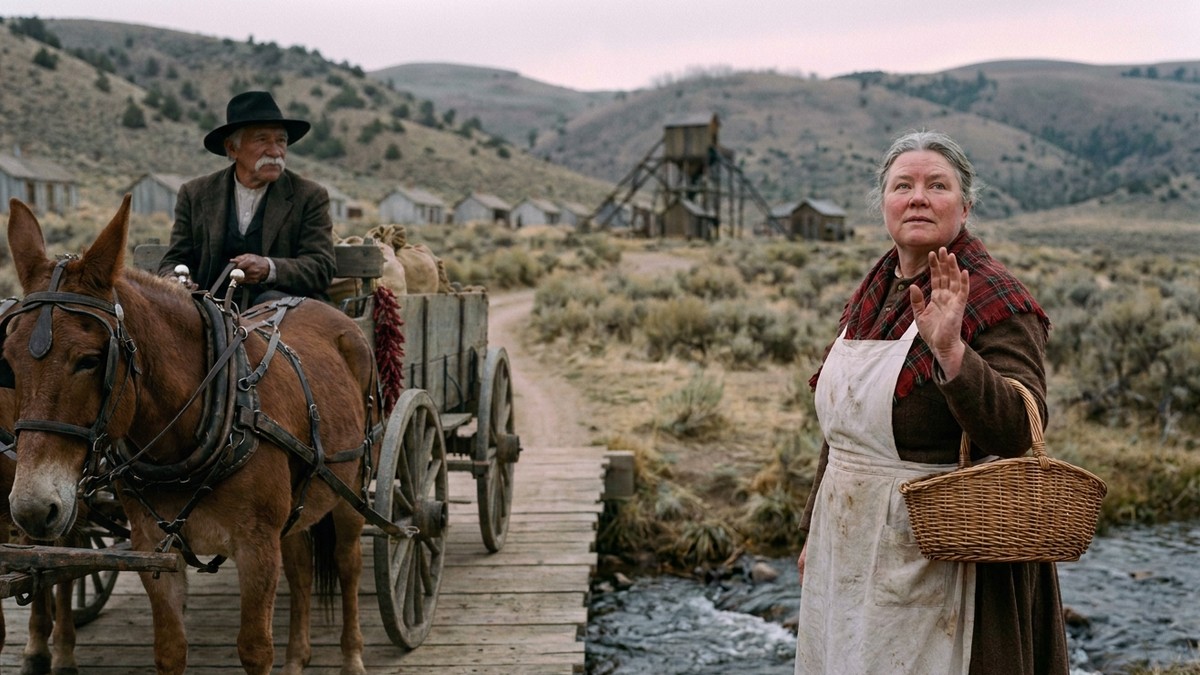
He reined in. He was a lean, white-mustached man of seventy in a black hat, with a face like old leather, and he looked down at her from the wagon seat with grave curiosity.
"Señora," he said. "You are the cook of Señor Lindsay."
"I am," said Effie. "Don Eusebio, how much do you get for a sack of flour in Trinidad?"
He told her.
"And if a crowd of women met you here, at this bridge, on your own land, every Saturday, with cash in their hands," said Effie MacRae, "would you sell to us for that? Right here? And save yourself the twelve miles?"
Don Eusebio looked at her for a moment. Then up the hill at the camp, at the rows of company houses and the company store with its big painted sign.
"The company will not like it," he said.
"No," said Effie. "The company will not."
Up on the hill, behind them, a lamp was already burning in the back window of the company store, where the manager kept his books.