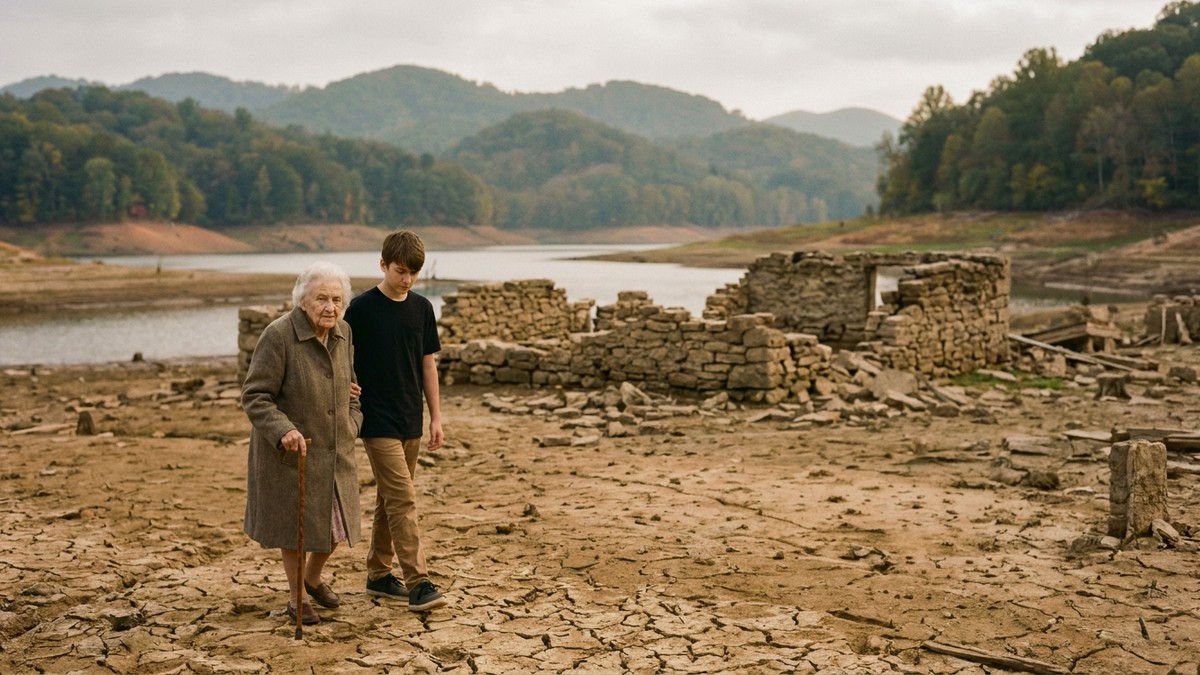
Eula Mae Gentry was eight years old when the water came up over Hollis Mill, and she was ninety-one when it went back down.
It was her great-grandson who told her. Wyatt was fifteen and lived with his mother in the house where Eula Mae had a bedroom off the kitchen, and on a Tuesday in October, he came in from school holding out his phone.
"Grandma Eula," he said. "The lake's down. Way down. They're saying you can see the old road."
She took the phone in both hands and held it at arm's length. On the little screen was a photograph somebody had taken from the hills above Hollis Lake. Where there should have been blue water, there was a long brown valley of cracked mud, and running down the middle of it, pale as a scar, was a road.
Eula Mae knew that road. She'd walked it to school.
The summer had been the driest anyone in east Tennessee could remember. No rain in July.
Almost none in August. By September the creeks were stones, and the farmers were hauling water, and every week the lake dropped a little more.
Then, in October, the dam started its usual fall drawdown to make room for winter rain. Except the rain didn't come. The lake kept falling past every mark on the old measuring posts, and one morning a fisherman in a johnboat saw a chimney.
By the end of the week, the whole old town of Hollis Mill was coming up out of the mud.
The television news had it. The Knoxville paper had it.
People were driving in from three states to stand on the overlook and take pictures. They called it a ghost town, and a lost town, and a drowned town.
Eula Mae called it home.
She'd been born in the apartment above the Hollis Mill post office in the spring of 1936. Her father, Asa Gentry, was a stonemason, the best in the county, and her mother ran the post office from a counter by the front window.
There were two hundred and some people in Hollis Mill then. A gristmill on the creek, a general store, a school, a Baptist church with a stone foundation her father had laid in 1921, when he was twenty years old.
Then the government decided the valley needed a dam.
She was too young to understand it. She only remembered men in good shoes coming to the house, and her father sitting at the kitchen table afterward with his big hands flat on the oilcloth. The government paid them for the land.
Not much, and not what it was worth, but it paid. The families scattered up the hills and into the towns.
The graves in the churchyard were dug up and moved to a new cemetery on the ridge. The church bell was taken down and given to a new church in town.
Her father had asked for one thing. He'd asked to take the church cornerstone with him.
They'd told him no. It was part of the foundation, and the foundation stayed.
In the spring of 1944, the gates of the dam closed, and the water began to rise. It took weeks. Eula Mae went up on the hill above the valley with her mother almost every evening to watch it climb.
She saw it cover the road and the schoolhouse steps. She saw it fill the windows of the store.
On the last evening, she saw it go over the roof of the post office where she'd been born.
Her father hadn't come up the hill with them. Not once. He said a man didn't need to watch a thing like that.
Before they went up that last evening, he'd knelt down in front of her and taken her face in his hands. "Don't you cry over it, Eula Mae," he'd told her. "It's just water and rock. We carry the town with us."
She'd cried anyway. She'd cried all the way down the hill.
She'd never cried about it since, not once in eighty-three years. She'd moved to the new town on the ridge, and grown up, and married, and run the new post office there for thirty-eight years.
She'd buried a husband and a son. And every time she'd driven past Hollis Lake, which was often, she'd looked straight ahead at the road.
"I want to go," she said.
Her granddaughter, Tammy, who was Wyatt's mother, was standing at the stove. She turned around.
"Grandma, you're ninety-one."
"I know how old I am."
"It's mud out there. They're saying people are getting stuck. A man went in up to his waist on Sunday."
"Then I'll stay out of the places a man would go in up to his waist," Eula Mae said. "I know where they are."
Tammy looked at her for a long time. Then she looked at Wyatt.
"I'll go with her," Wyatt said. "I'll hold on to her the whole way. I promise."
They went on Saturday morning. Tammy drove. Wyatt sat in the back with his phone, and Eula Mae sat in the front in her good church coat with her cane between her knees.
The overlook was crowded. There were cars parked along the shoulder for half a mile and people standing at the rail with cameras.
Down below, the old valley lay open to the sky. Eula Mae could see the line of the road, and the square gray outlines of foundations, and the stumps of trees that had been cut before the flooding, standing in rows like old men.
A gravel ramp led down from the boat launch to the mud flats. At the bottom of it, a young ranger in a green jacket stood beside an orange barricade.
He was maybe thirty. He had a kind, tired face and a radio on his belt.
"I'm sorry, folks," he was saying. "The flats are closed past this point."
Eula Mae made her way down the ramp on Wyatt's arm, one careful step at a time. When she got to the barricade, she stopped and looked out over the mud.
"Ma'am," the ranger said gently, "I can't let you out there. It's not safe. It's soft in places, and there's old rock and old wire buried all over. There's nothing out there but mud and some old foundations."
Eula Mae lifted her cane and pointed it, steady as a compass needle, at a gray rectangle of stone half a mile out.
"That old foundation," she said, "is the Hollis Mill post office. I was born upstairs."
The ranger opened his mouth and closed it.
"I walked those streets before your grandmother was born, son," Eula Mae said. "Now. Are you going to let me go home, or not?"