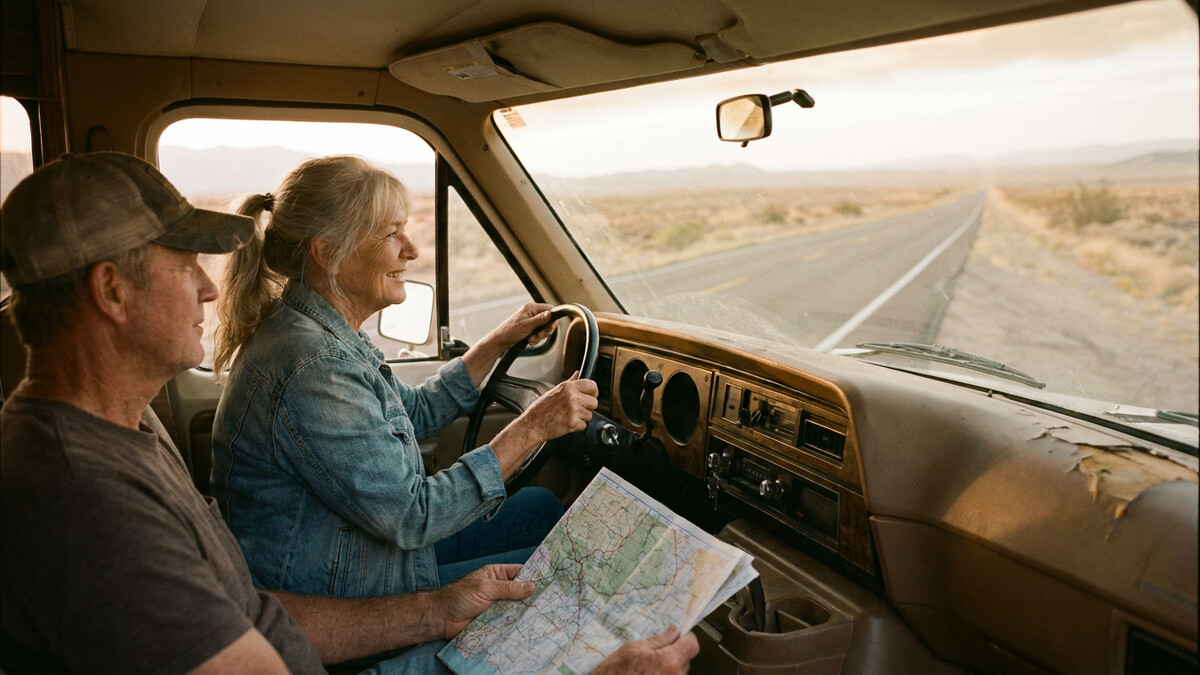
Shelly caught the first flight out of Phoenix. Todd drove down from Denver through the night. They met in the cardiac unit waiting room at three in the afternoon, two grown children who had not been in the same room since Christmas, and found their mother sitting in a vinyl chair with her purse in her lap and a paper cup of coffee she had not touched.
"He's all right," Darlene said before they could ask. "It was a blockage. They put in a stent. He's awake. He's grumpy. The doctor says he can go home in two days."
Shelly sat down beside her mother and burst into tears.
"Home," Shelly said. "Mom, you don't have a home. You sold it."
Darlene patted her hand.
"We have a home, honey," she said. "It's in the parking lot. It has a brown stripe."
They went in to see Roy one at a time.
He was propped up in the bed with tubes in his arm and wires on his chest, looking older than Shelly had ever seen him. He smiled when she came in.
"Hey, Shell. You didn't have to fly."
"Dad. You had a heart attack."
"Little one," Roy said. "Practically a sneeze."
She sat down by the bed. She did not know what to say. For six weeks, she had been angry at him. Now she could not remember why.
"Dad," she said finally. "What are you doing? Really? What is this trip?"
Roy looked at her for a long time.
Then he reached over to the little table beside the bed, where the nurses had put his wallet and his reading glasses, and handed her a folded piece of paper.
Shelly unfolded it. It was old, soft, almost worn through at the creases, covered in her father's square handwriting.
Nine names. Places. Years.
The first one was crossed out. Lyle Brandt. Rawlins, Wyoming. 1979. Pulled us out of the snow and drove Shelly to the hospital.
Shelly read it twice.
"Dad," she said. "That's me."
"That's you," Roy said. "You had a fever of a hundred and five. Your mother held you in the back seat. That man drove forty miles in a blizzard with us in his cab. He was eighty-eight last week. He cried when he saw your picture."
Shelly stared at the paper.
She read the second name. Gloria Fuentes. Amarillo, Texas. 1981. Stayed fourteen hours past her shift with Todd.
She read the third. And the fourth. All the way down to the ninth, which was in Maine, and which simply said: Bar Harbor, 1975. Where Darlene said yes.
"Your mother and I didn't have much," Roy said. "We still don't. But a lot of people helped us when we needed it. We never paid one of them back. I always told myself I'd do it someday." He looked at his daughter. "Someday's a funny word, Shell. You think it's a long way off. Then you're seventy-four with a stent."
Shelly folded the paper very carefully and gave it back to him.
"You sold the house to do this," she said.
"We sold the house to do this," Roy said. "And to see the country one more time before we can't. What's left goes to you and Todd. I promise you that. But this part was ours."
The next morning was Thursday.
Shelly and Todd went down to the hospital gift shop on the first floor. They did not tell their parents.
Behind the counter, arranging get-well balloons, was a small, white-haired woman of about eighty-five in a pink volunteer's smock. Her name tag said GLORIA.
Todd stood in front of the counter. He was forty-five, a big man with a beard, an accountant. He was suddenly not sure what to do with his hands.
"Mrs. Fuentes?" he said. "My name is Todd Pickett. I was born here. In 1981. Two months early. My mother says you stayed with me for fourteen hours after your shift was over."
Gloria Fuentes looked up at him. She looked for a long time.
"Darlene," she said slowly. "Darlene Pickett. From Arizona. She was so young. And the baby was so small. Two pounds, eleven ounces." She put her hand over her mouth. "That was you?"
"That was me," Todd said.
Gloria came out from behind the counter and put her arms around him. She came up to about the middle of his chest.
"Look at you," she said into his shirt. "Look how big you got."
They brought Gloria up to the cardiac unit that afternoon. She sat with Roy and Darlene for an hour and a half and told them about her five grandchildren, and Darlene showed her pictures of Todd's two boys. When she left, Roy took out the piece of paper and crossed off the second name.
Then he handed the pen to his son.
"You want to do the next one?" he said.
Roy got out of the hospital on Saturday. The doctor said he could travel, slowly, with his new medicine and a checkup at a clinic every two weeks.
Shelly took two weeks off work. Todd took one. They rode along in the motor home, Shelly at the dinette and Todd on the fold-out couch, through the Kansas wheat stubble to Dodge City, where Elmer Hagen was ninety-one and still farming, and through the hills of Missouri and the long flat of Ohio, crossing names off the list.
Darlene drove. She would not let anybody else.
They reached Bar Harbor, Maine, in the second week of November, on a cold, clear afternoon. The last name on the list.
The little inn where Roy and Darlene had spent their honeymoon in 1975 was still there, on a hill above the harbor. The same white clapboard. The same porch. A new owner, who had never heard of them.
It did not matter.
Roy and Darlene walked down to the rocks below the inn, the way they had in June of 1975, when Roy had gotten down on one knee on a granite ledge and asked a twenty-one-year-old school bus driver from Yuma if she would like to see the country with him someday.
Shelly and Todd stayed up on the porch and watched.
Their father stood on the granite ledge, holding their mother's hand, with the gray Atlantic rolling in below them. They could not hear what he said. They did not need to.
When they came back up the hill, Roy took the piece of paper out of his pocket for the last time.
He crossed off the ninth name.
Then he turned the paper over to the blank side and handed it to his daughter, with the pen.
"Your turn, Shell," he said. "Start your own list."