For eleven months, the loose cash in the 8:30 offering at Grace Methodist had come up about twelve dollars short every single Sunday, and Verna Huff was the only person in Pine Hollow who knew it.
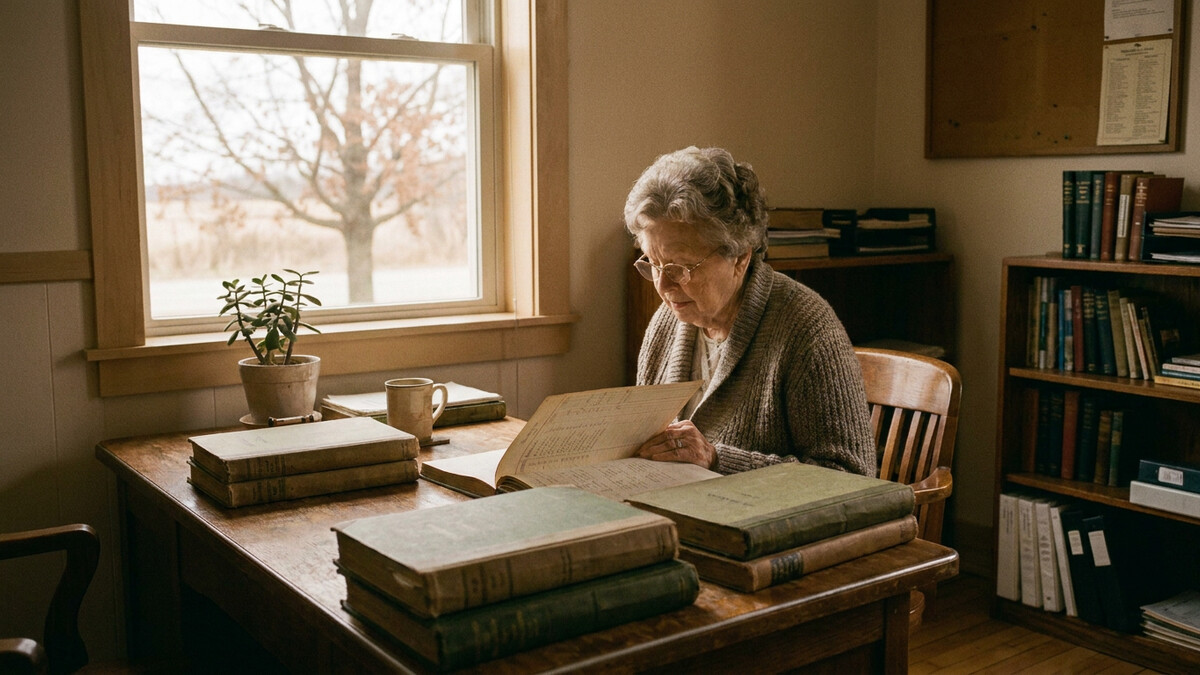
She found it on a Tuesday in October, at her desk in the church office, with a cup of coffee and twenty-one years of offering ledgers spread across the desk like a game of solitaire.
She had not been looking for anything. She had been doing the yearly report.
But numbers had a way of talking to Verna. They always had. And these numbers were saying something she did not want to hear.
Verna was seventy. She had kept the books at Calder Feed and Seed from 1974 to 2004, by hand at first and then on a computer she never fully trusted. When she retired, Pastor Sam's predecessor had asked her to keep the church books three mornings a week, just for a year or two.
That was twenty-one years ago.
She was not a member of the Liars' Table. She did not gossip. She did not do the flowers or run the bake sale. She came in at eight on Tuesdays, Wednesdays, and Fridays, sat at the desk in the little office behind the sanctuary, and kept every dollar that came into Grace Methodist written down in a green ledger, the old way, alongside the computer.
Most of the congregation did not know her last name.
The way the offering worked was simple. Two ushers on each side of the sanctuary passed the plates during the service. Afterward, two counters sat at a table in the back room, counted the money together, filled out a count sheet, and sealed it in a deposit bag. On Monday, Verna took the bag to the bank in Marietta.
Most people gave by check or in pledge envelopes with their names on them. That money always matched. Verna could have told you, almost to the dollar, what the Yoders gave and what the Brenners gave and what Floyd Eckert put in his envelope every week since 1974.
The loose cash was different. Bills dropped in the plate without an envelope. Visitors. Children with their dollar. Old men who did not want anybody to know what they gave.
Loose cash went up and down. There was no predicting it from one Sunday to the next.
But over twenty-one years, it averaged out. And Verna had all twenty-one years.
She laid them side by side.
The 11:00 service loose cash had been steady for five years. A little up at Easter, a little up at Christmas, a little down in August when people went to the lake.
The 8:30 service loose cash had been steady too. Until the second Sunday of last November.
From that Sunday on, the 8:30 loose cash had dropped. Not much. About twelve dollars a week. Some weeks ten, some weeks fifteen. But every week. Forty-seven Sundays in a row.
Verna got out a calculator and did it three times.
Five hundred and sixty-four dollars.
She sat back in her chair and looked out the office window at the bare maple in the churchyard.
The second Sunday of last November was the Sunday the usher schedule changed.
She took it to Pastor Sam Greer on Wednesday morning.
Sam was fifty-eight, a former Marine, a calm man who fixed problems quietly before Sunday. He sat in the chair across from her desk and looked at her charts for a long time.
"Verna," he said finally. "You're sure about this?"
"I'm sure about the numbers," Verna said. "I'm not sure about anything else."
"Twelve dollars a week."
"It doesn't sound like much," Verna said. "It's not the amount. It's that somebody is taking it out of the plate. During the service."
Sam rubbed his face.
"Who changed on the usher schedule last November?"
Verna had already looked.
"Lloyd Hersh moved to the 11:00. Bob Yoder had his knee surgery and dropped off. Darrell Simms moved from the 11:00 to the 8:30. And the Miller girl started ushering with her dad."
"Darrell," Sam said slowly. "And a twelve-year-old girl."
"And the counters are the same as always," Verna said. "Ruth Ann Mercer and Harold Pugh. I'd trust either one with my life."
Sam was quiet for a long time.
"Let me think about this," he said. "Please don't say anything to anybody. Not yet."
"I don't say anything to anybody, Pastor," Verna said. "That's why you've never noticed me."
She did not say anything to anybody.
But somebody else did.
On Saturday, the church council chairwoman, a brisk retired school principal named Connie Lutz, called Verna at home.
"Verna. I need to ask you something about the offering. Is there money missing?"
Verna was very quiet.
"Why do you ask, Connie?"
"Because Harold Pugh told me there was a problem with the count," Connie said. "And because two people have told me they saw the new organist in the back room alone after the 8:30 service. More than once. Where the offering plates are kept."
Verna sat down at her kitchen table.
The new organist was a young woman named Grace Okonkwo, twenty-six, who had moved to Pine Hollow from Columbus in October of last year to teach music at the elementary school. She had taken over the organ at Grace Methodist when the old organist's hands gave out. She played beautifully. She was quiet and shy and lived alone in an apartment over the hardware store, and she had started playing the 8:30 service on the second Sunday of last November.
"Connie," Verna said carefully, "I don't think it's Grace."
"Well, I don't know what to think," Connie said. "But the council is meeting after the 11:00 service tomorrow. I'm going to put it on the agenda. If people saw her back there alone with the plates, we have to ask her to step down until this is sorted out."
"Connie, please. Wait. Let me talk to Pastor Sam."
"Sam knew about this," Connie said, "and didn't tell the council. I'll be talking to him too."
She hung up.
Verna sat in her kitchen with the phone in her hand.
Tomorrow, in front of the whole church council, a shy young woman who had done nothing wrong was going to be accused of stealing from the offering plate. Her name would be all over Pine Hollow by Monday morning. And Verna knew exactly how this town worked. Once a story like that was out at Dot's, no apology would ever catch up to it.
She looked at the clock. It was four o'clock on Saturday afternoon.
The 8:30 service was in sixteen and a half hours.