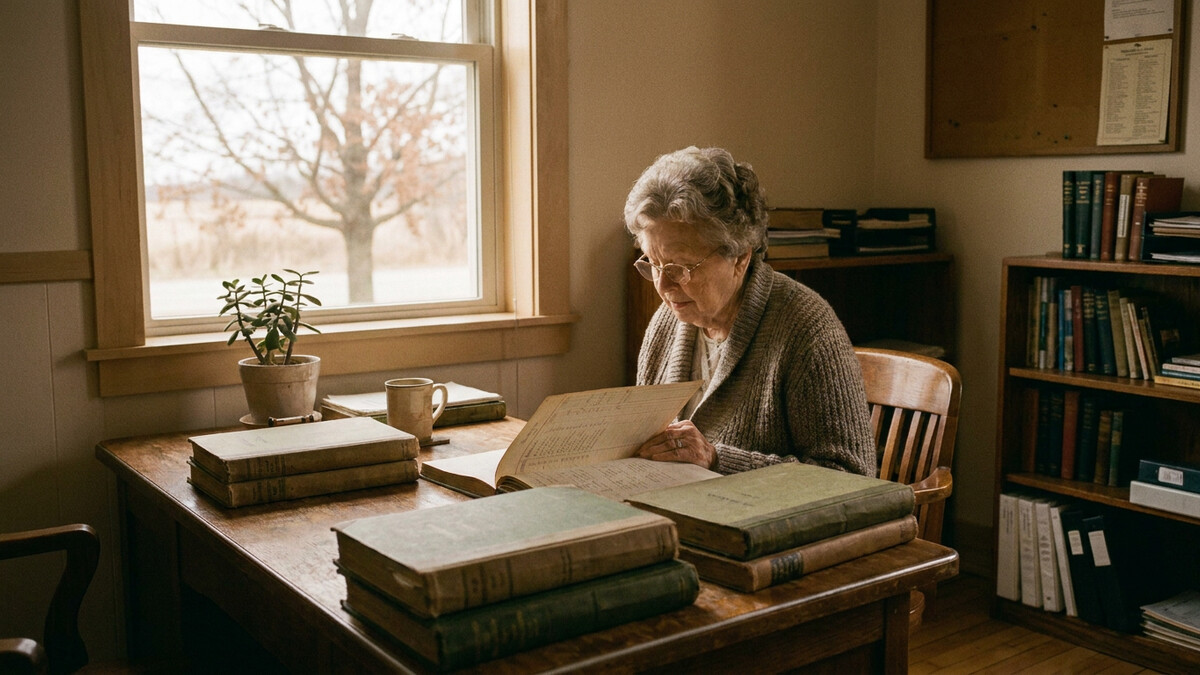
Verna Huff had not sat in the choir loft at Grace Methodist since 1983, when she quit the choir because the director made her sing alto.
At eight-fifteen on Sunday morning, she climbed the narrow back stairs to the loft and sat down in the back row, behind the empty choir chairs, in her navy blue coat. From up there, she could see the whole sanctuary. Every pew. Every usher. Every plate.
Grace Okonkwo was at the organ below, playing the prelude. She did not look up.
Pastor Sam saw Verna in the loft when he came out to the pulpit. He paused, very slightly, and then went on with the call to worship as if he had seen nothing at all.
The offering came after the second hymn.
Four ushers walked to the front. On the left side, Darrell Simms and the Miller girl, Hailey. On the right, Pete Yoder's grandson and old Ray Yoder.
They took the wooden plates from the altar rail and started down the aisles.
Verna watched the left side.
She watched it the way she had watched columns of figures for fifty years. Not looking for anything in particular. Just looking. Letting the thing show itself.
Hailey Miller took the front pews on the inside aisle. Darrell Simms took the back pews on the outside aisle, by the wall. He moved slowly, pew to pew, holding the plate out, nodding at the people he knew.
At the last pew, the plate came back to him. He turned toward the back of the church.
And for about one second, with his back to the congregation and his body between the plate and the sanctuary, his right hand went down into the plate and came out again, closed, and went into the pocket of his sport coat.
Then he walked to the back of the sanctuary and handed the plate to the counters as if nothing had happened.
Not one person in the pews could have seen it.
But Verna was not in the pews.
She did not go to the council. She did not go to Connie Lutz.
She went down the back stairs after the benediction and found Pastor Sam in his study, taking off his robe. She closed the door behind her.
"It's Darrell," she said.
Sam closed his eyes.
"Are you sure?"
"I watched him do it," Verna said. "At the back pew. Right hand. Sport coat pocket."
Sam sat down heavily at his desk. Through the window, they could see the congregation drifting out into the parking lot after the 8:30, standing around in clusters in the cold sun. Darrell Simms was out there, by his pickup, talking to his wife.
"Darrell has ushered here for twenty years," Sam said quietly. "He was laid off from the trucking company last September. I knew that. He told me he was fine. He told me he'd find something by Christmas."
"Last September," Verna said. "And the money started going missing the second Sunday of November."
They looked at each other.
"Will you come with me?" Sam asked. "I'd rather do this with someone he knows didn't go to the council."
They found Darrell alone in the back room after the 11:00 service, folding the bulletins for next week, the way he always did.
He looked up when they came in. He saw Verna. He saw her face.
He put down the bulletins.
He did not try to deny it. He was a big, quiet man of fifty-eight with gray at his temples and calluses on his hands from thirty years of loading trucks. He sat down on a folding chair and put his head in his hands.
"Twelve dollars," he said. "Every week. I never took more. I swear to God I never took more."
"What was it for, Darrell?" Sam asked gently.
Darrell did not look up.
"My granddaughter," he said. "Abby. She lives with us. Her mama's in Columbus, in rehab. The school lunch account was overdrawn in October. They sent a letter home. They said she'd have to eat the cheese sandwich, the one they give the kids who can't pay. In front of the whole lunchroom." His voice broke. "She's nine. Twelve dollars a week. That's her lunch. Two-forty a day."
"Why didn't you ask?" Verna said quietly.
"Because I've been putting money in that plate for twenty years," Darrell said. "I'm not the kind of man who takes it out."
He laughed then, a terrible sound, and wiped his face.
"Except I guess I am," he said.
Sam went to the council meeting.
He told them there was a problem with the offering, that it had been found and resolved, and that it had nothing to do with Grace Okonkwo, who should receive an apology from anyone who had spread that rumor. He did not say whose name it was. He said only that the person had confessed, was repaying every dollar, and that the matter was closed.
Connie Lutz started to argue. Then she looked at Sam's face and stopped.
She went to Grace Okonkwo's apartment that afternoon, alone, and apologized. Grace told Verna about it later. She said Mrs. Lutz had cried.
The church quietly paid Abby Simms's lunch account through the end of the school year, from the pastor's discretionary fund, which was what it was for. Darrell paid back the five hundred and sixty-four dollars at twenty dollars a week, in a plain envelope, which Verna logged in the green ledger every Monday under "Miscellaneous."
In January, the new distribution center out on the old glass works site hired him to drive a forklift on the night shift. Earl Whitaker put in a word.
He went on ushering at the 8:30. Sam saw no reason to stop him.
The next fall, Verna was doing the yearly report again at her desk in the little church office, with a cup of coffee and twenty-two years of ledgers spread out around her.
She laid the 8:30 loose cash beside the 11:00, the way she always did.
The 8:30 was up. Not by much. About twelve dollars a week. Some weeks ten, some weeks fifteen.
She looked at it for a long time.
Then she got up, walked to the window, and looked down at the parking lot, where Darrell Simms was helping old Floyd Eckert out of his car and into his walker, the way he did every Sunday now.
Verna sat back down, picked up her pencil, and wrote one word in the margin of the green ledger beside the November total, very small, where no other eyes would ever think to look.
Thanks.