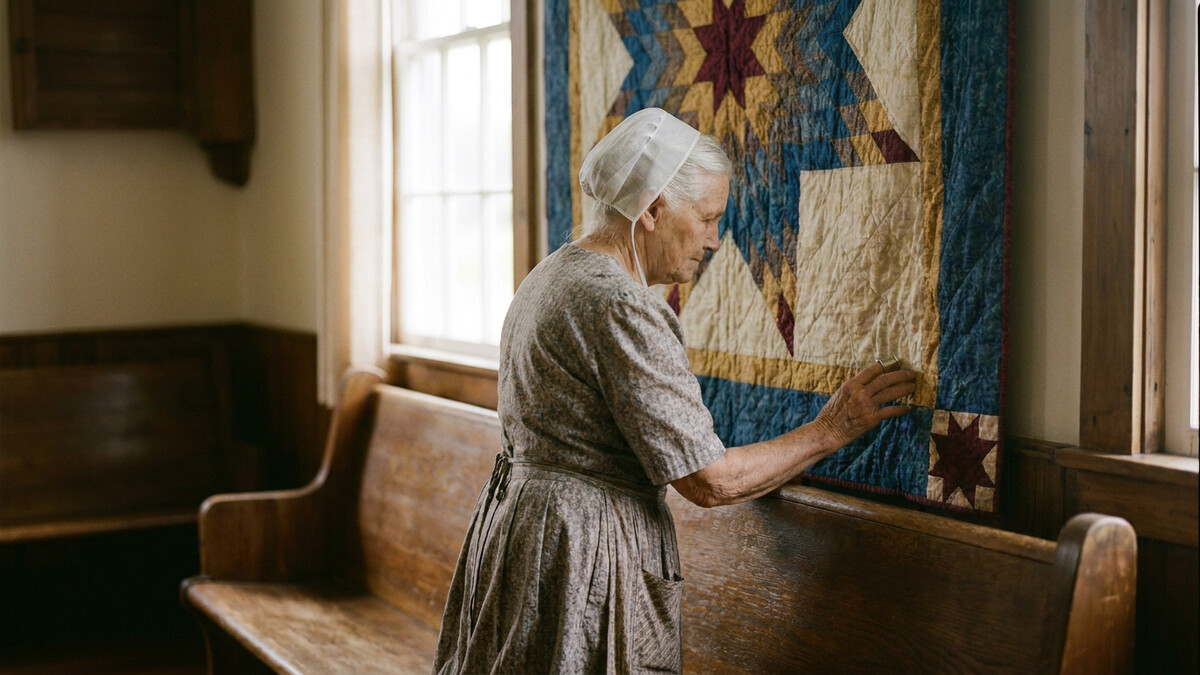
The raffle quilt was hanging right where it should be in the fellowship hall of Mill Creek Mennonite Church on Friday night, and Esther Weaver knew within ten seconds of touching the corner that it was not their quilt.
It looked the same. Same Lone Star pattern, eight points of blue and gold and cranberry radiating from the center. Same white border. Same size, queen. From across the room, anyone would have said it was the quilt the Tuesday circle had spent fourteen months making.
But Esther was not across the room. She was standing right in front of it, with the binding between her thumb and finger.
"Lord, have mercy," she said quietly. "Somebody's switched it."
Esther was seventy-nine. She had been quilting since she was seven, at her mother's frame in the farmhouse kitchen outside Mill Creek, Pennsylvania, in the rolling farm country of Lancaster County. She had been in the Tuesday circle at Mill Creek Mennonite for fifty-eight years. She had helped make every raffle quilt since 1968.
The raffle was tomorrow. Saturday, at the church's annual relief sale, after the chicken barbecue and before the pie auction. Every year, the raffle quilt raised money for disaster relief. Tickets were five dollars, and last year's quilt had brought in eleven thousand dollars.
This year's quilt was the best one the circle had ever made. A collector from Philadelphia had come to the sale preview on Wednesday and offered the church eight thousand dollars for it outright.
The circle had said no. The quilt was for the raffle.
"Esther, are you sure?" said Miriam Hurst, who was sixty-four and the circle's chairwoman. She had come over from the pie table when Esther called her. "It looks exactly the same."
"Feel the quilting," Esther said. "Right here. Along the border."
Miriam ran her fingers along the white border, where the circle had quilted a feathered vine, tiny stitches running through all three layers.
"It feels fine."
"Count them," Esther said.
Miriam looked at her.
"Count the stitches," Esther said. "One inch. Count."
Miriam bent close and counted. It took her a while.
"Nine," she said. "Maybe ten."
"Our border has twelve to the inch," Esther said. "Every inch. I did that border myself, with Anna Stauffer, over three Tuesdays in June. I've never quilted nine to the inch in my life. Not since I was nine years old."
Miriam went and got the pastor. The pastor got the deacon. The deacon got the treasurer. By eight o'clock, there were eleven people standing in the fellowship hall looking at the quilt, and most of them did not believe it.
"Esther, it's the same pattern. The same colors."
"The colors are close," Esther said. "Not the same. Look at the gold. Ours was a mustard gold. A Moda fabric, from the shop in Intercourse. This is brighter. It's newer."
"It's the lighting," the deacon said.
"It's not the lighting."
"Who would do such a thing?" Miriam said. "And when?"
That was the question.
The fellowship hall had been locked every night since Monday. The quilt had hung on the wall since Tuesday morning, when the circle hung it for the preview. On Wednesday, the hall was open for the relief sale preview from four to eight. On Thursday, it was closed. On Friday, the circle had come in at six to set up tables.
So it was Wednesday night. During the preview. With two hundred people walking through.
The circle went home at nine, upset and arguing. Some of them believed Esther. Some of them thought she was getting old.
She heard that last part. She was meant to. Lena Brubaker, who was eighty-two and had never forgiven Esther for winning the county fair quilt ribbon in 1987, said it in the parking lot loud enough to carry.
"Esther's eyes aren't what they used to be. It's the same quilt."
Esther got into her car and sat there for a minute with her hands on the wheel.
Then she drove home, made a cup of tea, and took out her quilt journal.
She had kept a journal for every quilt she had ever worked on. Sixty years of notebooks, on a shelf in the sewing room. Her mother had taught her that. You write down the pattern, the fabrics, who sewed which block, and what happened that day.
This year's journal was a green spiral notebook. She turned to the pages for the raffle quilt.
June 3. Border with Anna. Feathered vine. 12 per inch.
June 10. Border with Anna. Anna's hands bad today. I did most of the south side.
And then, on June 24, a line she had forgotten she wrote.
Finished the corners. Put Mother's mark in the northwest corner, under the binding, like always.
Esther set down her tea.
Her mother's mark. She had not thought about it in years. Her mother had done it on every quilt she ever made, and Esther had done it on every quilt since 1958. A tiny cross-stitch, no bigger than a grain of rice, in red thread, hidden under the binding in one corner where a stranger would never see it unless she knew to look.
Esther's own signature. A quilter's secret.
It would be in the real quilt. It would not be in the copy.
She drove back to the church at ten o'clock that night with a flashlight and the key the circle kept under the mat at the side door.
The fellowship hall was dark and smelled of chicken barbecue sauce and coffee. She turned on the light over the quilt. She found the northwest corner. With a seam ripper, very carefully, she opened three stitches in the binding and folded it back.
Nothing.
No red cross-stitch. Just white fabric, machine-washed, too bright.
So it was not their quilt. She had been right.
She was folding the binding back down when she heard a car in the parking lot. Headlights swept across the fellowship hall windows. A door slammed.
Esther turned off the light.
Through the window, she saw a dark SUV parked beside the side door, its engine running. A man got out. He was tall, in a good wool coat, with a cell phone pressed to his ear.
It was the collector from Philadelphia.
He tried the side door. It was locked. He bent down and lifted the mat, looking for the key that was in Esther's coat pocket. Then he straightened up, said something sharp into his phone, and walked back to his SUV.
Esther stood in the dark fellowship hall and heard him say, through the glass, very clearly, "It has to be tonight. The raffle's tomorrow. If that old woman figures it out before the sale, we're done."