Esther did not move until the SUV pulled out of the parking lot and its taillights disappeared down the road toward Route 340.
Then she sat down on a folding chair in the dark and found that her hands were shaking.
That old woman.
She had been called a lot of things in seventy-nine years. She had never been called that by a thief.
She called the state police from the church office phone. A trooper came at eleven-fifteen, a young man with a notebook, who listened politely and looked at the quilt on the wall and then looked at Esther.
"Ma'am, I understand you believe it's a different quilt. But I can't arrest someone for looking under a doormat."
"I know that."
"Do you know where the original might be?"
Esther thought about it.
"He offered eight thousand dollars for it on Wednesday," she said slowly. "We said no. So he made a copy and switched it during the preview. That means he planned it. He had a copy ready." She looked at the quilt on the wall. "Somebody made that copy. Quickly. On a machine. Somebody who could get our pattern and our colors."
"From where?"
"From the pictures," Esther said. "Miriam put our quilt on the church's computer page in September. To sell raffle tickets. Big pictures. Close up."
The trooper wrote that down.
"And why would he come back tonight?"
Esther had been thinking about that too.
"Because he's not finished," she said. "If our quilt is gone and the church never notices until after the raffle, some poor family wins a nine-stitch copy and never knows the difference. But if I notice before the raffle, the church calls the police, and he can't sell it. He came back to switch them again. Put ours back, take his copy. So there'd be nothing to find."
The trooper looked at her for a long moment.
"Ma'am," he said, "were you ever a police officer?"
"I've been a quilter for seventy-two years," Esther said. "It's about the same."
The trooper made some calls. Esther went home and did not sleep.
At six in the morning, she was back in the fellowship hall, setting up tables for the relief sale with the rest of the circle, while two state troopers in plain clothes drank coffee by the pie table and pretended to be husbands.
The sale opened at eight. By nine, the fellowship hall and the parking lot outside were full. Hundreds of people. Chicken barbecue smoke drifting across the field. Kids lined up for the pony rides. Pies, quilts, baked goods, and handmade furniture on long tables.
At ten-thirty, the collector from Philadelphia walked in.
He was smiling. He shook hands with the pastor. He bought a pie. Then he wandered over to the quilt display, carrying a large shopping bag, the kind with handles, from a department store.
Esther was standing ten feet away, behind the jam table. She watched him look at the copy on the wall. She watched him look at the crowd. She watched him set the shopping bag down very casually on the floor beside the display, right under the quilt.
Then he looked up and saw her watching him.
For a long moment, neither of them moved.
Then the collector smiled again, a little less. He picked up the shopping bag and started to walk away, toward the door.
Esther stepped out from behind the jam table.
"Excuse me," she said, loud enough to carry. "Sir. I believe you have something of ours."
Heads turned. The collector kept walking.
One of the plainclothes troopers stepped into the doorway in front of him.
"Sir," the trooper said. "Could I see in the bag?"
It was in the bag. Folded neatly in tissue paper.
The trooper took it out and held it up, and Esther walked over and took the northwest corner in her hands. With the same seam ripper from her apron pocket, in front of half the congregation and two state troopers and the collector from Philadelphia, she opened three stitches in the binding and folded it back.
There it was. A tiny red cross-stitch, no bigger than a grain of rice.
Her mother's mark.
"That's ours," Esther said quietly. "I put that there on June 24."
Then she held up the border to the light and counted, out loud, one inch, in front of the whole hall, the way her mother had taught her.
"Ten. Eleven. Twelve."
The collector's name was Dennis Hartzler. He was from Lancaster, not Philadelphia, and he was not really a collector. He was a dealer who sold antique and handmade quilts to wealthy buyers in New York, and he owed some people a great deal of money. A buyer had already paid him fifteen thousand dollars for a "museum quality Mennonite Lone Star." He had paid a quilt factory overseas to copy the pictures from the church website in three weeks.
He told the troopers all of it, sitting on a folding chair in the church kitchen, with his head in his hands.
Esther brought him a cup of coffee. She did not have to. She did it anyway.
"You could have just asked to buy a ticket," she said.
He looked up at her. He almost laughed.
"I'd never have won," he said.
"No," Esther said. "Probably not."
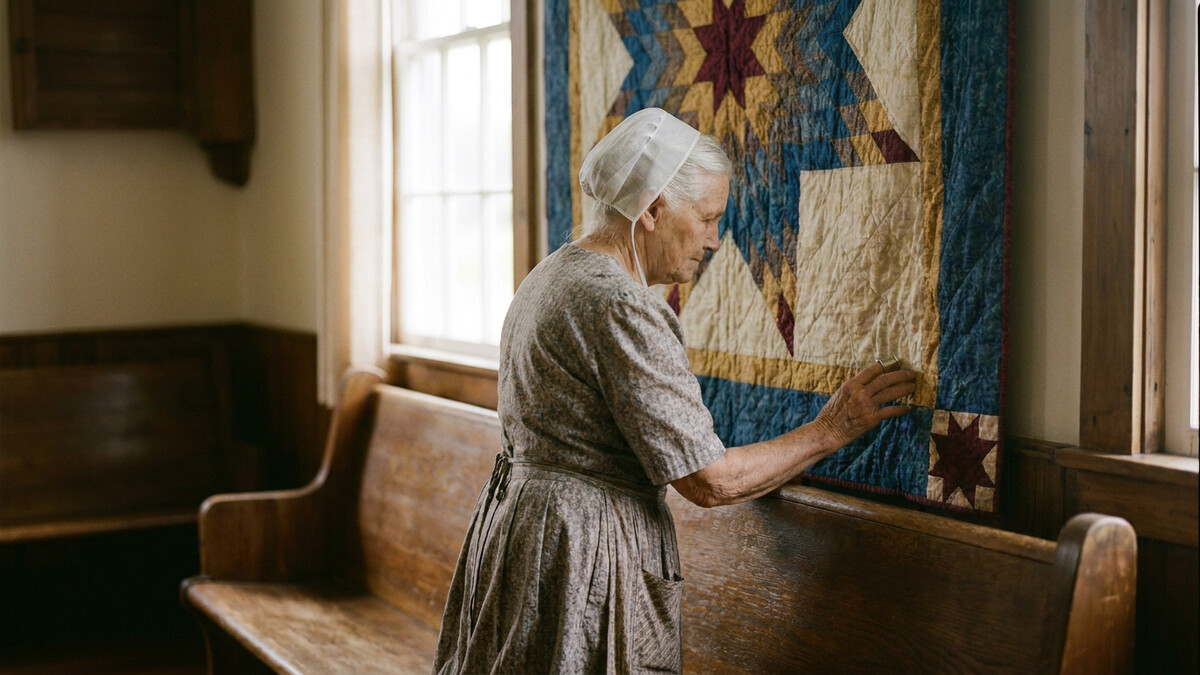
The raffle went on at two o'clock, an hour late. The real Lone Star hung on the wall of the fellowship hall, with its twelve stitches to the inch and its red cross-stitch tucked back under the binding.
The story of the switched quilt had gone around the sale grounds twice by noon. People who had already bought tickets bought more. People who had not bought any bought ten. Lena Brubaker bought fifty, and when she handed Esther the money, she did not say a word, but she squeezed her hand.
The quilt raised twenty-three thousand dollars for disaster relief. The most in the history of the church.
It was won by a young farm wife from Strasburg with three little children, who burst into tears and said she had bought one ticket, with her egg money.
On Tuesday morning, the circle met as usual around the quilt frame in the church basement, to start next year's quilt.
Esther threaded her needle. Then she looked around the frame at the eleven other women, from twenty-six to ninety-one.
"Before we start," she said, "I want to teach you something my mother taught me."
She took a spool of red thread out of her sewing bag and held it up.
"Every one of you," she said, "is going to learn to put your own mark under the binding. So the next time a man in a good wool coat tries to switch our quilt, it won't take an old woman with a seam ripper to catch him."
Lena Brubaker, eighty-two, was the first to hold out her needle.