Rita set down the potato.
She reached up to the shelf above the range, found the box of kitchen matches by feel, and struck one. The flame made a small yellow room in the dark. She turned the knob on the front burner, heard the hiss of gas, and held the match to it.
The burner caught with a soft blue whump.
She lit the other five, one after another. The kitchen filled with blue light and the smell of gas and then the smell of nothing at all, which was how it was supposed to smell.
"Thanksgiving," she called out into the dining room, "is running a little behind."
Somebody laughed. Then a lot of people did.
The first thing she needed was light.
Ray Montoya had a headlamp, and so did half the drivers. The gift shop had a shelf of Christmas candles in jars, cinnamon and pine, and Rita told the college girl to light every one of them and set them on the tables and charge them to Dale.
Then a trucker named Dewey Hatch, from Idaho, stood up and went to the window and looked out at the line of big rigs along the fence.
"Hang on," he said.
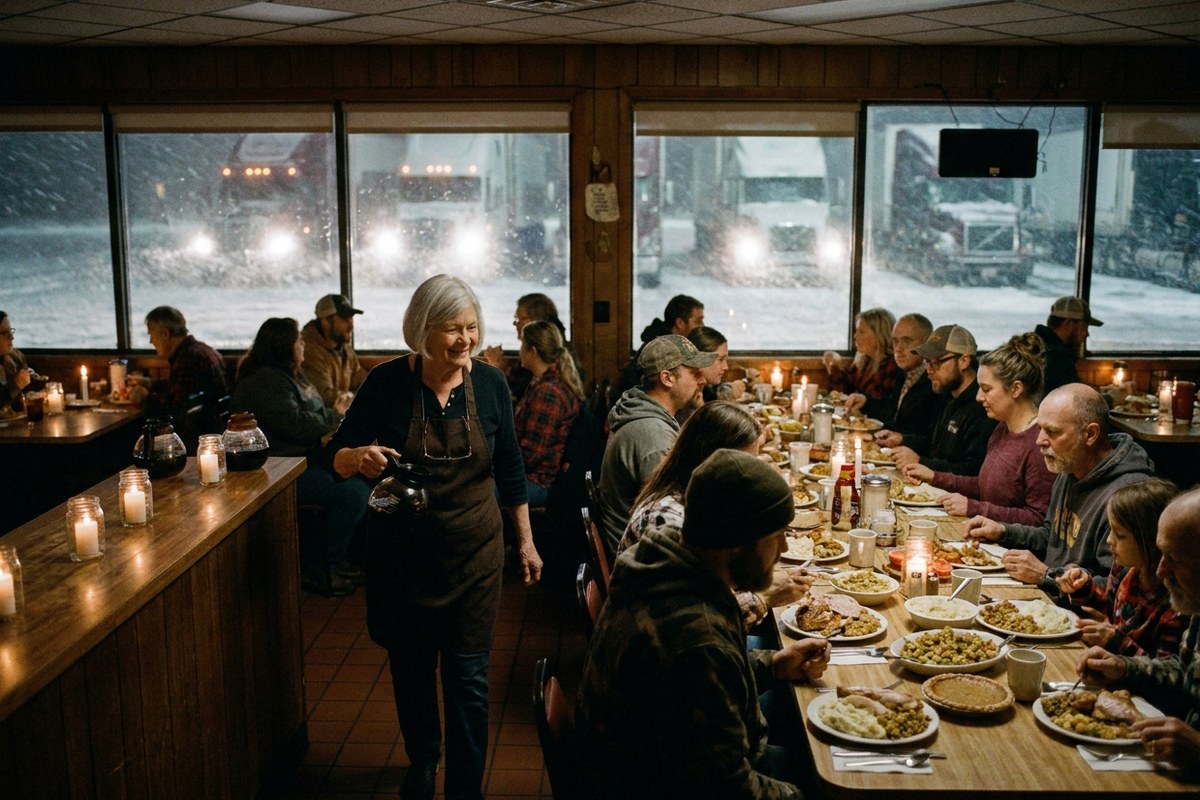
He went out into the wind with his collar up. A minute later, his truck's headlights came on, high beams, shining straight through the front windows of the diner. Then the truck next to it.
Then the next one. Driver after driver went out into the snow and climbed into his cab and turned on his lights, until there were fourteen sets of headlights blazing through the front windows of the Sagebrush Lantern and the dining room was bright as a Friday night football field.
The little girl from Denver stood at the window with her mouth open.
The second thing Rita needed was the turkey.
She pulled it out of the dead oven and set it on the big cutting board under a trucker's headlamp. It was cooked on the outside and nowhere near done inside. If she left it whole, it would take hours more, and she had no oven to give it.
So she did what she'd done in 2003. She took her long boning knife, found the joint between the leg and the body, and cut. Legs.
Thighs. Wings. She split the breast off the bone in two big halves and sliced them thick.
"That's not how my mama did it," said the man in the Broncos jacket, watching from the pass.
"Your mama had electricity," Rita said.
She browned the pieces in the two biggest cast-iron skillets on the front burners. Then she laid them in deep steel pans, poured in chicken stock from the walk-in, covered them with foil, and set them over the back burners at a low simmer.
The potatoes went in the stockpot. The stuffing went in a saucepan with butter and the broth from the pans. The green beans went in a pot with bacon from the breakfast line.
There was no coffee maker, so Rita made cowboy coffee. She filled the big soup pot with water, brought it to a boil, dumped in a pound of grounds, let it steep four minutes, and then poured in a cup of cold water to settle the grounds to the bottom. The old drivers lined up for it like it was 1975.
Every twenty minutes, she checked the turkey with the thermometer. Thighs first.
At 6:20, the dark meat hit 175. At 6:30, the breast hit 165.
Rita turned off the burners, took a breath, and said, "Line up."
They ate by headlight and candlelight, forty-three strangers at pushed-together tables in a truck stop on the high plains.
Rita served the plates herself, the way she'd done for forty-one years. Turkey, potatoes, stuffing, gravy, green beans, and a spoonful of the old couple's cranberry relish, which turned out to be the best thing on the plate.
Ray Montoya's green chile stew went fast after that. The pecan pie was cut into forty-three slivers so thin you could almost read through them, and every plate came back clean.
The young soldier said grace. He kept it short. The truckers liked that.
At some point, Rita realized she hadn't sat down since one o'clock. Dewey Hatch brought her a plate and a cup of cowboy coffee and pointed at a stool at the end of the counter until she sat on it.
The Wyoming Highway Patrol trooper who'd been parked at the gate came in at eight, half frozen, and Rita fed him twice.
The power came back at 2:10 in the morning. Most of the diner was asleep in the booths by then. Rita turned the lights back off so she wouldn't wake them.
At seven the next morning, the wind dropped, and the gates opened.
One by one, the trucks pulled out, flashing their lights at the window as they went. The families packed their cars. The old couple from Cheyenne left a twenty-dollar bill under the cranberry jar with a note that said For the cook.
Wes got there at eight with four pies on the passenger seat. He stood in the kitchen doorway and looked at the cast-iron skillets, the empty pans, the box of matches sitting open on the range.
"You fed all of them," he said. "With no power."
"Forty-four," Rita said. "The trooper ate twice."
On the counter by the register was a drawing on the back of a paper placemat. The little girl from Denver had done it in crayon before she left: a row of big trucks with yellow lines coming out of their headlights, and a small building in the middle full of stick people, and at the window, a woman with gray hair holding up a turkey leg.
Rita taped it to the register, beside the sign that said Open 24 Hours, and went to put the box of matches back on its shelf.