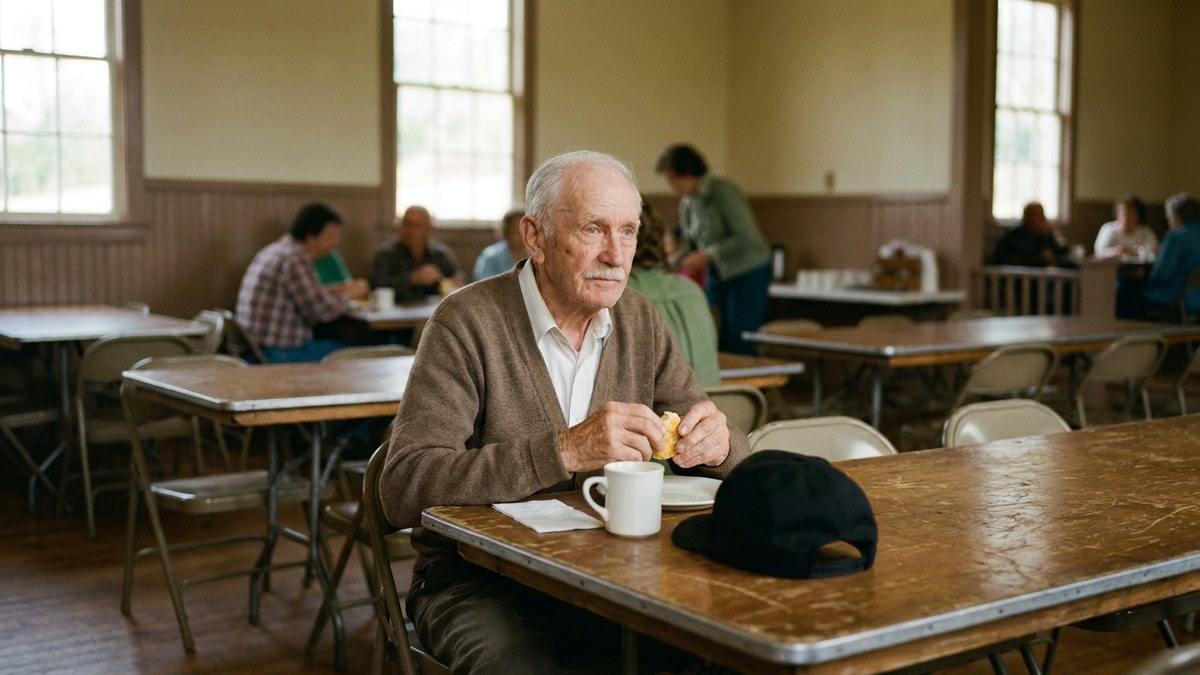
He came every Thursday, ate half a biscuit, and wrapped the other half in a paper napkin to take home.
Leah Dawson noticed it on her second week. She was twenty-two, in her last year of nursing school, and she volunteered at the Thursday Veterans' Breakfast because her clinical hours didn't start until ten. The breakfast ran from seven to nine in the fellowship hall of Sycamore Street Methodist in Millbrook, Tennessee, and it had been running since 1994.
The old man sat at table four, by the window, always the same chair.
His name tag said Harold. The sign-in sheet said Harold Briggs, Army, Korea. Leah had looked at the birth year, 1931, and done the math twice.
Ninety-five.
He wore a brown cardigan over a pressed white shirt and a black ball cap with no patches on it. Most of the men had something on their caps.
A ship, a division, the word Vietnam in yellow and green. Harold's cap was plain.
"Morning, Mr. Briggs," Leah said, and filled his coffee.
"Morning."
"Two eggs and a biscuit?"
"Yes, ma'am. Thank you."
That was most of what he ever said. He ate the eggs slowly.
He split the biscuit with his thumbs, buttered one half, and ate it. Then he folded the other half into a napkin, tucked it into his cardigan pocket, and sat with his coffee until 8:30.
At 8:30 he stood, pushed in his chair, nodded to the room, and left.
The other men talked across him while he was there, the way men talk across a stove. They argued about the Titans and the price of feed and whose grandson had wrecked whose truck. Now and then one of them would ask Harold something small, about the weather or his tomatoes, and he'd answer in four words or less.
The men didn't seem to mind. Leah minded a little. She was the kind of person who wanted to fix things.
By the fourth Thursday, Leah had decided he wasn't eating enough at home.
She'd learned the signs in school. Old men living alone, saving food, losing weight. She talked to Joyce Tidwell, who'd run the breakfast for twenty years and ran it like a mess sergeant.
"Harold?" Joyce said. "Harold's fine, honey."
"He takes half his biscuit home every week."
"I know he does."
"Doesn't that worry you?"
Joyce gave her a look Leah couldn't read. "Not one bit."
Leah didn't let it go. The next Thursday she packed a to-go box with two biscuits, a sausage patty, and a cup of grits, and set it beside his plate when she poured his coffee.
Harold looked at the box. Then he looked at her.
"That's kind of you," he said. "No thank you."
"It's extra. We'd just throw it out."
"Half's plenty, ma'am."
He said it gently. He also didn't touch the box, and when he left at 8:30, it was still sitting there, closed, with the napkin-wrapped half biscuit gone from the table and riding home in his pocket.
Across the room, a man in a Vietnam cap was watching her. Walter Lindell was seventy-eight, a retired TVA lineman with hands like baseball mitts.
He didn't say anything. He just shook his head a little and went back to his eggs.
The Thursday before Veterans Day was the big breakfast.
Joyce hung bunting on the serving window. The high school ROTC brought the colors in. The pastor said a prayer, short, because he knew his audience, and then Joyce read the eras one at a time and asked the men to stand.
"Vietnam."
Fourteen men stood. The room clapped.
"Desert Storm." Three. "Iraq and Afghanistan." Five younger ones, a woman among them.
"Korea," Joyce said.
Harold stood. He was the only one. He stood with his cap in his hand for about two seconds, nodded to the room, and sat down before the clapping had finished.
Leah felt it in her chest. Ninety-five years old, the last Korea man in the room, and he'd sat down like he was embarrassed.
She'd been thinking about it all week. She'd even written a few lines on an index card. Somebody ought to say something about him while he was still here to hear it.
When Joyce finished and asked if anybody had a word, Leah raised her hand before she could talk herself out of it.
"I just wanted to say," Leah said, and her voice came out too loud. "Mr. Briggs, at table four, is ninety-five years old. He served in Korea. And I think it would mean a lot to all of us if he'd tell us a little bit about it. Maybe next week. If he wanted to."
The room went quiet in a way she hadn't heard it go quiet before.
Harold set down his fork.
He put his napkin on the table. He picked up his plain black cap, stood up, and put it on. He pushed in his chair the way he always did.
Then he walked toward the door, an hour early, without looking at anybody.
Leah's face burned. She looked at Joyce. Joyce was looking at the floor.
Harold reached the door and put his hand flat on the push bar.
Behind Leah, a chair scraped.
She turned. Walter Lindell was on his feet at table seven, standing very straight with his cap over his heart. Then a chair scraped at table two, and another at table nine, and the old Navy man with the oxygen tank was pushing himself up on his walker.
One by one, every veteran in the fellowship hall stood up and faced the door, silent, and Leah Dawson had no idea why.