Harold didn't turn around.
He stood with his hand on the push bar for a long moment. Then he nodded once, to the door or to the room, and went out into the cold.
The men sat down. Somebody coughed. Joyce said, "Well, the eggs are getting cold," and the room started up again, slow, like an engine that had been sitting.
Leah went into the kitchen and stood at the big steel sink with the water running and nothing in it.
Walter found her there five minutes later. He took two clean mugs off the rack and filled them from the urn and handed her one.
"I didn't mean anything by it," she said.
"I know you didn't."
"I just thought somebody should say something."
"Somebody did, a long time ago," Walter said. "Sit down a minute."
They sat on two overturned milk crates by the back door, where the cooks took their breaks.
"You ever hear of the Chosin Reservoir?" Walter asked.
"In a history class. Sort of."
"Korea. November 1950. Up in the mountains, so cold the guns froze and the medics kept the morphine in their mouths to keep it from freezing. The Marines get most of the books. But there was an Army outfit on the east side of the reservoir, about three thousand men. The Chinese hit them for four nights straight."
He drank his coffee.
"Harold was nineteen. When it was over, the ones who could still walk went out across the ice. The reservoir was frozen solid, and the Marines were holding a town on the far side. Four miles, maybe, at thirty below."
Leah didn't say anything.
"There was a boy in Harold's company named Ray Hollins. From right here in Millbrook. They'd gone in together. Ray got shot through both legs the last night and couldn't walk. So Harold laid him on a poncho and pulled him across that ice. Four miles. Wouldn't let anybody else take a turn."
"How do you know all this? He doesn't talk."
"Harold doesn't. Ray did." Walter smiled a little. "Ray came to this breakfast every Thursday from 1994 until he passed in 2009. Sat at table four. Told that story about once a month, whether you wanted to hear it or not. Harold would sit right next to him and look out the window like he was hearing about some other fellow."
Leah thought about the plain black cap.
"Out on the ice, they had one cracker between them," Walter said. "From a ration tin. Harold broke it in half and gave Ray one piece and put the other in his pocket. Ray asked him why he didn't eat it. And Harold said, 'Save half. It means you're planning on tomorrow.'"
The coffee had gone cool in her hands.
"Ray said that's the only reason he made it," Walter said. "Not the poncho. The half a cracker. He kept thinking, Harold's saving it for tomorrow, so I guess there's going to be one."
"The biscuit," Leah said.
"Every Thursday since Ray died. Takes half home. I asked him once what he does with it. He said he eats it Friday morning, with his coffee." Walter set his mug on the floor. "That's all. He just eats it on Friday. Because there's a Friday."
"And everybody stands up when he leaves."
"We stood up when he walked in, too. The first Thursday after Ray's funeral, every man in here stood up. He about walked back out. So we quit doing it. Agreed we'd only do it if he ever needed it."
Walter looked at her kindly. "Today he needed it."
Leah put her face in her hands. "I'm an idiot."
"No, ma'am. You're young. Joyce did the same thing in 1996, and she asked him to lead the Pledge."
Walter stood up, knees cracking. "He'll be back next week. He's never missed one."
He was back.
At 7:12 the next Thursday, Harold Briggs came through the door in his brown cardigan and sat at table four by the window, in the same chair.
Leah had been awake since five deciding what to say. She'd written it on an index card and then torn the card up.
She brought the coffee pot and filled his cup. Then she set down a small plate with one biscuit on it. Not a box.
Not two. Just one.
"Mr. Briggs, I owe you an apology," she said. "I'm sorry about last week."
He looked up at her for a long moment. His eyes were very pale blue, and they didn't look ninety-five.
"Walter talks too much," he said.
"Yes, sir."
"Always has. Ray was worse."
Something that might have been a smile moved under his mustache. He picked up the biscuit and split it with his thumbs, the way he always did. He buttered one half and set it on his plate.
Across the room, Joyce Tidwell was refilling the creamer and pretending not to watch. At table seven, Walter Lindell had his back turned on purpose.
Then Harold folded the other half into a paper napkin. But instead of tucking it into his cardigan pocket, he held it out to her.
Leah took it. It was still warm.
"For tomorrow," Harold said, and picked up his coffee.
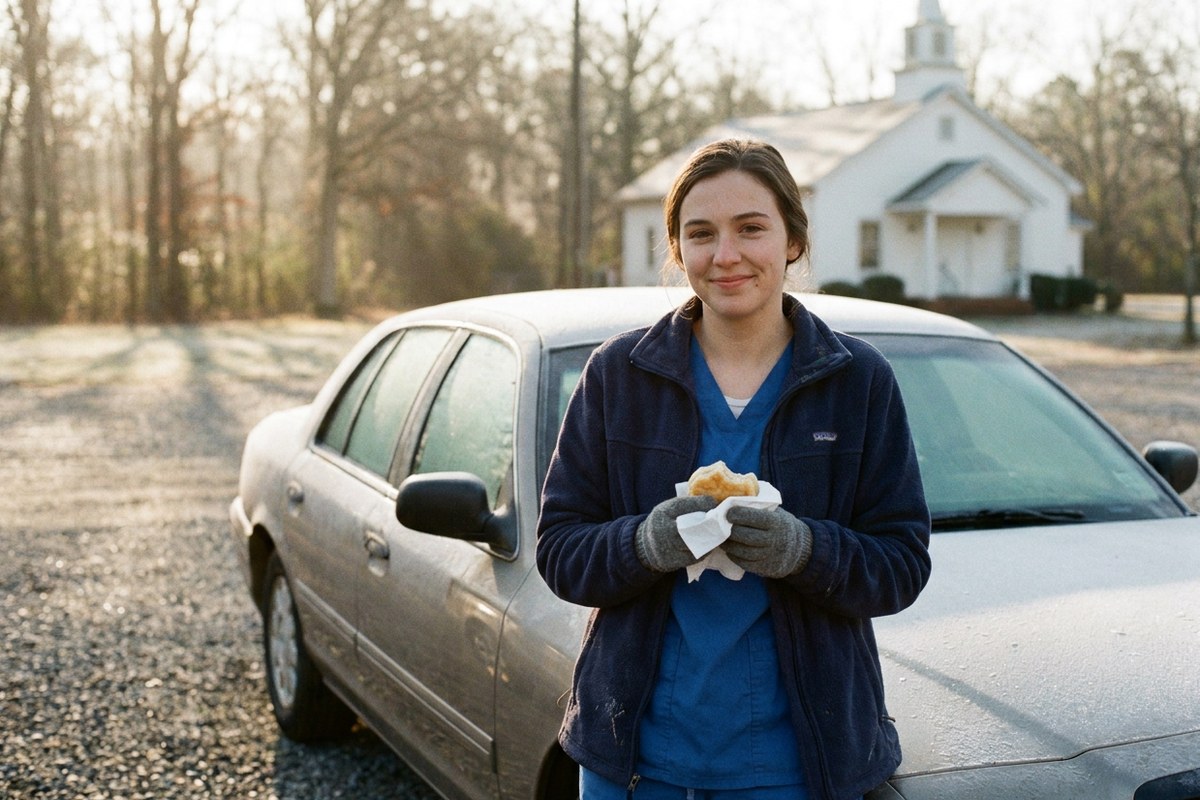
She drove to her clinical shift at ten with the napkin in her coat pocket, and she didn't eat it until Friday.