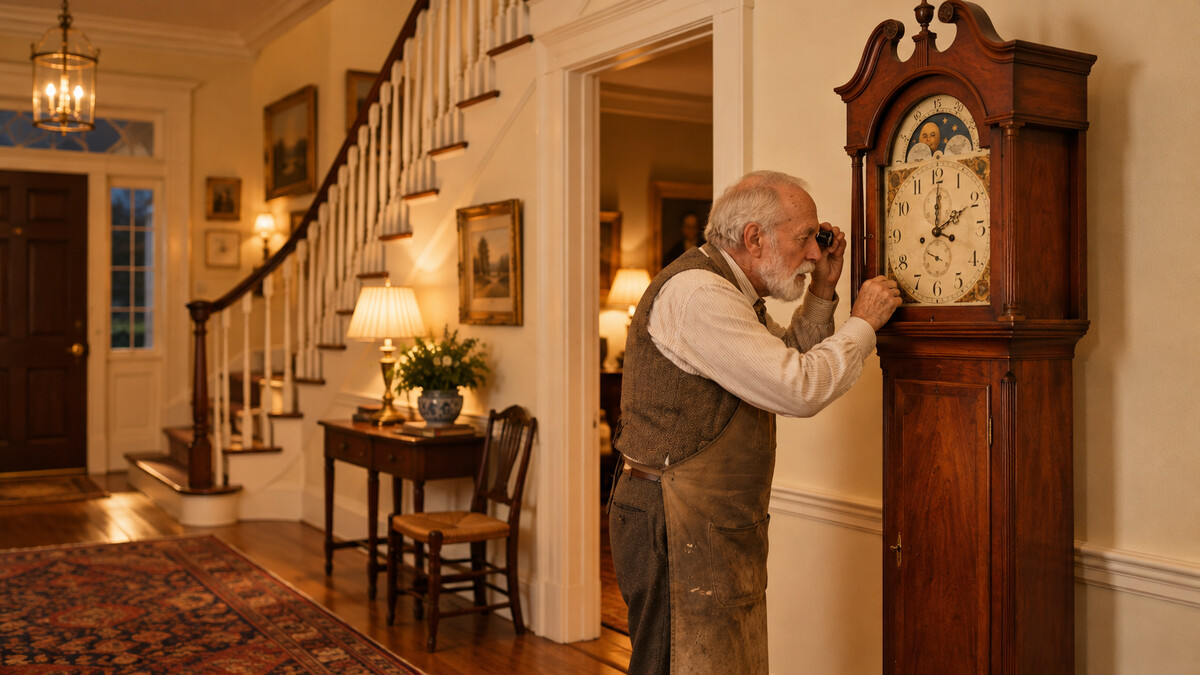
Henrik knelt on the floor of the front hall for a long time with the little wedge of wood in his hand.
Then he took his flashlight and lay down on his side on the floorboards, slowly, because his back was eighty-one years old, and shone the light under the clock.
The tall case clock stood on four small carved feet. The two back feet sat flat on the old pine floor. The right front foot sat flat too.
The left front foot did not. There was a gap under it. Thin. No thicker than a pencil.
Henrik slid the wedge into the gap.
It fit exactly.
He stood up, using the staircase banister, and opened the hood, and started the pendulum again. He set the hands to two-eleven by his watch.
Tick. Tock. Tick. Tock.
Beneath the floor, the old furnace roared on. The floorboards still trembled, very faintly.
The clock did not.
It ran until morning.
Nora came down the stairs at seven in her bathrobe and found him asleep in her sister's wing chair, with the quilt around him and his flashlight in his lap.
The clock was running. The hands said seven-oh-two.
She stood on the bottom stair and stared at it.
Henrik woke up when she gasped.
"It's running," she said. "It didn't stop."
"No," Henrik said. He sat up and rubbed his face. "Mrs. Bishop. Did you have the floors in this house refinished before you moved in?"
Nora looked at him.
"Yes," she said slowly. "In September. The movers had to take everything out of the front hall. Including the clock. They put it back where it was."
"Almost where it was," Henrik said.
He held up the little wedge of wood and showed her the pencil writing.
He explained it at the kitchen table, over coffee.
The old pine floor in the front hall was not level. Old floors never were. It sagged a little toward the staircase, after two hundred years. And under the front hall, in the basement, was the furnace.
"Every time the furnace comes on," Henrik said, "the floor shakes a little. Not enough for you to notice. But a tall clock is very sensitive. Seven feet tall, with a heavy pendulum. If it is not standing perfectly level, perfectly steady, a little shake will knock it out of beat, and it stops."
"So Constance put a shim under the foot."
"In 1994," Henrik said. "The year I started servicing it." He turned the wedge over in his fingers. "I never noticed it. Not in thirty years. She must have done it herself, before I ever came. And it stayed there. Until the movers lifted the clock for your floors, and it fell inside the case."
Nora was quiet for a while.
"But why two-ten?" she said. "Why does the furnace come on at two-ten?"
Henrik smiled a little.
"Go look at your thermostat," he said.
The thermostat was on the wall in the dining room. An old round one, with a little clock dial and a set of tiny pins you could move to set the times the heat came on and went off.
Nora put on her reading glasses and looked at it for a long time.
The heat went off at nine o'clock at night. And it came back on at two-ten in the morning.
"Two-ten," she said.
"Your sister got up at two-twenty every morning of her life," Henrik said gently. "For forty-one years. She left this house at two-forty-five and walked across the green and unlocked the bakery at three o'clock." He paused. "She told me once that she set the furnace to come on ten minutes before she woke up. So the kitchen would be warm when she came down. So she would not have to get out of bed in the cold."
Nora stood in the dining room in her bathrobe and looked at the little round dial for a long time.
Then she began to cry.
"I didn't know any of that," she said at the kitchen table, when she could talk again. "I didn't know she got up at two-twenty. I didn't know she walked to the bakery in the dark. I didn't know anything about her life. Not really." She wiped her eyes. "I lived in Arizona for forty years. I came home for Thanksgiving every other year. We talked on the phone on Sundays. About the weather."
Henrik did not say anything.
"I thought it was her," Nora said. "Stopping the clock. Every night. I thought she was angry with me. For not coming home more." She shook her head. "And it was just the furnace. Warming up the kitchen. For a woman who isn't here anymore."
"It wasn't just the furnace," Henrik said quietly.
Nora looked at him.
"She kept this house running for forty-one years," Henrik said. "Every little thing. The shim under the clock. The pins in the thermostat. The ovens at the bakery at three a.m. She was a woman who took care of things." He looked down at his coffee. "She took care of a great many people, Mrs. Bishop. She never once let me pay for a loaf of bread. In thirty years."
Nora looked at him across the kitchen table for a long time.
She was a chemistry teacher. She noticed things.
"You were sweet on her," she said.
Henrik Sauer, eighty-one years old, turned a deep and remarkable shade of red.
"I never told her," he said. "I was always going to. Next spring, I would think. When I come to oil the clock. And then I would come, and she would bring me rye bread, and we would talk, and I would lose my nerve." He shook his head. "Thirty springs. I am a coward, Mrs. Bishop."
"No," Nora said. "You're a clockmaker. You thought you had time."
Henrik did not change the thermostat. Nora asked him not to.
He changed the shim instead. He made a new one in his shop, from a piece of old cherry wood that matched the clock, and fitted it under the left front foot so it would never fall out again. And he kept the old one.
He gave it to Nora, with Constance's pencil writing on it. She put it on the mantel in the parlor, in a little glass dish.
The furnace in the old Bishop house still comes on every night at two-ten.
And the clock in the front hall does not stop anymore.
But Nora Bishop does not always sleep through it. Some nights, she hears the whump of the furnace beneath the floor, and she lies awake in her sister's house and listens to the old clock ticking, and thinks about a woman walking across the green in the dark at two-forty-five, to make bread for a whole town.
In January, she started getting up.
Not every night. Just on Saturdays. At two-twenty, when the kitchen was warm.
She had found Constance's recipe box in the pantry. Rye bread. Sticky buns. Forty-one years of notes in the margins in a small, neat hand.
On the first Saturday in February, at seven in the morning, Henrik Sauer's shop bell rang.
Nora Bishop stood in the doorway with a paper bag in her arms, still warm.
"Rye," she said. "Her recipe. My first try." She held it out. "I'm told you never paid."
Henrik took the bag. He looked down at it for a long moment.
"Mrs. Bishop," he said. "Would you like a cup of coffee?"
"Nora," she said. "And yes."