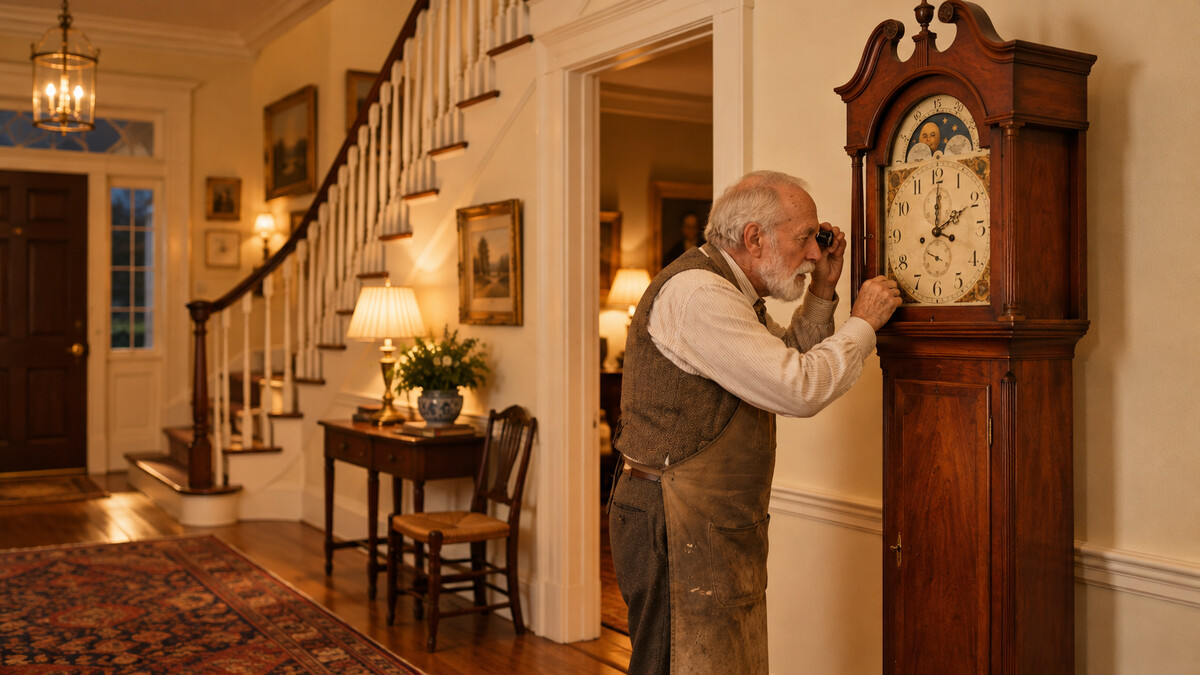
For eleven nights in a row, the tall case clock in the front hall of the old Bishop house in Millbrook Landing, Connecticut, stopped at exactly ten minutes past two in the morning, and on the twelfth day, Nora Bishop called the only clockmaker left in the county and told him she thought her dead sister was doing it.
Henrik Sauer listened to her on the phone without interrupting.
"Mrs. Bishop," he said, when she had finished. "I knew your sister for thirty years. I serviced that clock every spring since 1994." He paused. "Constance would never in her life have stopped a clock. She would have been much too annoyed."
Nora laughed in spite of herself. It was the first time she had laughed in a month.
"Then what is it?" she said.
"I don't know," Henrik said. "Yet. I'll come tomorrow."
Henrik was eighty-one. He had come to America from Denmark in 1962, at seventeen, to apprentice with an old clockmaker in Hartford. He had opened his own shop on Main Street in Millbrook Landing in 1978, a narrow room full of ticking, with a bell over the door. He had fixed every clock in that end of the Connecticut River valley for forty-eight years.
He did not believe in ghosts. He believed in gears.
But he had liked Constance Bishop very much. More than he had ever told her.
Constance had run the Millbrook Bakery on the green for forty-one years. She had never married. She had lived alone in the big white Federal house on Elm Street that had been in the Bishop family since 1791, with the tall case clock in the front hall that a Connecticut clockmaker had built for her great-great-great-grandfather.
Every morning at three o'clock, for forty-one years, she had unlocked the bakery and turned on the ovens. By six, the whole green smelled of bread. People drove in from three towns for her rye and her sticky buns.
And every spring, when Henrik came to clean and oil the old clock, she had brought him a loaf of rye bread and a cup of coffee and stood in the front hall and talked to him while he worked. About nothing much.
He had looked forward to it all year.
She had died in August, of a stroke, in her kitchen, at seventy-four. She had left the house to her younger sister, Nora, who had lived in Arizona for forty years.
Nora met him at the front door the next morning. She was sixty-nine, small and tired, with her sister's sharp gray eyes.
"I'm sorry," she said. "I know it sounds foolish. A ghost. I'm not a foolish woman. I taught high school chemistry for thirty-three years." She led him into the front hall. "But I moved in three weeks ago. And every night since, it stops at two-ten. Exactly. I wind it. I start it. I set the time. It runs perfectly all day. And every morning, I come down, and it's stopped. Two-ten."
Henrik looked at the clock.
It stood against the wall at the foot of the staircase. Seven and a half feet tall. Cherry wood, dark with two hundred years. A painted moon dial at the top, with a smiling moon. Brass weights hanging behind a little glass window in the long trunk door. A brass pendulum, swinging slowly.
Tick. Tock. Tick. Tock.
"It's running now," he said.
"It always runs in the daytime," Nora said.
He spent the morning on it.
He opened the hood and looked at the movement with his loupe. He checked the escapement, the pallets, the teeth of the escape wheel. He checked the weights and the cables and the pulleys. He let the pendulum swing and listened to the beat with his head tilted, the way he had listened to clocks for sixty-four years.
Tick. Tock. Even. Steady.
Everything was perfect.
"Mrs. Bishop," he said finally. "There is nothing wrong with this clock."
"Then why does it stop?"
Henrik closed the hood. He was quiet for a while.
"A clock that runs in the day and stops at night," he said slowly, "is not a clock problem. It is a house problem. Something in this house happens at two-ten in the morning." He looked at her. "May I stay tonight? In the front hall? I would like to listen."
Nora looked at him in surprise.
"You'd sit up all night?"
"I'm eighty-one," Henrik said. "I don't sleep much anyway."
He came back at ten o'clock that night with a thermos of coffee, a flashlight, and a folding stool from his shop.
Nora brought down a quilt and a pillow and set up her sister's old wing chair in the front hall, facing the clock. She made him a ham sandwich. She sat with him for an hour and they talked about Constance. Then she went up to bed.
Henrik turned off the lights.
He sat in the wing chair in the dark with the quilt over his knees and listened.
Tick. Tock. Tick. Tock.
The old house creaked. The wind moved in the elm trees on the street. At midnight, the clock struck twelve, slow and deep, and Henrik counted every stroke.
At one, the clock struck once.
He poured himself more coffee.
At two o'clock, the clock struck twice.
Henrik sat forward in the wing chair.
At two-oh-five, nothing.
At two-oh-eight, nothing.
At two-oh-nine, from somewhere deep below the floor, in the basement, he heard a click. Then a low, rumbling whump, like a big animal turning over in its sleep.
He felt it through the soles of his feet. A faint shudder in the old wide floorboards of the front hall.
It was the furnace. An old oil furnace, coming on.
Henrik held his breath and watched the pendulum in the flashlight beam.
It swung. Tick. It swung back. Tock.
Then, as the furnace settled into its long, low roar beneath the floor, the floorboards trembled, very slightly, and the tall case clock rocked on its feet. Not much. A sixteenth of an inch. Less.
The pendulum swung, and caught, and hesitated.
Tick.
And stopped.
Henrik looked at his watch in the flashlight.
Two-ten.
He sat in the dark for a moment with his heart going.
Then he got up, slowly, and knelt on the floor in front of the clock with his flashlight, and opened the long trunk door at the bottom.
He shone the light down into the base of the case. Behind the hanging weights. Into the dark wooden box at the very bottom of the clock, where clockmakers never bothered to look, because there was never anything there but dust.
There was something there.
A small, thin wedge of wood. Old and worn smooth. About three inches long. Lying in the dust in the corner of the case, where it must have fallen.
Henrik picked it up.
He turned it over in the flashlight beam.
On one side, in faded pencil, in a small, neat, familiar hand that he had seen on a thousand bakery receipts, there were three words and a date.
Left front foot. C.B. 1994.