Part 2
Lydia's heart went cold in her chest.
So that was how it would end. Ezra Coyle would stand at the counter and swear she had gone east every winter, and Walt would file on her quarter at one minute past noon, and seven years would be gone as if she had never driven a single stake.
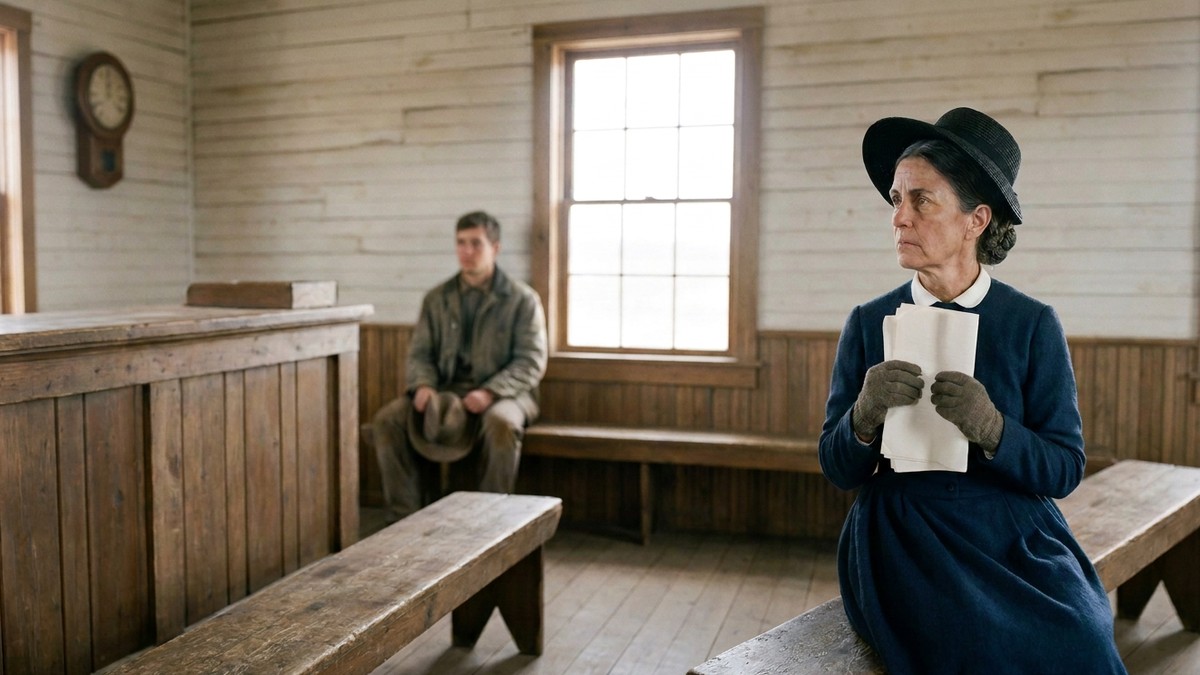
She stood up. She would not sit for it.
"Name?" said the clerk.
"Ezra Coyle. Beadle County. Section adjoining." He did not look at her. "I've known Miss Fenn since May of 1881. I'll swear for her."
The room was very still.
"Pa," said Walt, from the bench.
Ezra Coyle did not turn around.
"I'll swear she built a sod house that first summer and a frame shanty in '84," he said to the clerk. "I'll swear she's lived in it winter and summer, every year, for seven years, because I've looked at her stovepipe smoking every morning of my life since. I'll swear she broke forty acres and cropped it every season."
The clerk dipped his pen.
"Can you give particulars, Mr. Coyle? Crops and years?"
Ezra Coyle unfolded the papers in his big hand and laid them on the counter, one by one, smoothing each one flat.
Lydia knew them before she could read them. Lined school paper. Her own copperplate hand.
"Sod corn, 1882," Ezra read aloud. "Two acres, trampled. Four dollars. Flax, 1883, an acre and a half. Six dollars. Oats, 1885. Wheat, 1886, what there was of it. Wheat, 1887." He looked up. "She billed me for my steers every year. I kept every bill. There's your particulars. You can't trample a crop that isn't there."
The clerk looked at the bills. Then he looked at Ezra Coyle, and then at Lydia, and his mouth twitched at one corner.
"That's one witness," he said. "The law wants two. It's eight minutes to twelve."
Ezra Coyle turned around for the first time.
He looked at his son on the bench. Walt sat with the filing paper crumpled in his fist and his face red to the ears.
"Walt," said Ezra.
"Pa, you said..."
"I know what I said. I said it for seven years." Ezra's voice was quiet. "I said she wouldn't last a winter. I said it to every man at the elevator. I let them say worse and I didn't stop them." He drew a breath. "You herded those steers, son. Every year. You know what they ate. You know where she was. Come up here and tell the man."
Walt did not move.
"I wanted that quarter for you," Ezra said. "I'm not sorry I wanted it. But she beat us to it fair, and she stuck it out, and I'll not have my son take a woman's land on a lie. Your mother wouldn't have it either. Come up here, Walt."
The clock ticked. Five minutes to twelve.
Walt Coyle stood up. He crossed the floor of the land office in four long steps and put the crumpled filing paper in his pocket.
"Walter Coyle," he said to the clerk, hoarsely. "Same section as my father. I'll swear to all of it."
They signed at two minutes to noon.
Lydia paid her fee, six dollars, out of a little leather purse. The clerk wrote out her final certificate and blotted it and stamped it and slid it across the counter to her.
She picked it up. Her hands were steady, which surprised her. She read it once, every word, the way she had read the law seven years ago. Her own name, in a clerk's round hand. One hundred and sixty acres, Beadle County, Dakota Territory. Hers.
Then she turned to Ezra Coyle.
"Why?" she said.
He looked at the floor of the land office, and turned his hat once in his big hands.
"A man can fight his neighbor seven years," he said, "and still swear true about her. Else what's the use of swearing?" He put his hat on. "And last January, in the blizzard, you sat up three nights with my boy Walt when his lungs went bad. You walked the half mile in it. I never said thank you for that, either."
Walt went out first, to bring the wagons around. He held her team's heads while she climbed up.
They drove home together, the two wagons side by side on the long road north from Huron, with the green prairie rolling away on both sides under the wind.
Nobody said much. Somewhere past the county line, Ezra Coyle reached into his Sunday coat and brought out his purse and counted something into his hand, and leaned across the gap between the wagons, and held it out to her.
"Four dollars," he said. "Six. Five. Three, I think, for '86. And seven." He tipped it into her palm. "Twenty-five dollars. Five years of damages. I'll fence my steers this summer."
Lydia looked at the money.
"You kept the bills," she said. "All this time. Why did you keep them, if you never meant to pay?"
Ezra Coyle almost smiled. It was the first time she had ever seen him do it.
"Never could throw away a thing written that neat," he said.
He clucked to his team. His wagon pulled ahead of hers on the prairie road. Lydia sat with the certificate in her lap and the money in her hand, and watched him go, and laughed out loud, all by herself, in the wind.