Part 1
To prove up her homestead, Lydia Fenn needed two witnesses to swear she had lived there five years, and by May 1888 she had none.
It was spring in Beadle County, Dakota Territory, and the prairie around her claim was greening up in long low swells under a wide wind. Lydia was fifty-six. She had taught school in Vermont for thirty years, and buried her parents, and found herself at fifty with no husband, no house, and a small savings account. So she had come west and filed on a quarter section of government land.
That was in May 1881. People had laughed.
The law was simple, and she had read every word of it.
Any person twenty-one years old, or the head of a family, could claim a hundred and sixty acres. Live on it five years, build a home, break and farm the ground, and it was yours. Then you went to the land office with two witnesses who would swear they had seen you do it, paid your fee, and got your final certificate.
You had five years to live on the land. And then only two more to prove it. After seven years, if you had not proved up, the claim was cancelled, as if you had never been.
Lydia had filed on the sixteenth of May, 1881.
Seven years ran out on the fifteenth of May, 1888.
She had meant to prove up two years ago. But the fees were money, and the crops had failed in '86, and then last January the great blizzard had come, and she had spent the spring nursing half the township through the after-effects. She had put it off and put it off.
Now it was the eighth of May. And her witnesses had both backed out.
The Reverend Ward came to tell her himself. He stood in the door of her claim shanty and could not look her in the eye.
"There's been talk, Miss Fenn," he said. "That you're not really a homesteader. That you're holding the claim for your nephew's land company in Minneapolis. That you go back east every winter."
"I have not been east of the Big Sioux River in seven years."
"I know. I know." He turned his hat around. "But if I swear for you and someone contests it, my congregation..." He stopped. "Mr. Sayre feels the same."
He went away. Lydia sat down on her one chair and looked out the door at the long green rise of land toward the east.
There, a half mile off, was Ezra Coyle's farm.
She and Ezra Coyle had been at war since the first day.
He had wanted her quarter. Everyone knew it. He had wanted it for his son, Walt, who had been twenty that spring of 1881, one year too young to file. Coyle had meant to hold it for him with a plowed furrow and a cattle herd until the boy turned twenty-one. Then a schoolmarm from Vermont had walked into the land office at Huron and filed on it first.
Coyle had said, to anyone who would listen, that she would not last one winter.
She had lasted seven.
And every single year, his cattle had got into her crops. Every year she had marched across the half mile to his door with a bill for the damages, written out neatly on lined school paper in her best copperplate hand. Sod corn, two acres trampled, 1882, four dollars. Flax, 1883, one acre and a half, six dollars. Oats, 1885. Wheat, 1887.
He had never paid one. He had taken each bill from her hand, read it, said nothing, and closed the door.
The talk about her nephew's land company, Lydia felt quite sure, had started at that door.
She went to Huron anyway.
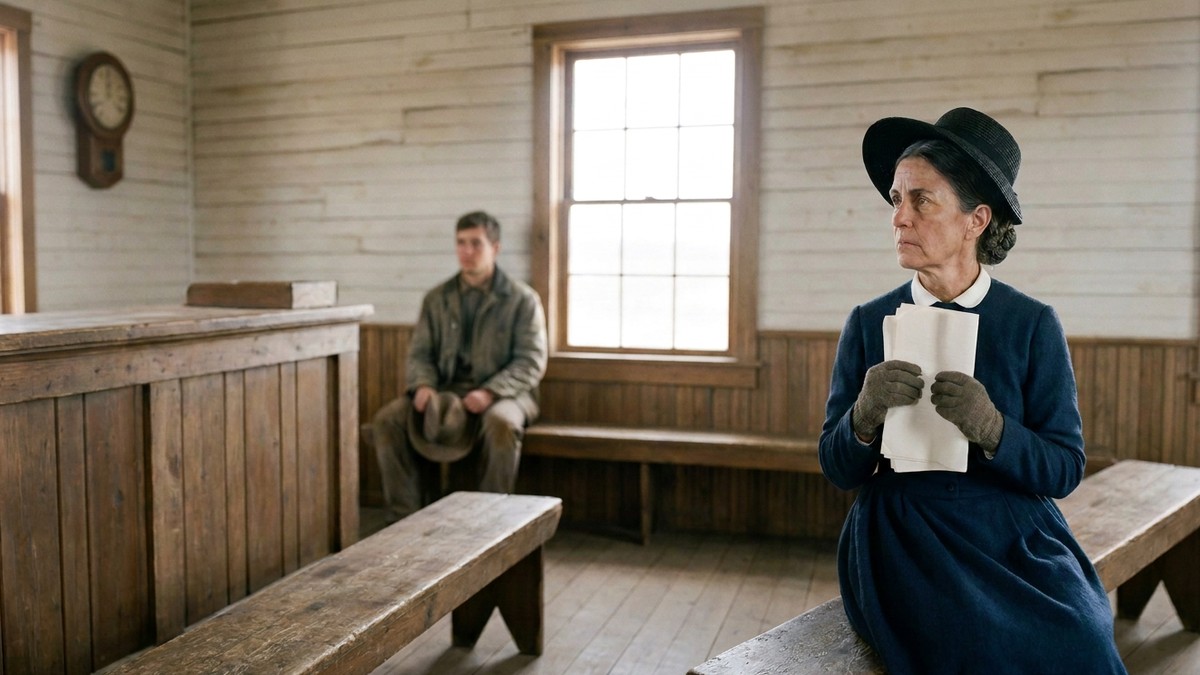
There was nothing else to do. She drove the thirty miles in her old spring wagon on the fourteenth and slept in the wagon behind the land office, and at nine o'clock on the morning of the fifteenth of May, she was standing at the counter.
The clerk was a young man with sleeve garters. He looked at her papers. He looked at the clock.
"Final proof, Miss Fenn? Seven years to the day." He raised his eyebrows. "That's cutting it close. And your witnesses?"
"They are delayed," Lydia said.
"The register closes the books at noon, ma'am. If you can't make proof today, your seven years are up. He'll cancel the entry, and somebody else can file on that quarter." He looked past her at the door. "And I believe somebody means to."
Lydia turned.
A young man was sitting on the bench by the land office door, with his hat on his knees and a filing paper in his hand. Broad, sunburned, about twenty-seven.
It was Walt Coyle.
She sat down on the other end of the bench. She did not look at him. He did not look at her.
The clock on the wall said ten. Then half past. Then eleven.
At ten minutes to twelve, the door of the land office opened, and Ezra Coyle walked in.
He was sixty-two, big and gray and slow, in his Sunday coat, with his hat in one hand and something folded in the other. He looked at his son on the bench. He looked at the clock.
Then he looked at Lydia Fenn, and walked straight up to the clerk's counter, and laid his hand flat on it.
"I've come about the Fenn claim," he said.