Travis Kellum stood up first.
He didn't make a speech. He was too smart for that. He just asked the man with the laptop to play the video, and the man did, on a screen at the front of the room.
Nine seconds. The slide. The dust.
Cooper's foot on the plate. The catcher's glove nowhere in sight.
The man played it three times. Each time, a murmur went through the room.
"I like Chet," Travis said, when the video was done. "I want that on the record. I grew up with him behind the plate. He called my games when I was ten." He spread his hands. "But these kids worked all season. They deserve to have the call right. And at a certain point, a man has to admit he can't see like he used to." He sat down. "That's all I've got to say."
A few people clapped.
The league president looked toward the back row. "Chet? Would you like to respond?"
Chet stood up slowly. His knees cracked. He held on to the back of the chair in front of him.
"I don't have a video," he said. "I just had a pair of eyes, three feet from home plate. I saw the glove come down on that boy's hip, and then I saw his foot touch the plate." He looked at the screen. "That camera was forty feet away, behind the runner. I was three feet away, in front of him. That's all I can tell you."
He sat back down.
The president waited a moment. "All right," she said quietly. "If there's no other discussion, we'll vote."
"Wait."
It came from the front row. A small voice, not loud.
Cooper Kellum was standing up.
The whole room turned. Travis looked at his son in surprise. "Coop. Sit down, buddy."
Cooper didn't sit down. He was twelve, small for a shortstop, with a sunburned nose and his father's eyes.
His hands were shaking at his sides. He looked at the board table, and then at the back row, at the old man in the good shirt.
"I was out," Cooper said.
The room went dead silent.
"I felt the tag," the boy said. His voice cracked. "On my hip. Right here." He touched his left hip. "Before my foot got to the plate. I felt Jamal's glove. I knew I was out when I was still sliding." He swallowed hard. "I knew it the whole time. Mr. Dawes was right."
Travis Kellum stared at his son. His face had gone gray.
"Coop," he said. "Why didn't you say something?"
"Because you were so mad," Cooper whispered. "And then the video was on the internet, and all those people were saying mean things about Mr. Dawes, and I didn't know how to make it stop." Tears were running down his face now. "But Mr. Dawes taught us. At the clinic, when I was eight. He said, the call is the call, and the truth is the truth, and a ballplayer always knows which one he was." He wiped his nose on his wrist. "I knew. I'm sorry, Dad."
The room was so quiet you could hear the coffee urn ticking in the back.
Then a chair scraped near the side wall.
An old Black woman in a church hat was standing up, holding a large pink phone in both hands. She was about seventy-five. Chet knew her.
Odessa Grier, the Hornets catcher's grandmother. She'd been coming to her grandson's games for six years, always in the same folding chair, directly behind the backstop.
"I've got a video too," she said. "Didn't think anybody would want it. My grandbaby lost." She held up the pink phone. "But I was sitting right behind home plate. I tape every one of Jamal's games. His mama's in the Army, in Germany, and she likes to watch."
The league president stared at her. "Mrs. Grier, would you mind?"
They played it on the laptop.
It was from directly behind the plate, through the chain link of the backstop, steady as a tripod. You could see the whole thing. Cooper racing down the line.
Jamal grabbing the ball and diving. And Jamal's glove coming down across the boy's left hip, clear as day, a full step before Cooper's foot touched the plate.
And right there, on one knee, three feet away, with his mask on and his eyes wide open, an eighty-two-year-old umpire throwing up his right fist.
They played it three times.
Then someone in the room started to clap. Then another. Then the whole room.
Travis Kellum stood up. He didn't say anything at first. He walked down the aisle between the folding chairs, past a room full of his neighbors, to the back row.
Chet stood up to meet him.
"Chet," Travis said. His voice was rough. "I'm ashamed of myself. I want the motion withdrawn. And I want to say, in front of this whole room, that I was wrong. And my boy was right. And you were right." He held out his hand. "I'm sorry."
Chet took it.
"You raised a fine son, Travis," he said. "That took more nerve tonight than anything I did."
Travis looked back at Cooper, still standing in the front row with his face red and wet. He nodded. He couldn't say anything else.
The motion was withdrawn. The meeting was over in four minutes.
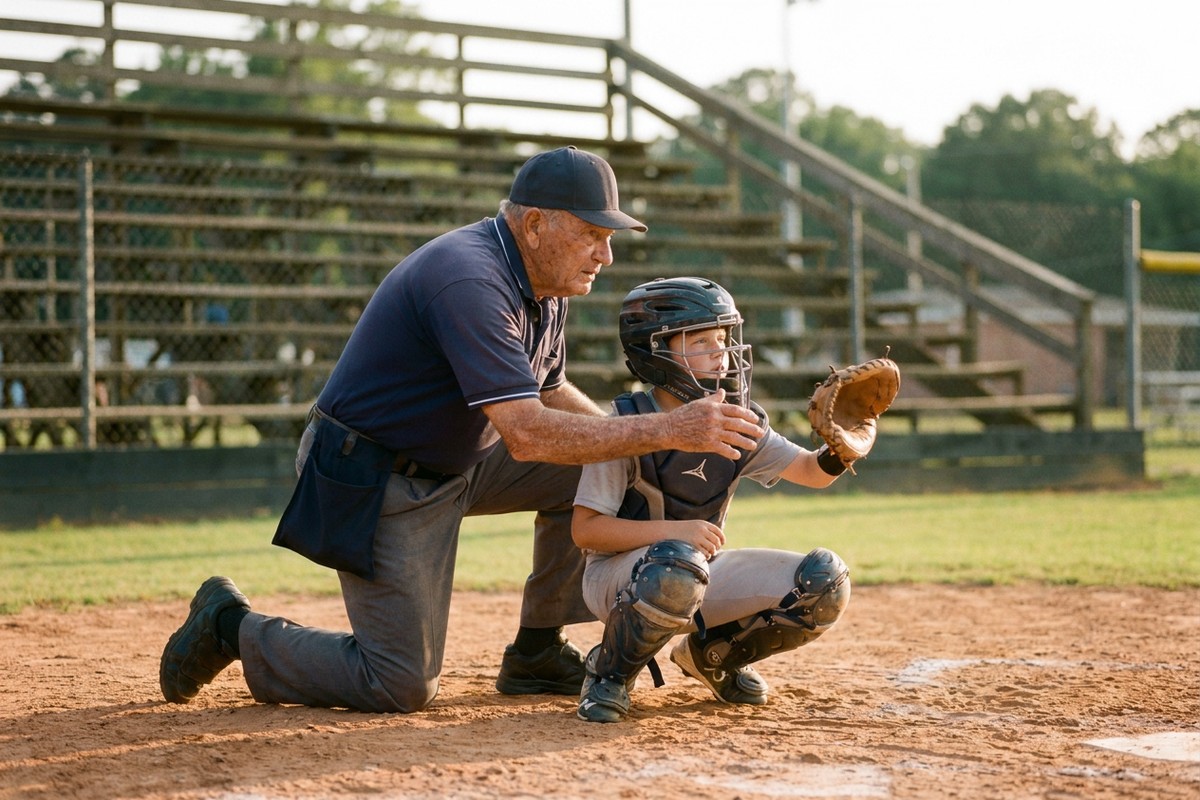
The next spring, Chet Dawes ran the Pine Ridge Little League umpire clinic, for the forty-ninth time. He'd asked for a helper.
His helper was twelve, small for a shortstop, with a sunburned nose. He'd been to every session.
He'd learned the rule book cover to cover. He could explain the infield fly rule better than half the coaches in the county.
On the last evening of the clinic, the field was empty and the sun was going down orange over the pines. Chet stood behind home plate with an old catcher's mask in his hands. He held it out to the boy.
"Chin strap first," he said. "Then you pull it down. Snug, but not so tight you can't turn your head. You've got to be able to see everything."
Cooper put on the mask. It was too big for him. Chet tightened the straps.
"Now get down," Chet said. "On one knee. Right behind the plate. Closer. Closer than that. Close enough to see the glove."
Cooper got down. Chet crouched beside him, slowly, on his own bad knees, in the red dust.
"What do you see?" Chet asked.
The boy looked out through the bars of the mask at the empty diamond in the evening light.
"Everything," Cooper said.
"That's right," said Chet. "Now call what you see. Every time. No matter who's hollering."