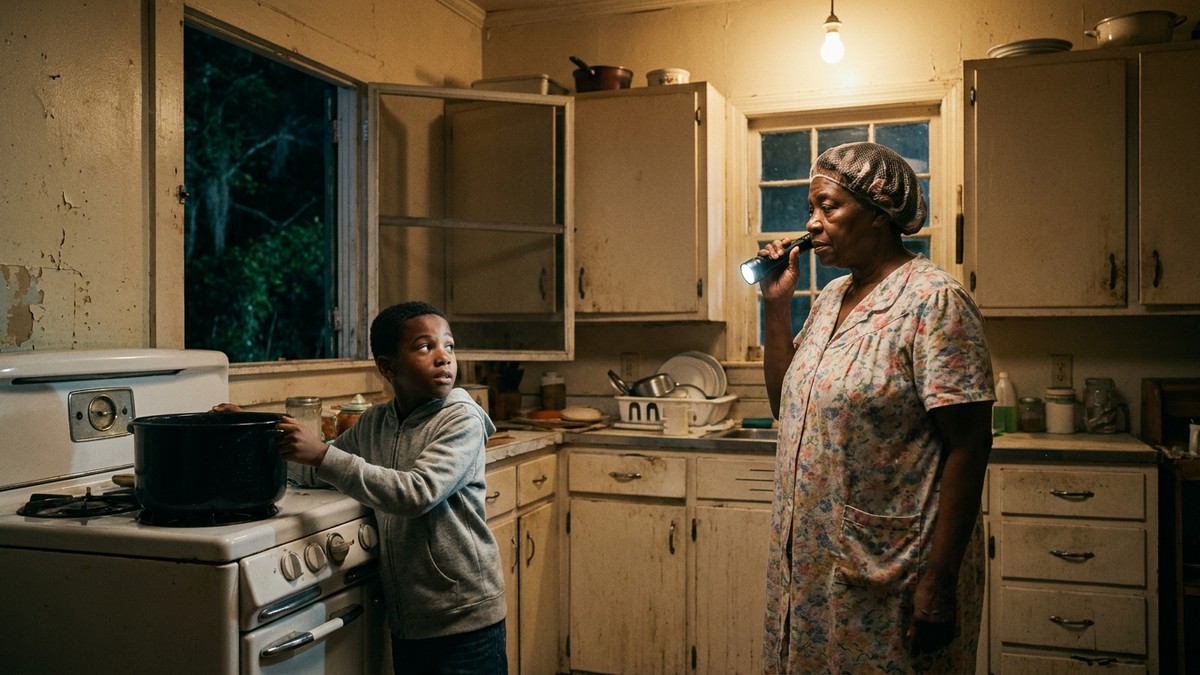
The boy in Ophie Batiste's kitchen had broken in through the window over the sink, and he was eating cold gumbo out of the pot with his hands.
Ophie stood in the kitchen doorway in her housecoat and her hair net and her house slippers, with her late husband's old flashlight in one hand, and watched him do it.
He hadn't heard her. He was too busy eating. He was standing at the stove with his back to her, bent over the big black pot she'd left on the burner to cool overnight, scooping gumbo into his mouth with his bare fingers as fast as he could swallow.
Shrimp and sausage and okra. Rice.
He wasn't even chewing. He was eating the way Ophie had seen only one other kind of creature eat in her life, a stray dog that hadn't had a meal in a week.
It was 3:10 in the morning.
Ophie clicked on the flashlight.
She was eighty-one years old. She'd run the cafeteria at St. Jules Elementary School, in St. Jules, Louisiana, for thirty-two years.
She'd fed the children of that town for three decades, from 1971 to 2003. She knew exactly what hunger looked like on a child's face.
She'd lived alone in the little green house on Bayou Street since her husband, Lucien, died in 2015. She had two daughters, one in Houston and one in Baton Rouge, who called every Sunday and worried about her living alone. She told them not to.
She'd never once been afraid in that house.
She wasn't afraid now, exactly. Her heart was going. But she wasn't afraid.
The boy spun around at the light. He was holding the gumbo pot against his chest with both arms, like somebody was going to take it.
His mouth was full. There was gumbo on his chin and down the front of a filthy gray T-shirt.
He was fifteen, maybe. Tall, but thin as a broom handle. His jeans were torn.
His sneakers had no laces. His eyes, in the flashlight beam, were wide and terrified.
Ophie knew him.
She didn't know his name, not right away. But she knew his face. She'd seen it on a piece of paper taped to the window of the Dollar General three weeks ago, and in the church bulletin at St. Jules Catholic, and on the news out of Lafayette.
Missing. Fifteen years old. Last seen at St. Jules High School on September 2.
Darius Comeaux.
She also knew who his grandmother was. Marguerite Comeaux had stood beside Ophie in the alto section of the choir at St. Jules Catholic for twenty-two years, until she died in August of a heart attack, in her sleep, at seventy-four. Ophie had sung at her funeral.
She remembered a tall, quiet boy in a borrowed black suit, sitting alone in the front pew.
He'd lived with his grandmother since he was four. His mother had troubles with drugs, and had been in and out of jail in Texas for years. Ophie didn't know anything about a father.
And after the funeral, Ophie realized now, she had never once wondered what became of the boy.
"Don't call the cops," the boy said. His voice cracked in the middle. "Please. Please, ma'am. I'll go. I'm sorry. I'll go right now."
He set the gumbo pot down on the stove with a clang. He looked at the window over the sink, measuring it.
"You'll do no such thing," Ophie said.
He froze.
"You're Darius," she said. "Marguerite's grandbaby."
The boy's face crumpled. He didn't answer. He didn't have to.
Ophie looked at him for a long moment in the flashlight beam. The torn jeans. The shoes with no laces.
The gumbo on his chin. His shoulder blades sticking out under his T-shirt like wings.
Then she turned off the flashlight and turned on the kitchen light.
"Sit down at that table," she said. "Not one more bite out of that pot with your hands. You're not a dog. I'll heat it up. And then you're going to eat it in a bowl, with a spoon, like Marguerite raised you."
He ate three bowls. Then a fourth. Ophie sat across from him at the kitchen table and watched him, and didn't ask him a single question until he'd put down the spoon.
Then she asked him one.
"Where've you been sleeping, baby?"
He looked at the table.
"In Grandma's shed," he said finally. "Behind the house. The house got sold. To some man from Lafayette. But he hasn't torn the shed down yet." He swallowed. "There's a lawn chair in there. And her old radio."
"Since when?"
"Since the funeral."
Ophie closed her eyes. Six weeks. A fifteen-year-old boy, sleeping in a tin shed behind his dead grandmother's house, through the end of a Louisiana summer.
"Why didn't you go to somebody? The church? The school?"
"Because they'd call the state." His voice went hard. "And the state would put me in a home with strangers in Lafayette, or Lake Charles, or wherever. And I'd never come back here." He looked up at her. "This is the only place I ever lived. Grandma's buried here. I wasn't leaving."
He'd been eating out of dumpsters behind the Popeyes and the Winn-Dixie, he said. Taking showers at the public pool before it closed for the season. Two weeks ago, he'd gotten so hungry he'd broken into the bait shop on the highway at night, and taken six packs of crackers and a jar of peanut butter.
The owner had seen him on the camera.
"That's why I can't go back to school," he said. "There's a warrant. For burglary."
Ophie made him take a hot shower. She found him a pair of Lucien's old pajamas, which were too short in the legs and too wide in the middle. She put clean sheets on the bed in her daughter's old room and told him to sleep as long as he wanted.
He was asleep before she turned off the light.
Ophie didn't sleep. She sat in her kitchen with a cup of coffee and her rosary until the sun came up, thinking.
At 8:15, there was a knock on the front door.
Ophie went and opened it. It was a sheriff's deputy, a young man in his twenties with a crew cut and a tired face. Behind him in the street, a patrol car sat idling.
"Morning, Miss Ophie," he said. She'd fed him, too, at St. Jules Elementary, a long time ago. "Sorry to bother you so early. Your neighbor Mr. Guidry called. He saw a kid climbing in your kitchen window last night around three. Said he looked a lot like that missing boy, the Comeaux kid." He shifted his feet. "Is he here, ma'am? Because he's got a warrant out. I've got to take him in."
Ophie Batiste stood in her doorway in her housecoat and folded her arms across her chest.
"Not in my kitchen he doesn't," she said.