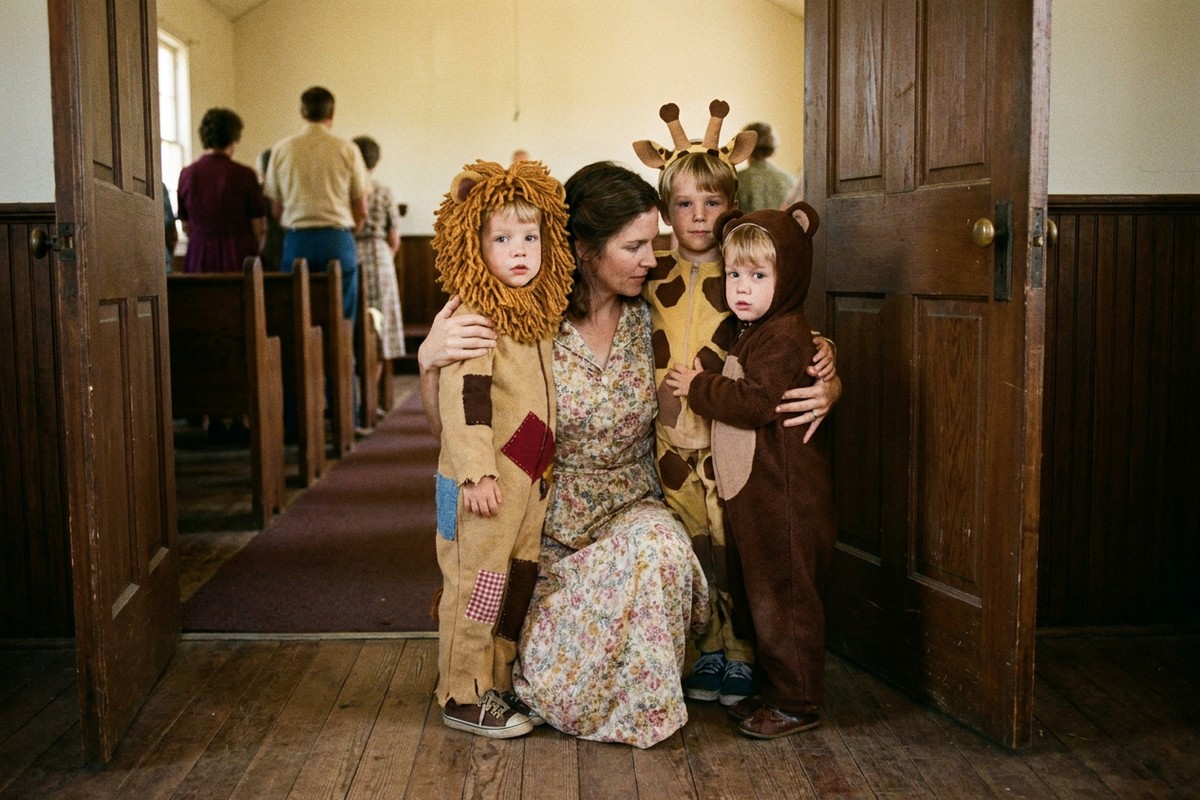
Tucker stood there with his hand on the ark door, looking at Birdie for help. Birdie looked at Bo.
The little giraffe was holding the microphone in both hands now, the way you'd hold a hymnbook. His felt horns were crooked again. He looked out at a fellowship hall full of grown-ups he didn't know, and his chin was shaking, and he didn't let go of the door.
"Miss Birdie said the ark was for the animals God wanted to save," he said into the microphone. "Two of every kind. And they all got to go in."
"That's right, honey," Birdie said quietly, from the side of the stage.
Bo looked at her.
"Is there room on the ark for my mom?"
The fellowship hall was so quiet you could hear the air conditioner kick on.
"She's sick," Bo said. "But she's getting better. She goes to meetings every day. She says she's going to get well and come get us." He swallowed. "But she couldn't come tonight. And if you close the door, then she's not on the ark. And it's going to rain."
Somebody in the third row made a small sound. Donna Whitfield had both hands over her mouth. Ray had his arm around her.
Birdie Tanksley stood at the edge of the stage holding a script she'd been using for fifty years. It was typed on Harold's old Smith-Corona, on paper gone yellow and soft. It said exactly what Noah said, and when the dove came in, and when to shake the tin.
It didn't say anything about this.
She thought about Harold, sawing plywood in the church parking lot in the summer of 1977, sweat running down his face. She'd asked him why he was making the ark so big, when there were only twenty children in Bible school that year. He'd said, Birdie, you never know who's going to need to get on.
Birdie folded the script in half. Then she folded it again, and set it down on the piano bench, and walked out to the middle of the stage.
Her knees didn't like it. She did it anyway.
She knelt down in front of Bo, slowly, until she was eye to eye with a six-year-old giraffe.
"Bo," she said, "there is room on this ark for your mama. There's room for her right now, tonight, even if she's not here. And the door is not going to close until we're sure."
Bo looked at her for a long moment. Then he nodded, very seriously, and kept his hand on the door.
Birdie stood up and took the microphone from him, gently. She turned and looked out at the congregation.
"Y'all," she said. "We're going to do this a little different this year."
She'd never in her life spoken from that stage without notes. Her voice shook a little. She didn't care.
"Noah brought them in two by two," she said, "because he couldn't do it by himself. Somebody's got to walk in with you." She looked down at Bo. "These boys have been walking by themselves for a long time. So I'm asking. Anybody who'd like to stand with them, and with their mama, come on up. Two by two. Get on the ark."
For a moment, nothing happened.
Then Ray and Donna Whitfield stood up in the second row. They walked up together, holding hands, and stepped onto the stage, and stood behind the three boys.
Then Wendell Gaskin stood up.
The retired banker who'd wanted the boys to sit this one out walked up the center aisle with his wife, Nadine, beside him. He climbed the two steps to the stage, and he put his big hand on Cameron's shoulder, and he didn't say a word. Cameron looked up at him in surprise.
After that, they kept coming.
The Sunday school teachers came up two by two. The choir came up, and the youth group, and three generations of the Lassiter family in matching church shirts.
A pair of old widowers who'd sat together on the back pew for twenty years came up side by side. The Methodists from the third row came up, all eleven of them, and the pastor came up with his wife, and the woman with the camcorder came up still filming.
They crowded onto that little stage until it creaked. They crowded around Harold's plywood ark and the crooked giraffes and the lion and the bears, and when there wasn't any room left on the stage, they stood in the aisle and held hands.
Birdie's piano player started "Rise and Shine" on her own. Hardly anybody could sing it.
That was when Donna Whitfield saw her.
A young woman was standing at the very back of the fellowship hall, by the door, in jeans and a work shirt with her hair pulled back. She looked about twenty-eight. She had a church bulletin crushed in one hand, and she was crying so hard she was shaking.
Donna had called the caseworker on Wednesday. She'd gotten permission for one supervised visit, Friday night, at the church. She'd told the boys' mother that it might be too late, that her meeting in Gadsden didn't let out till six, and the play started at seven.
Don't promise them, she'd said. Just come if you can.
She'd come. She'd slipped in late, in the dark, and stood at the back, and heard her youngest boy ask if there was room for her.
Donna caught Birdie's eye and nodded toward the door.
Birdie looked. Then she bent down to Bo and said, very softly, "Honey. Look in the back."
Bo looked.
He dropped Birdie's hand. He jumped off the front of the stage in his yellow spotted sweatshirt and ran up the center aisle, right through the middle of the congregation, with his felt horns flying.
Cameron and Eli were right behind him, the lion and the bear. The crowd in the aisle parted to let them through.
Their mother went down on her knees by the back door and opened her arms.
The three boys hit her all at once and knocked her backward, and she held on to all of them, laughing and crying, with a lion's mane in her face and a giraffe's horns poking her in the eye.
Up on the stage, Tucker looked at Birdie. Birdie nodded.
Noah closed the door.
Behind the curtain, somebody shook the tin sheet, and it thundered over the fellowship hall. The paper dove came in on its fishing line, wobbling. The rainbow came down from the ceiling, a little crooked, the way it had every year since 1977.
And then the fellowship hall ate banana pudding.