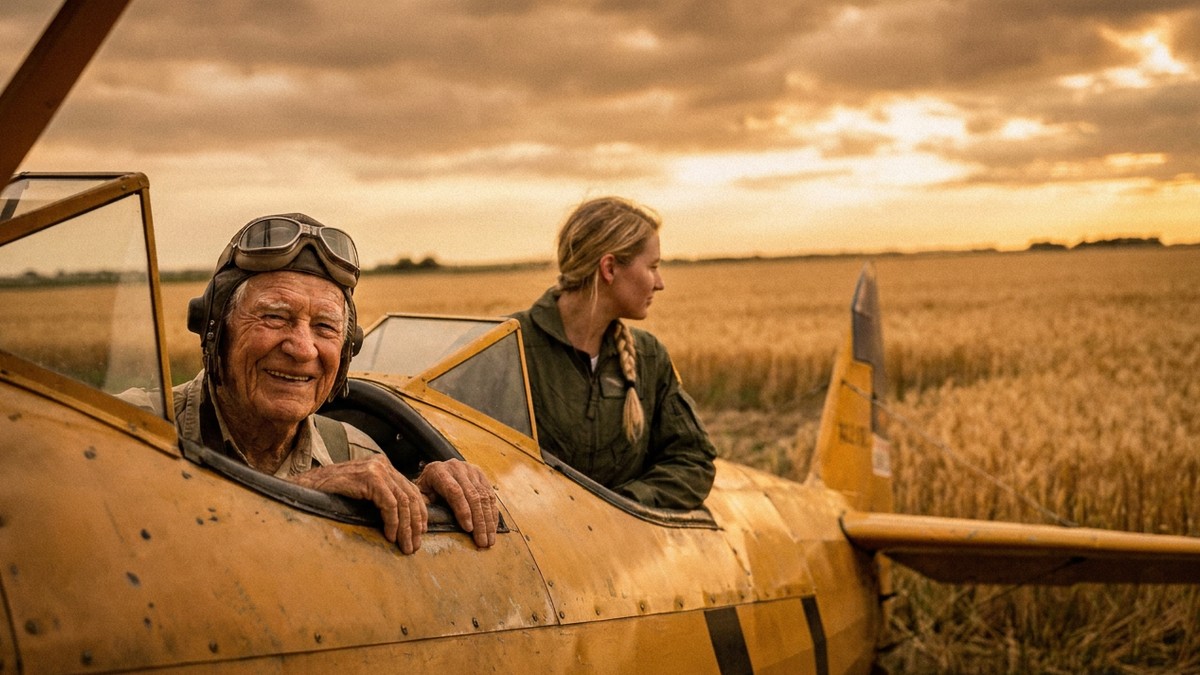
Woody Kimbrough had soloed a yellow Stearman in the spring of 1944, and for eighty-three years, he'd dreamed about it once a week.
It was always the same dream. Always a Tuesday, for some reason. He was eighteen years old, in a leather helmet and goggles, alone in the rear cockpit of a Navy N2S biplane painted yellow from nose to tail.
He was climbing out over the flat green wheat fields of central Kansas, with the wind singing in the wires between the wings, and the front seat was empty. Just him and the sky.
He'd wake up in his bed at the senior apartments in Hutchinson with his hands moving on the blanket, working a control stick that wasn't there.
He was a hundred and one.
The Navy had built an air station outside Hutchinson in 1942, out on the prairie southeast of town. It was one of the places where young men learned to fly. They came by the trainload from all over the country, eighteen and nineteen years old, farm boys and city boys and college boys, and they learned in Stearman biplanes so bright yellow that the cadets called them Yellow Perils.
Woody Kimbrough had been one of those boys. He'd grown up on a wheat farm thirty miles away, near Nickerson. He'd never been farther from home than Wichita.
His older brother, Lyle, had joined the Navy right after Pearl Harbor. Woody had followed him the week he turned eighteen, in the fall of 1943.
He wanted to be a fighter pilot. He wanted to go where Lyle was.
He soloed on a Tuesday in April 1944, on his twelfth hour in the airplane. He went on to Corpus Christi, Texas, and earned his gold wings in March of 1945. He was ready to go to the Pacific.
The Navy sent him back to Kansas instead.
They needed instructors. Woody had been near the top of his class, and the Navy put him back at Hutchinson, in the front seat of the same yellow biplanes, teaching scared eighteen-year-olds how to fly.
He taught sixty-one cadets that spring and summer. He wrote every one of their names in a little brown logbook.
On May 11, 1945, two Japanese planes hit the aircraft carrier USS Bunker Hill off Okinawa. Lyle Kimbrough was one of the men who died.
Woody got the telegram in his barracks at Hutchinson. He was nineteen.
The war in the Pacific ended that August. He never left Kansas.
He'd married a girl from Hutchinson named Dorothy and farmed wheat for fifty years. He'd raised four children and buried two of them, and Dorothy too, in 2012.
He'd been a deacon and a school board member and a 4-H leader. He'd been a good man by any reasonable measure.
But when people thanked him for his service, at the grocery store, or on Veterans Day at the high school, Woody always shook his head.
"I didn't do much," he'd say. "I stayed home. My brother's the one who served."
His granddaughter Beth had heard him say it for thirty years. She was fifty-eight, a schoolteacher in Wichita, and she'd finally had enough.
In the spring, she found a volunteer group out of Oklahoma that restored old Stearman biplanes and gave free rides to World War II veterans. She'd read about them in the paper. Their pilots had flown more than a thousand old men in the last few years.
Some of them had tears running down their faces when they landed. Some of them had been fliers in the war. Some of them had just dreamed about it.
She called them in March.
"He's a hundred and one," she said. "He trained Navy pilots at Hutchinson in 1945. He thinks he didn't do enough."
There was a short silence on the line.
"Ma'am," the man said, "we'll be there."
They came on a Saturday in June.
The old Navy field was a regional airport now, but some of the long concrete runways the Navy had poured in 1942 were still there, cracked and patched. Beth drove Woody out at eight in the morning. He wore his best shirt and a Navy ball cap with his old squadron number that his grandson had found online.
He saw the airplane from the parking lot.
It sat on the ramp in the morning sun, a yellow biplane exactly like the ones he'd flown, painted in Navy colors, with blue numbers on the side and the old star insignia on the wings. The wires between the wings caught the light.
Woody stopped walking. Beth held his arm. He stood there on his cane for a long time, just looking at it.
"Well," he said finally, in a voice she'd never heard before. "Hello, old girl."
The pilot came over to meet him. She was a young woman, about twenty-nine, in a flight suit, with a blond braid and freckles.
Her name was Kasey Lindqvist. She flew jets for an airline during the week, she said, and she flew the Stearman on weekends for nothing, because her own grandfather had flown them in 1943.
"Mr. Kimbrough," she said, shaking his hand. "It's an honor."
"Woody," he said. "Please. And it's my honor, young lady."
There was a small crowd by then. Beth, and Woody's son Hal, and three great-grandchildren.
A reporter from the Hutchinson paper. A dozen Navy ROTC midshipmen from the University of Kansas in their summer whites, who had driven over that morning because Kasey's group had called them.
Then the wind came up.
It came up out of the southwest the way Kansas wind always does, all at once, like somebody opening a door. The windsock at the end of the runway snapped straight out.
Dust blew across the ramp. The yellow biplane rocked on its wheels, and its wings hummed.
Kasey looked up at the windsock. Then she looked down at the weather on her tablet. Her face got serious.
She walked over to Beth and Woody, and she crouched down beside Woody's chair so she could look him in the eye.
"Woody," she said. "I'm going to be straight with you, pilot to pilot. That's twenty-five knots, gusting thirty-five, and it's across the runway. In a tailwheel airplane, that's a handful even for me." She paused. "I'm worried it might not be safe today. Not for a man your age. I don't want to hurt you."
Woody looked at her, then up at the windsock, standing straight out against the blue Kansas sky.
He'd waited eighty-three years. He was a hundred and one.
He knew perfectly well he might not get another day.