Woody didn't argue with her. He'd been a flight instructor. He'd said those same words himself, to eager young cadets on windy mornings in 1945, standing on this same concrete.
"You're the pilot in command," he said. "It's your call."
Kasey nodded slowly. She looked relieved and sorry at the same time.
"Then here's my call," she said. "We wait."
They waited all day.
Somebody brought folding chairs and a cooler. Beth went to town for sandwiches. The midshipmen in their white uniforms sat in the shade under the wing of the airport's old hangar, and one by one, they came over and asked Woody questions.
He told them about Hutchinson in 1944. About the thousands of cadets and the long rows of yellow biplanes on the flight line, and the sound of two hundred radial engines warming up at dawn. He told them about his first solo, how he'd been so scared he forgot to breathe on the takeoff roll, and how he'd laughed out loud the moment the wheels left the ground.
He told them about his instructor, a tough little ensign from Georgia who'd rapped him on the helmet with a pencil every time he forgot to check his mirrors.
He didn't tell them about Lyle. They didn't ask, and Beth didn't say.
The wind blew all afternoon. The windsock stood straight out. Every hour, Kasey looked at her tablet and shook her head.
At five o'clock, Hal said maybe they should take Dad home. He was a hundred and one. He'd been sitting out in the wind for nine hours.
"I'll stay," Woody said.
At six, the great-grandchildren fell asleep in the back of Beth's car. At seven, the reporter went home.
At seven-thirty, the sun was getting low over the wheat to the west, going orange and enormous the way it does on the Kansas plains in June. And the wind began, very slowly, to die.
Woody felt it before anyone else. He'd farmed for fifty years.
He'd felt the evening calm come down over a wheat field a thousand times. He lifted his face, and the hair on his arms went flat, and the windsock at the end of the runway began to droop.
Kasey stood up from her chair and looked at it. Then she looked at her tablet. Then she looked at Woody.
"Eight knots," she said. "Right down the runway."
She was grinning.
It took two midshipmen and Hal and Kasey to get him into the front cockpit.
He didn't mind. He was a hundred and one. When they finally lowered him into the seat, he sat back, and put his hands on the cockpit rim, and closed his eyes, and breathed.
The leather. The oil. The gasoline.
The particular smell of a hot radial engine cooling. It was all exactly the same.
Kasey buckled his harness and pulled a leather flight helmet down over his white hair and settled the goggles on his face.
"You know where everything is," she said.
"I do," Woody said. His voice shook. "I surely do."
The engine started with a cough and a bang and a cloud of blue smoke, and then caught and settled into a deep, uneven rumble that Woody felt in his chest. The wires began to sing. Kasey taxied slowly to the end of the old Navy runway, swinging the long nose from side to side so she could see past it, the way he'd taught cadets to do in 1945.
They turned into the last of the wind. She pushed the throttle forward.
The yellow biplane rolled, and gathered speed, and the tail came up. Then the rumbling stopped, and the wheels let go of Kansas, and they were flying.
Woody Kimbrough laughed out loud in the front seat. He'd forgotten to breathe on the takeoff roll. Again.
They climbed out to two thousand feet over the old Navy field.
Below them, the wheat was gold and orange in the sunset, stretching away flat to every horizon. Woody could see the old runways in their big Navy triangle, the outline of foundations where the hangars had stood, the long straight road into town.
He could see the field where he'd soloed. He could see the whole world.
Kasey's voice came through the old intercom in his helmet.
"Woody," she said. "You want to take her?"
He didn't answer. He couldn't. He just reached down with his right hand, slowly, an old man's spotted, trembling hand in a leather glove, and took hold of the control stick between his knees.
"Your airplane," Kasey said.
"My airplane," Woody said.
He made one turn. A long, slow, perfect turn to the left, the wings tilted against the sunset, around the field where he'd learned to fly at eighteen and taught sixty-one boys to fly at nineteen. His hands remembered everything.
Stick and rudder together. Nose on the horizon.
Ball in the center. Smooth.
When he rolled out, he let go of the stick, and Kasey took it back.
"That was beautiful flying," she said quietly. "Instructor."
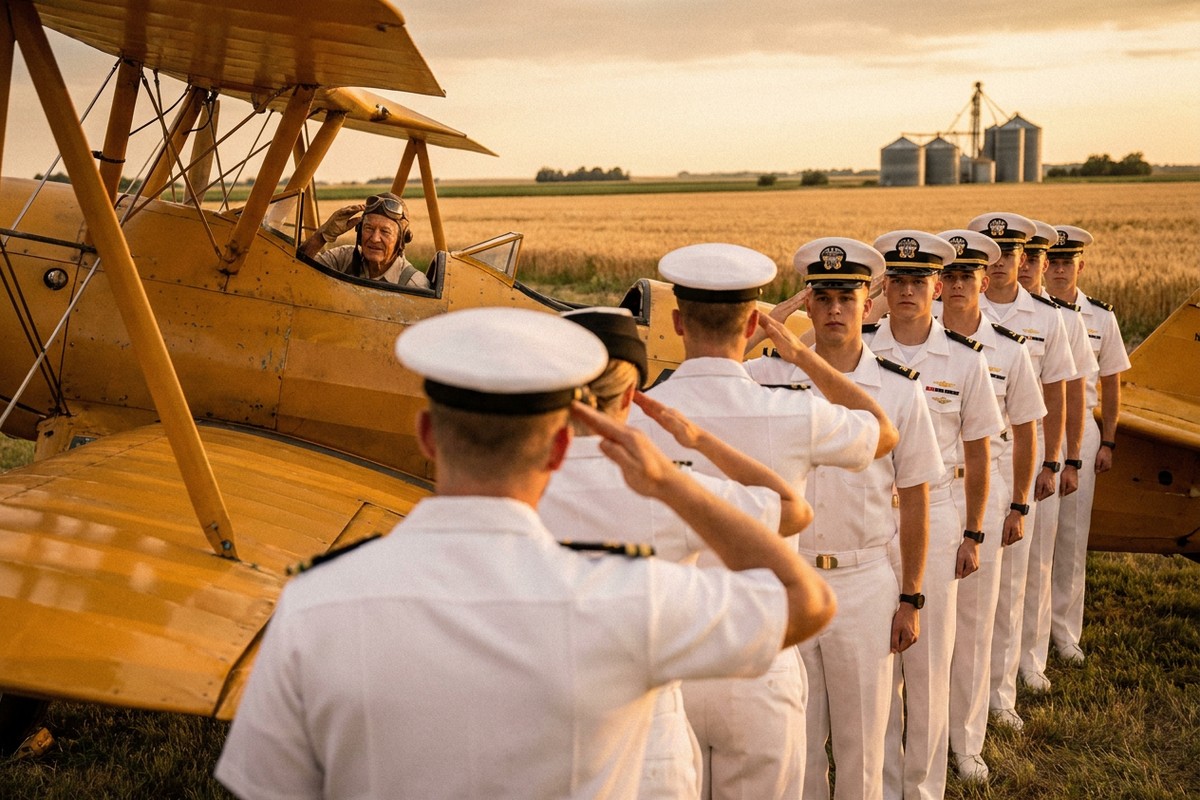
When they landed and taxied in, the midshipmen were standing in a line on the ramp in their white uniforms, in the orange evening light. There were twelve of them.
As the propeller wound down and stopped, they came to attention all at once. They raised their right hands, sharp and together, in a salute.
Woody stared at them from the front cockpit.
Kasey climbed down first. She came around to the side of the airplane and stood on the wing root beside him, and she took a folded paper out of the pocket of her flight suit.
"Beth sent me your logbook last month," she said. "I did some looking. Of the sixty-one cadets you trained in 1945, thirty-eight of them went to the fleet. Eleven of them flew in combat in the Pacific before it ended." She put the paper in his gloved hand. "Every one of them came home."
Woody looked down at the paper. The names were there. His boys.
"Somebody had to teach them, Woody," Kasey said. "The Navy picked you because you were the best they had. You didn't stay home. You stood on this field and you made sure those boys came back to their mothers." Her voice cracked. "Your brother would have been proud."
Woody Kimbrough sat in the front seat of a yellow biplane with the sun going down behind him and the paper in his hand, and he cried, the way he hadn't cried since May of 1945.
Then he looked up at the line of young midshipmen still standing at attention, still saluting.
And slowly, with the last of the sunset turning the yellow wings to gold, the old Navy instructor raised his gloved right hand and saluted them back.