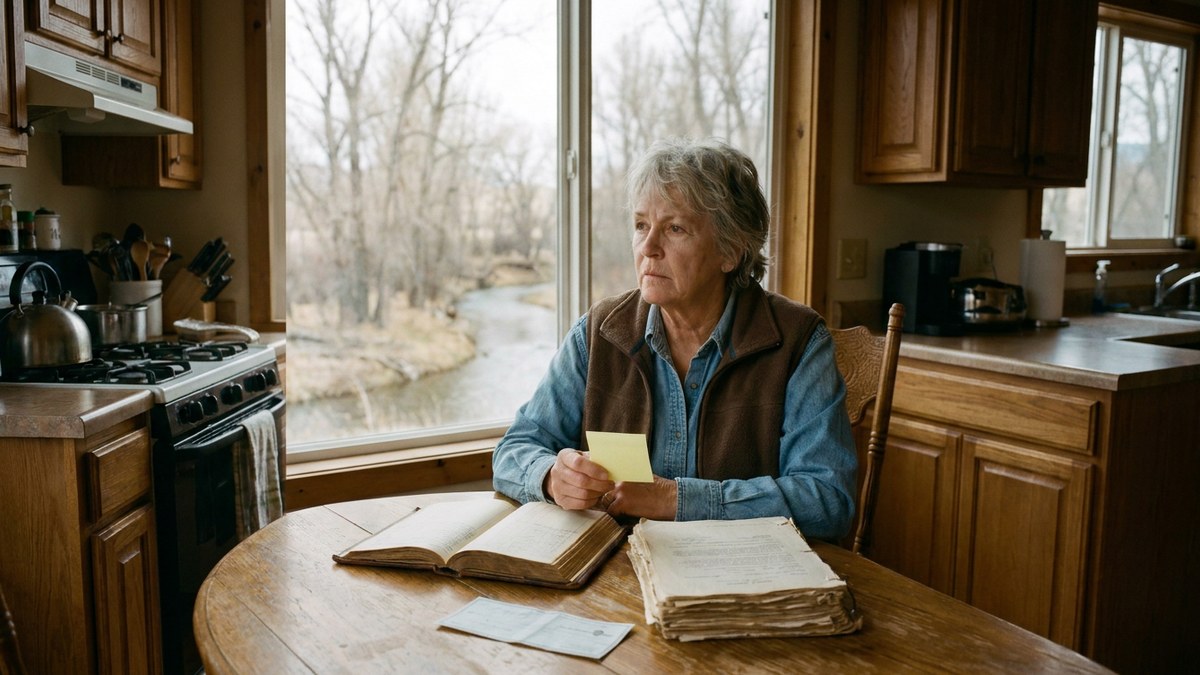
The land man brought a check already filled out, and Edith Lowry let it sit on the kitchen table while she poured him coffee.
"One point one million," Grant Sorley said. "For the whole place. Land, buildings, everything. That's well above what grazing land's been selling for around here, Mrs. Lowry. I checked the county records myself."
Edith set the coffee in front of him. She didn't look at the check.
"Cream?" she said.
"No, thank you, ma'am. Black's fine."
She sat down across from him. Through the kitchen window, past his shoulder, she could see the cottonwoods along Otter Creek, bare and gray in the March wind, and the long brown hills of southeastern Montana rolling away toward the Tongue River.
She was sixty-nine. She'd lived on this ranch for forty-six years, the last two of them alone. She'd kept its books for every one of those years, in green ledgers with her own careful columns, and she'd never once been off by more than a dollar.
Her husband, Hal, had died two Februarys ago. A heart attack, in the calving barn, at seventy-three.
Their son was a lawyer in Denver and didn't want the ranch. Their daughter lived in Billings with three kids and a husband who sold insurance.
Edith had kept the place running. She'd sold off most of the cattle.
She leased the grass to a neighbor. She fixed what she could fix and paid for what she couldn't, and she sat on the porch in the evenings and listened to the creek.
She was tired. She'd admitted that to herself in January. She was very tired.
So when Grant Sorley called in February and asked if she'd consider an offer, she'd said she'd listen.
Grant was about forty-five, in a pressed shirt and a fleece vest and new boots that still had the shine on the toes. He was polite.
He was pleasant. He worked for a company in Colorado called High Plains Land Partners.
"What does your company want with a cow ranch?" Edith asked.
"We invest in agricultural land," Grant said smoothly. "Long-term holdings. We'd probably lease it out for grazing, the way you're doing now. Maybe put in some improvements."
"And you'd keep the name? The Lowry place?"
"We could certainly discuss that."
Edith nodded. She picked up her own coffee and held it in both hands.
"It's a good offer," she said.
"It's a very good offer, ma'am. Frankly, I don't think you'll see another one like it. Ranches out here don't move fast." He tapped the check gently. "It's good through Friday. After that, the partners will move on to other properties."
They talked for a while longer. Grant asked about the house, the barns, the wells. Edith answered.
Then, as he was standing up to leave, he looked out the window at the cottonwoods and said, almost to himself:
"Beautiful stretch of Otter Creek. Must be nice to have that first right on it."
Edith set down her coffee cup.
"What did you say?"
Grant turned. For a second, his face was perfectly blank. Then he smiled.
"The creek," he said. "Must be nice to have it."
"You said the first right."
"Did I?" He laughed easily. "Sorry, ma'am. Long week. I look at a lot of creeks."
He shook her hand and thanked her for the coffee and left the check on the table. She stood at the kitchen window and watched his rental car go down the lane, and turn onto the county road, and disappear over the hill.
The first right.
Hal had always taken care of the water.
Edith had kept the cattle records and the books. Hal had dealt with the ditch and the headgate and the water commissioner and the state.
It was the one thing about the ranch he never talked to her about, because he said it would bore her to tears. It probably would have.
But she remembered one thing he'd said to her, years ago, sitting on the porch in July with the hay coming in green along the creek.
That water's older than Montana, Edie. Don't ever let anybody tell you different.
She'd thought it was just something he said.
Hal's desk was in the little room off the kitchen. Edith hadn't opened most of the drawers since the funeral.
She opened them now.
The bottom drawer on the right was full of folders. Water. It said so on the tab, in Hal's slanting handwriting.
Inside were forty years of papers. Ditch assessments.
Letters from the Department of Natural Resources. A thick bound document from the Montana Water Court with the word Decree on the cover and a tab marked with a paper clip.
She opened it to the tab.
It was a list. Every water right on Otter Creek, from the mouth to the headwaters, with the owner's name and the amount of water and a date beside each one. Most of the dates were from the 1900s, and the 1920s, and the 1950s.
The Lowry ranch was at the top of the page. The oldest right on the creek.
Priority date, April 2, 1887. Two years before Montana was a state.
Paper-clipped to the page was a yellow sticky note in Hal's handwriting, gone faint with age. Edith read it, and then she sat down in his chair.
Edie. If anybody ever comes asking to buy this place, it isn't for the grass.
Call Bud Pfeiffer before you sign anything. The Pfeiffers live on this water too.