He didn't sleep much that night.
He sat at the kitchen table with the lights off, the way he'd done a lot of nights since March. The kitchen was clean, because he never used it.
Joanie's apron still hung on the hook by the stove. Her radio still sat on the windowsill, tuned to the station out of St. Johnsbury that played old country and the farm report.
On the shelf above the stove, next to the salt and pepper, was a small wooden box. Pine, with a hinged lid, painted with faded red apples.
Norm had made it for her in the shop in 1974, the first Christmas they were married, because she'd been keeping her recipe cards in a shoebox. It was the only thing he'd ever built that she said was perfect.
He hadn't touched it since the funeral.
Around midnight, he got up and took it down.
Inside were the cards. Hundreds of them. Yellowed index cards and pages torn from church cookbooks and backs of envelopes, in Joanie's round, looping handwriting, with grease spots and flour fingerprints and notes in the margins.
Apple pie. Maple baked beans. Johnnycake.
Red flannel hash. Mrs. Gilman's macaroni and cheese, with a note: Too much salt, use half.
And near the front, where she could reach it without looking, a card so soft and stained it was almost cloth.
Joanie's Chicken Pie. Sundays.
Norm sat at the kitchen table and held it for a long time.
On the next Wednesday, he was the first one at the senior center. He came into the kitchen in his barn coat with the pine box under his arm and set it down on the steel counter in front of Hazel.
She looked at the box. Then at him.
"I'm sorry about last week," Norm said. He looked at the floor. "You asked a fair question. I just wasn't ready for it."
"It's okay, Mr. F.," Hazel said quietly. "I get it."
He opened the box and took out the soft, stained card and handed it to her.
"Chicken pie," he said. "She made it every Sunday for fifty-four years. Biscuit on top, not pie crust. She said pie crust was for people who didn't have time." He cleared his throat. "I don't know the first thing about it. I just know what it tasted like."
Hazel read the card carefully, all the way down. Then she looked up at him. Her eyes were wet.
"My mom died when I was twelve," she said. "Cancer. She used to make pot roast on Sundays. I didn't have her recipe. She never wrote it down." She swallowed. "I made it about a hundred times before I got it right. My dad cried the first time I did."
Norm didn't say anything. He didn't need to.
"We can make this," Hazel said. "Together. If you want."
It took them four Wednesdays.
The first time, the chicken was dry and the gravy was lumpy and the biscuits were hockey pucks. Hazel said that was normal.
The second time, the gravy was good but Norm forgot the salt. The third time, the biscuits were perfect and everything under them was soup.
The fourth Wednesday, Hazel stood back and let him do it all himself.
Norm poached the chicken the way the card said, with an onion and a bay leaf and a carrot. He made the gravy with the broth and butter and flour, stirring it slowly on medium heat until it was the color of maple syrup. He pulled the chicken apart with his big farmer's hands and laid it in the old Pyrex dish that he'd brought from home, Joanie's dish.
He poured the gravy over it. Then he made the biscuits, cutting them out with an upside-down jelly glass, because Joanie's card said to, and set them on top in a ring, touching, so they'd rise together.
He put it in the oven. Hazel taped the recipe card to the cabinet above the stove where he could see it.
Twenty-five minutes later, they pulled it out together.
The biscuits were tall and golden. The gravy bubbled up between them. The whole senior center kitchen smelled like a Sunday afternoon on the Fairbanks farm in 1975.
Norm took a fork and tasted it.
He set the fork down. He put both hands flat on the steel counter and stood there for a long time, with his head down, not saying anything. Hazel put her hand on his back.
"It's right," he said finally. "It's hers."
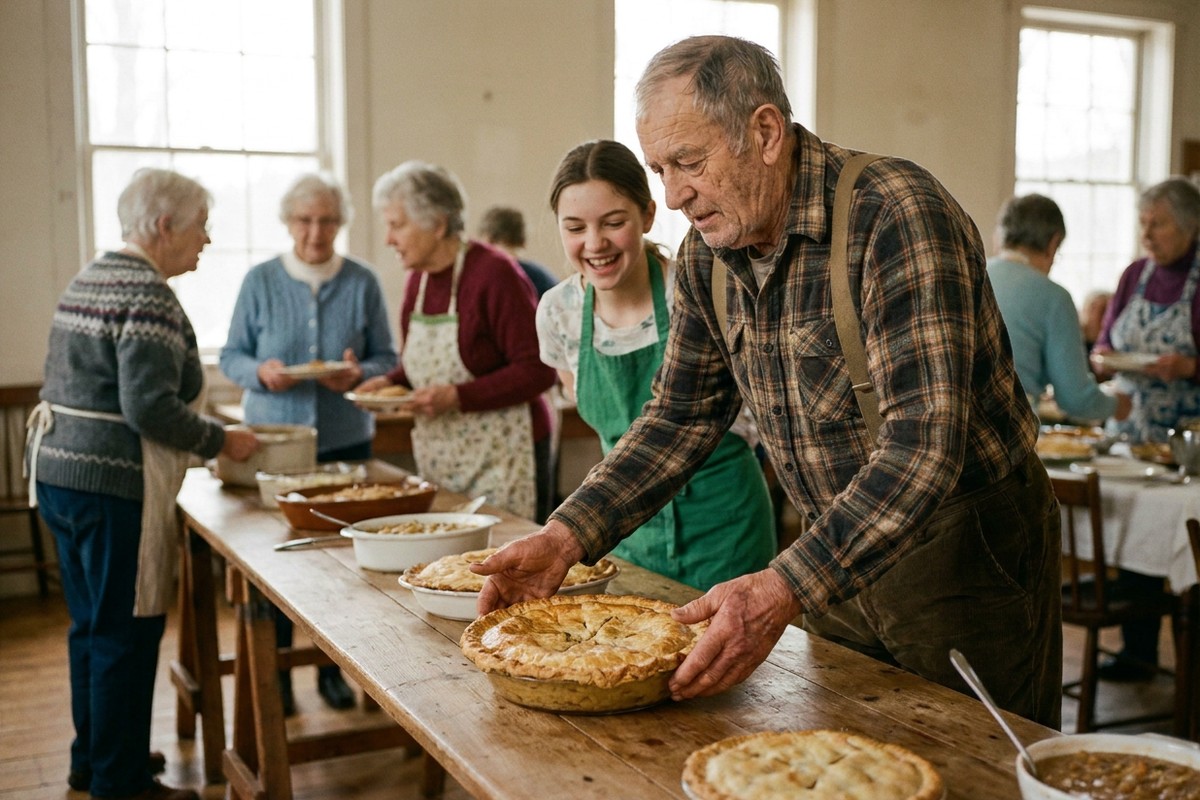
The East Calder Congregational Church holds a chicken pie supper every October. It has since 1911. The church ladies make sixty pies, and people drive in from three counties and sit at long tables in the vestry and pay fifteen dollars a plate.
Joanie Fairbanks had made four pies for that supper every year for fifty years.
That October, there were sixty-one.
The extra one came in a Pyrex dish carried by a seventy-nine-year-old dairy farmer in a clean flannel shirt and a sixteen-year-old girl with a nose ring. It had a biscuit top, golden and tall, cut out with a jelly glass. Norm set it on the serving table with the others and didn't tell anybody whose recipe it was.
He didn't need to.
Mrs. Gilman took one bite at the serving table, and set down her fork, and turned around and looked at him across the vestry with her hand over her mouth.
"Norman Fairbanks," she said. "That's Joanie's."
"Yes, ma'am," said Norm. "It is."
Then the church ladies came, one by one, and tasted it, and some of them cried, and all of them hugged him. Hazel stood by the coffee urn and tried to pretend she wasn't crying too.
When the supper was over, Norm drove Hazel home to Lyndonville. On the way, he handed her a small envelope.
"For culinary school," he said. "In New York. It's not much."
She opened it. It was a check. And a recipe card, in Norm's big blocky farmer's printing, copied off the original.
Joanie's Chicken Pie. Sundays. For Hazel.