Roz stood in her front hall with the phone against her ear and her hand on the deadbolt.
Danny had told her not to open the door. He was right. But she'd watched that van for eight days, and she knew how it worked.
If she didn't answer, they'd go next door. And next door was Dottie Sheehan, who was home from Cherry Hill now, eighty-five and half deaf, who opened her door to Jehovah's Witnesses and Girl Scouts and anybody else who rang the bell.
Roz wasn't going to send them to Dottie.
"Danny," she said quietly into the phone, "I'm going to put you in my pocket. Don't hang up. Just listen."
"Miss Roz, don't you dare."
She slid the phone into the pocket of her housecoat with the line still open. Thirty-one years at a switchboard, and she'd never once dropped a call on purpose.
Then she did two more things. She picked up the old Polaroid camera from the shelf by the stairs, the OneStep Flash she'd bought in 1983 for block parties, and set it on the hall table with a dish towel over it.
Her grandnephew had bought her fresh film for it at Christmas. And she took the green steno pad off the windowsill and set it beside the camera, open to a clean page.
She unlocked the door.
"Good morning," the man in front said. He was about forty, clean shaven, with a laminated badge clipped to his shirt pocket. "Gas Service, ma'am. We've got a reported leak on the block. We just need to check your line and your meter, real quick."
"Well, come in," Roz said. "Come in. I don't want to blow up."
They came in. The second man was younger and bigger and didn't smile. He carried the tool bag.
"What's your name, honey?" Roz asked the first one.
"Kevin."
"Kevin what?"
He hesitated just a hair. "Kevin Ward."
"And your badge number, Kevin? I like to write it down. My late husband always said write it down." She picked up the pen. "You read it to me, slow. My eyes aren't what they were."
He read it to her. She wrote it on the steno pad, and she said it back to him, loud and clear, every digit, the way she used to repeat a number back to a caller in 1971. She heard her own voice going straight into her pocket.
"Which company did you say?"
"Gas Service, ma'am."
"There isn't a company called Gas Service," Roz said pleasantly. "But that's all right. Where would you like to start?"
Kevin's smile flickered and came back. "Basement. The meter. And my partner needs to check your upstairs radiators. Sometimes a leak travels in the walls."
"Oh, he does?"
"Yes, ma'am. Just takes a minute. You can come down and show me the meter."
That was how it worked. One kept you busy downstairs.
One went upstairs to your dresser. Roz had heard Angie tell it, and Leon, and she'd heard it in her head a hundred times since.
"Honey, I've got two bad knees," Roz said, which was true. "I haven't been down those cellar stairs since Easter. Meter's on the left wall, behind the furnace. You go on down. I'll stand right here and holler if I smell anything."
Kevin looked at his partner. His partner shrugged and started up the stairs to the second floor.
Kevin went down to the basement.
Roz stood at the bottom of the front stairs, where she could see the whole flight, and she waited. She heard the big man's boots overhead, crossing to her bedroom at the front of the house.
She heard her top dresser drawer open. It stuck halfway, the way it had since 1974, and she heard him yank it.
She took the dish towel off the Polaroid.
A minute later the big man came down the stairs. He came quickly and quietly for a big man, with one arm pressed against his side. There was a square shape under his gray shirt where her mother's wooden jewelry box should have been.
He was halfway down when he saw her standing at the bottom with the camera up.
The flash went off in the narrow hall like lightning.
The camera whirred and pushed out the picture. Roz pulled it loose and dropped it straight down the front of her housecoat, where it stuck against her slip, and she folded her arms over it.
"Young man," she said, "that's my mother's jewelry box."
He stood on the stairs with his mouth open. From the basement door, Kevin came up fast, looking from his partner to the old woman to the camera.
"Give me that picture," the big man said.
"You'll have to come and get it," Roz said. "And I'll tell you right now, I've got a police officer listening in my pocket who learned to ride a bicycle in front of this house."
She was off by about thirty seconds. That was when the siren came around the corner from Snyder Avenue.
The two men ran. Kevin went out the front door and straight into Danny DiSanto, who was coming up Roz's steps two at a time, and they both went down on her front walk. The big man went through the kitchen and out the back, into the little alley behind the rowhouses, and he got about forty feet before he ran into the second patrol car Danny had called on his way over.
The jewelry box was still under his shirt.
It came together fast after that. The Polaroid showed a big man on a staircase with his arm around a wooden box, his face perfectly clear in the flash.
The plate on the white van, washed clean now, started with JZK 8. Danny matched it to Roz's notes from Monday and Wednesday and Friday, down to the minute.
And the badge number she'd read out loud went straight into Danny's notebook. It was fake, but it turned out to be the same fake number on reports from Upper Darby, Ridley Township, and two neighborhoods in the Northeast.
Eleven cases in all, going back to March. Detectives found Angie's mother's ring in a pawn shop on Market Street in Upper Darby, still with its little garnet.
Officer Mullen came by the next Sunday, alone, with his hat in his hand.
"Mrs. Fenwick," he said, standing on her step, "I owe you an apology. You weren't confused. I should have read your notes before I opened my mouth."
"You were polite," Roz said. "That counts. Next time, read the notes first."
"Yes, ma'am."
She gave him a cup of coffee and a lecture, and he stayed for both.
Danny told her she was the reason eleven families got their answers, and she told him he still took her steps two at a time, the same as when he was seven.
Something else happened on Mercer Street that summer. Angie Iannucci bought a steno pad. So did Dottie Sheehan, and Leon's sister, and the widow on the corner whose name Roz had never quite learned in forty years.
Danny brought them a stack of the real gas company's flyers with the right number to call. They taped them to their front doors.
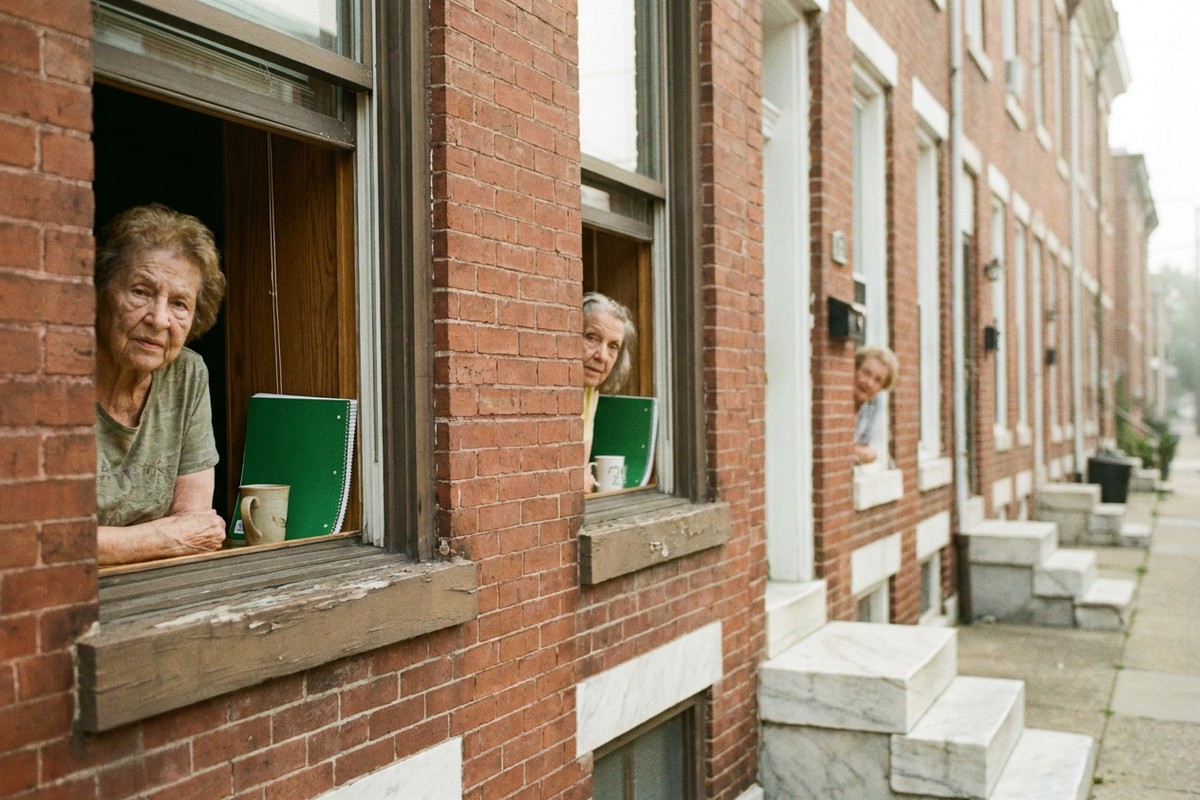
By the Fourth of July there were nine of them, women on the long side of seventy, sitting at their front windows in the mornings with their coffee. Each one had a notebook on the sill and a pen.
They called it the window watch. Roz ran it like a switchboard.