The text said, "Hi Grandma, I got a B on my chemistry test," and Clifford Ingram had never had a granddaughter in his life.
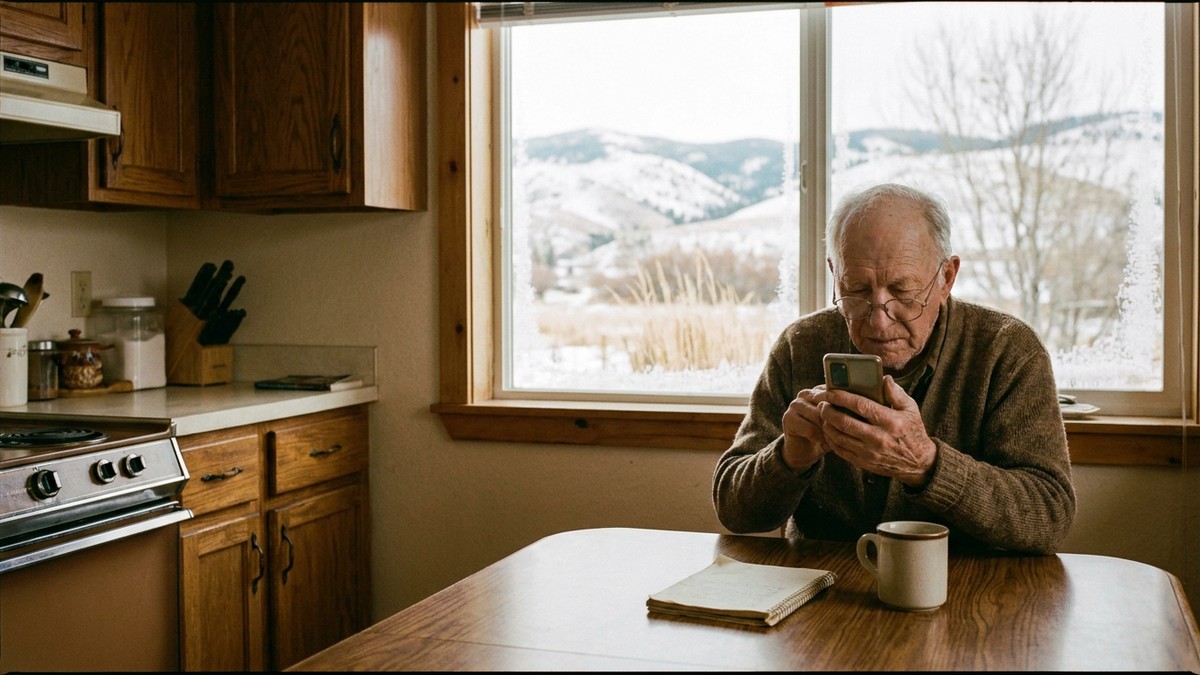
He read it twice on the little screen of the phone his nephew had made him buy. Then he set it down on the kitchen table next to his coffee and looked at it like it might bite.
It was a Sunday morning in February. The wind was coming down off the Blue Mountains, and the house on Alder Street in Juniper Flats, Oregon, was very quiet, the way it had been every Sunday for four years.
Clifford was eighty-one. He'd been a clerk for the Union Pacific for thirty-eight years, in the freight office by the rail yard, and he'd been married to Helen for fifty-three. They'd never had children.
It wasn't for lack of wanting. It just never happened, and after a while, they'd stopped talking about it and made a good life anyway.
Helen had died in the spring of 2023. Since then, Clifford had mostly talked to the radio.
The phone was new. His old one, a flip phone, had finally quit in December, and his nephew in Portland had set him up with a smartphone and a new number. Clifford had used it to call the pharmacy twice and the furnace man once.
Now somebody was texting him about chemistry.
He typed back, slowly, with one finger. I think you have the wrong number.
Then he deleted it. He didn't know why. He just did.
The next Sunday, another text came. Same time, ten in the morning.
Hi Grandma. Mom and I made your snickerdoodles.
They weren't as good as yours. Mom burned the first batch and said a word you wouldn't like.
Clifford laughed out loud in the empty kitchen. It surprised him. He hadn't heard himself laugh in a while.
The Sunday after that, she told him about a boy in her history class who was "fine, I guess." The Sunday after that, about the driving test she'd failed because she'd rolled through a stop sign. Then about a fight with her best friend. About the dog getting into the trash. About missing the way Grandma's kitchen smelled.
Her name was Addie. He knew that because she signed every message, Love, Addie, the way young people never sign anything anymore. She was sixteen.
She lived somewhere in Idaho, he guessed, because she mentioned Boise. Her grandma, whoever she'd been, had died in the fall.
Clifford understood, after the second week, what had happened. The phone company had given him the old woman's number. And her granddaughter, who missed her, kept writing to it every Sunday morning like a letter dropped in a mailbox that wasn't there anymore.
He knew he should tell her. He knew it was wrong to keep reading.
But he didn't know how to tell a grieving sixteen-year-old girl that the person she'd been writing to was a lonely old stranger in eastern Oregon. So he never answered.
He just read. Every Sunday at ten, with his coffee, the way Helen used to read the funny papers to him.
It went on that way into spring.
He started looking forward to Sundays. He'd get up early and shave, which was ridiculous, since the phone couldn't see him. He'd make a full pot of coffee instead of half.
He even started writing things down. Addie's chemistry grade. The best friend's name, which was Jordyn, with a y.
The dog, a beagle mix named Pickles, who ate a whole loaf of bread off the counter in March. He wrote them in a spiral notebook he kept by the phone, the way he used to keep freight numbers, so he wouldn't forget.
He didn't know what he was keeping them for.
In April, Addie passed her driving test on the second try. Clifford found himself standing up in his kitchen and saying "Well, good for you, kiddo," out loud, to the refrigerator.
Some Sundays were harder.
Grandma, I don't know how to talk to Mom anymore. She works all the time since you died, and when she's home she just sits in your chair.
Grandma, I found your blue sweater in the hall closet and I wore it to school. A girl said it was ugly and I wanted to punch her.
Grandma, I keep forgetting your voice. I listen to your old voicemails so I won't.
Clifford read that one three times. Then he went into the bedroom and sat on Helen's side of the bed for a long time.
He had kept the last voicemail Helen ever left him on the old flip phone. Pick up some milk, Cliff, and don't forget the good bread. He'd played it so many times the phone had died with the message still on it.
On a Sunday in late May, the text came at ten o'clock, as always. But it was different.
Hi Grandma. Today's your birthday. You'd be 78.
Mom has to work a double. She said we'd go to the cemetery next weekend instead, but I don't want to wait. So I'm going to ride my bike there by myself.
I don't think I can do this by myself.
Clifford sat very still at the kitchen table.
A sixteen-year-old girl. Alone at a cemetery. Writing to a dead woman's phone, and getting nothing back, the way she'd gotten nothing back for four months.
He thought about Helen. He thought about what she'd say if she could see him sitting there with his coffee, reading a child's heart every Sunday like a newspaper and never once saying a word.
She'd say, Clifford Ingram, you are better than that.
He picked up the phone. His hands were shaking. He typed slowly, with one finger, and it took him a long time to get it right.