Part 2
"Give it here, granny," the leader said.
Mena gave it to him. There was nothing else to do.
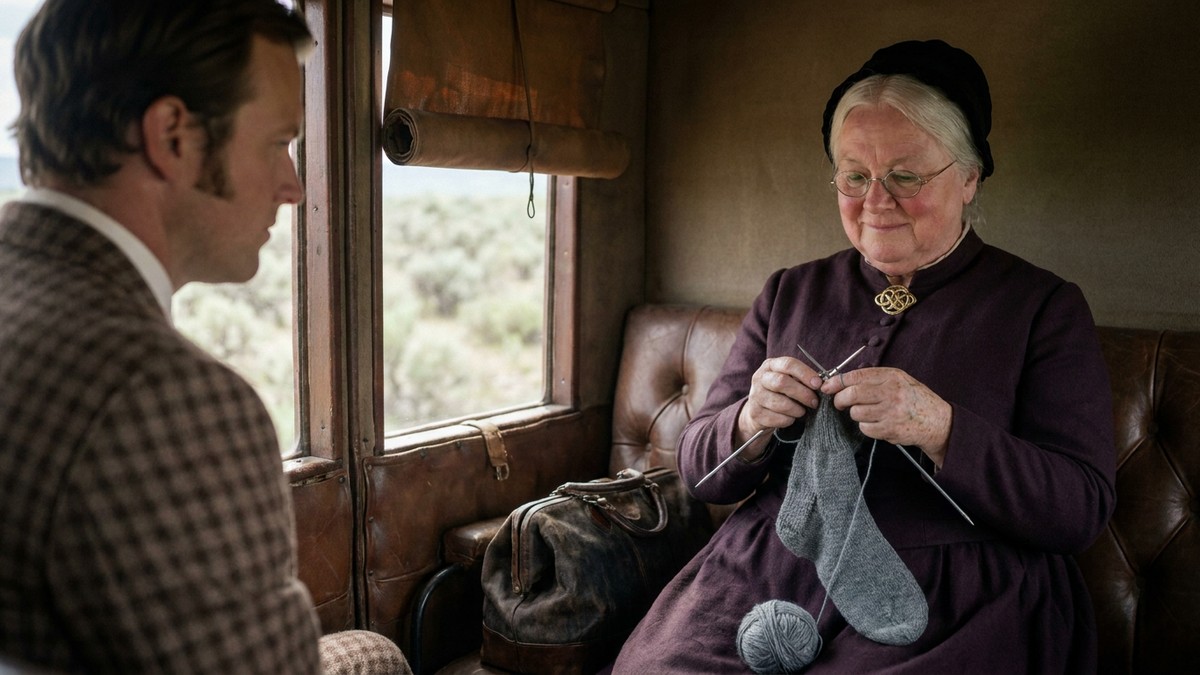
He set the carpetbag on the ground at her feet and crouched over it with his shotgun across his knees. He pulled out the gray stocking on its four needles and tossed it to her, and she caught it against her chest. Then he pulled out the yarn.
Six balls of it. Gray wool, wound tight and round, each one as big as a man's fist.
He turned one over in his hand. He weighed it. Mena watched his thumb press into it, and press again, and her heart stopped and started.
"Mind you don't tangle that," she said. "It's a misery to untangle in a wind."
She sat down on the coach step, because her knees told her to, and she took up the stocking and found her place. She drew out a length of yarn from the ball in her lap, the one she had been knitting from for three days, and she began to knit.
Knit two. Purl two. Never hurry a sock.
The leader squeezed the second ball. The third. He tossed them one by one back into the bag. On the fourth he stopped, and held it close to the eye holes of the flour sack, and Mena knitted a whole row without breathing.
Then he threw it into the bag with the others and stood up.
"Nothing but yarn," he said. He sounded disgusted.
"It's on this coach somewhere," Sloat said loudly. "Has to be. Look in the boot, man."
Every passenger in the line turned and looked at him.
Sloat heard himself a moment too late. His face went the color of the dust. He shut his mouth so hard his teeth clicked.
The robbers searched the boot. They threw out every trunk and valise on the coach and broke open two of them, and found shirts and pump samples and a Bible. They did not find a payroll. The wind blew a drummer's collars away across the sage.
The leader came back to the line at last. He stood in front of Mena with the grain sack hanging from his hand.
"You know, ma'am," he said, "I drove cattle eight hundred miles from Texas for forty dollars and spent it in a week. Those mine owners in the gulch dig a million out of these hills and pay a man three a day to die in the dark." He shook his head. "I ain't any worse than them. I'm just faster."
"My son pays four," Mena said. "When he can get it."
The leader looked at her a moment through the holes in the sack. Then he laughed, short and surprised.
"Mount up," he said to the others.
The slim boy was the last to go. He looked back once at Mena, sitting on the coach step with her stocking, and lifted his pistol hand halfway, as if he meant to wave and then thought better of it.
They reached Deadwood the next afternoon.
The marshal met the coach, because word had gone ahead from the next station. Mena got down, and walked up to him with her carpetbag in her hand, and said in a clear voice that the gentleman in the brown checked suit had been in the bank in Cheyenne when she spoke to the cashier, and had nodded to the robbers when the box came up empty, and had told them to search the boot.
Sloat tried to get back on the coach. Two miners stopped him.
"And the others?" the marshal said.
Mena described the leader, his voice, his boots, a white scar across the back of his left hand. She described the man with the chisel.
"There was a third," she said. "A boy, not seventeen. He's the one told them to let me keep my knitting." She looked down the long muddy street of the gulch. "Find him before the other two finish ruining him. That's all I ask."
Michael was waiting at the Shamrock with fourteen men standing around the shaft house in the late sun.
Mena set her carpetbag on the table in the little board office. She took out the first ball of gray yarn and found the loose end, and she began to unwind it.
Under the first layer of wool, folded flat and wound tight, was a greenback. Then another. Then a whole thick ribbon of them, wound round and round under the yarn, the way she had wound them in her Cheyenne hotel room, and wound the loosest one again by candlelight at Hat Creek.
Five balls. Eighteen hundred dollars.
The sixth ball was only yarn. It was the one she had been knitting from all the way from Cheyenne.
Michael sat down on a crate and put his face in his hands. One of the miners laughed out loud and then wiped his eyes with his sleeve.
They paid every man that evening, in the shaft house, by lamplight. Afterward Mena sat on the office step and finished the gray stocking. She bound off the last stitch and held it up.
Michael sat down beside her. He looked at her bare collar, where the brooch had been since before he was born.
"Mam," he said. "Your brooch."
"It bought fourteen men their wages," Mena said. "Your father would call that a bargain."
It was a good stocking. She had not dropped a single stitch.