Part 1
Philomena Dorsey had knitted her way through three days on the Cheyenne to Deadwood stage, and she had not dropped a single stitch.
It was August 1877. The coach was a big Concord, slung on leather straps, and it rocked like a cradle and pitched like a ship. Six passengers sat knee to knee inside, breathing each other's dust. Every man aboard had a pistol. Every man aboard had told her, at least once, that road agents were working this road thicker than flies.
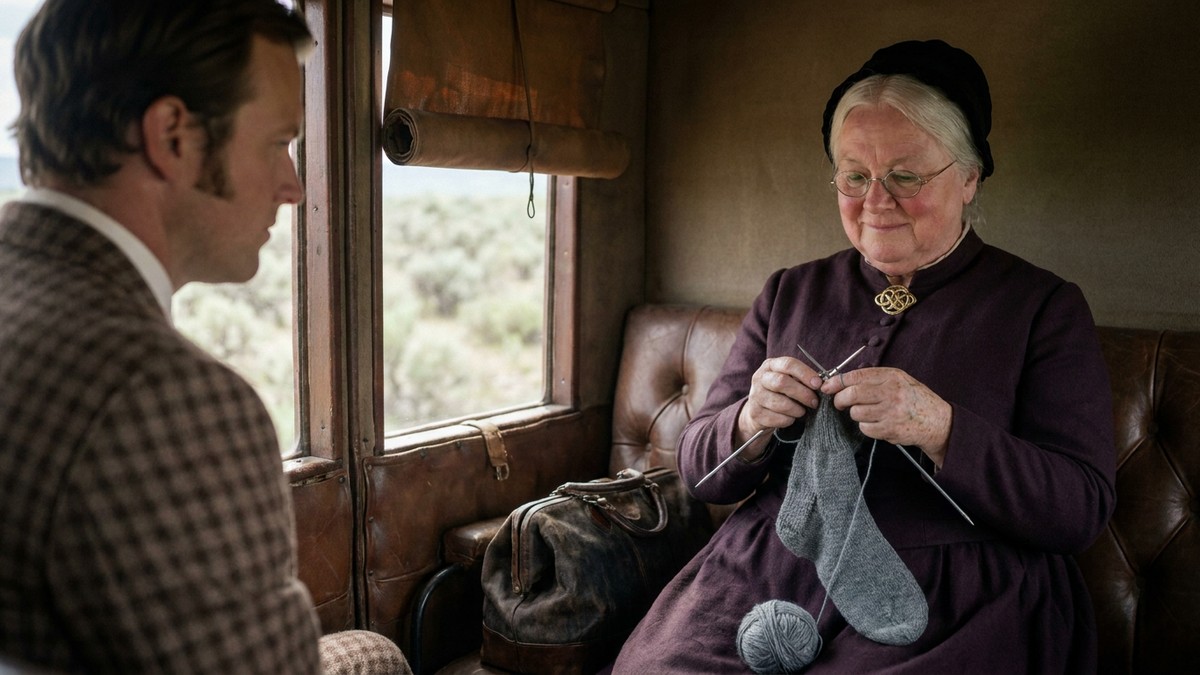
Mena Dorsey was sixty-nine, Irish, and a widow. She had a gray stocking on four steel needles and a carpetbag of gray yarn at her feet, and she did not look up much.
"Never hurry a sock," her mother had told her in County Clare, sixty years ago. "It knows."
She was going to her son.
Michael Dorsey had a small mine in Deadwood Gulch called the Shamrock, with fourteen men working it. Twice that summer the bank in Cheyenne had shipped his payroll north in the express box, and twice the express box had been blown open on the road. Fourteen men had gone unpaid for a month. Two had quit. One had a wife expecting.
Michael had written her a short letter. Mam, I don't know what to do.
She had written back an even shorter one. I'm coming.
The passengers were mostly miners and drummers. The talkative one was a drummer named Sloat, in a brown checked suit, who sold patent pumps and laughed at his own jokes.
"Now that is a powerful lot of yarn for one pair of socks, ma'am," he said on the first morning, nodding at her bag.
"I've a big son," Mena said, and went on knitting.
Sloat laughed. He had a heavy silver watch chain and a way of looking at a person's bags instead of their face. She had seen him somewhere before, she thought, and then on the second day she remembered where. In the bank in Cheyenne, three days ago. Standing at the counter behind her, buying a draft, while she spoke very quietly to the cashier.
She thought about that for twenty miles and did not drop a stitch.
That night, at the Hat Creek station, she sat up late by a candle with her bag on her knees. She unwound one ball of gray yarn and wound it up again, slowly and very tight, the way her mother had taught her to wind for a long winter. The station keeper's wife came in with a lamp and asked if she couldn't sleep.
"Old women never can," Mena said.
They came on the third afternoon, near the Cheyenne River.
The coach was laboring up out of a dry wash when someone outside shouted "Halt" and the driver hauled the six horses back so hard the coach slewed sideways. Mena's needles jabbed her palm. A shotgun boomed once, into the air.
"Hands out the windows, gents," said a voice outside. "Out slow, and all the way. Nobody wants to be a hero today."
There were three of them, with flour sacks over their heads and eye holes cut in the sacks. Two had shotguns. The third was a slim boy with a pistol that shook a little, and a voice that had not finished breaking.
They made everyone get down. They lined the passengers up beside the wheel in the hot wind, with the dust blowing between them, and the leader went down the line with a grain sack, holding it open.
Watches. Pocketbooks. A miner's poke of dust. A ring off a young man's finger. Sloat gave up his wallet without a word and with no expression at all.
When the leader reached Mena, she already had her purse open.
"Four dollars and eleven cents," she said. "And this."
She unpinned the brooch at her throat. It was a gold Celtic knot with a little garnet in the middle, and her husband had given it to her on the day they sailed from Liverpool. She held it out in her palm.
The leader looked at it through the eye holes. He took it, and the purse, and dropped them both in the sack. Then he looked down at the carpetbag in her other hand.
"What's in there, granny?"
"Socks," Mena said. "And yarn for more socks. You're welcome to a pair, if your feet are cold."
The boy with the pistol laughed. It was a young laugh, almost shy.
"Let her keep her knitting, Cal," he said. "She's somebody's grandma."
The leader hesitated a moment. Then he shrugged and moved on down the line.
Mena stood very straight beside the wheel with her bag held in front of her in both hands. She could feel her pulse in her fingertips against the handles.
The third robber had climbed up on the coach and was working on the express box with a hammer and a cold chisel. It took him a long time. When it finally came open, he swore so loud the horses threw their heads.
"Empty," he shouted down. "Nothing in it but letters."
The leader went very still.
He turned and looked at the line of passengers. He looked at them one by one, through the holes in the flour sack, until he came to Sloat. Sloat gave him the smallest nod Mena had ever seen a man give.
Then the leader turned, slowly, and looked at the carpetbag in Mena Dorsey's hands.