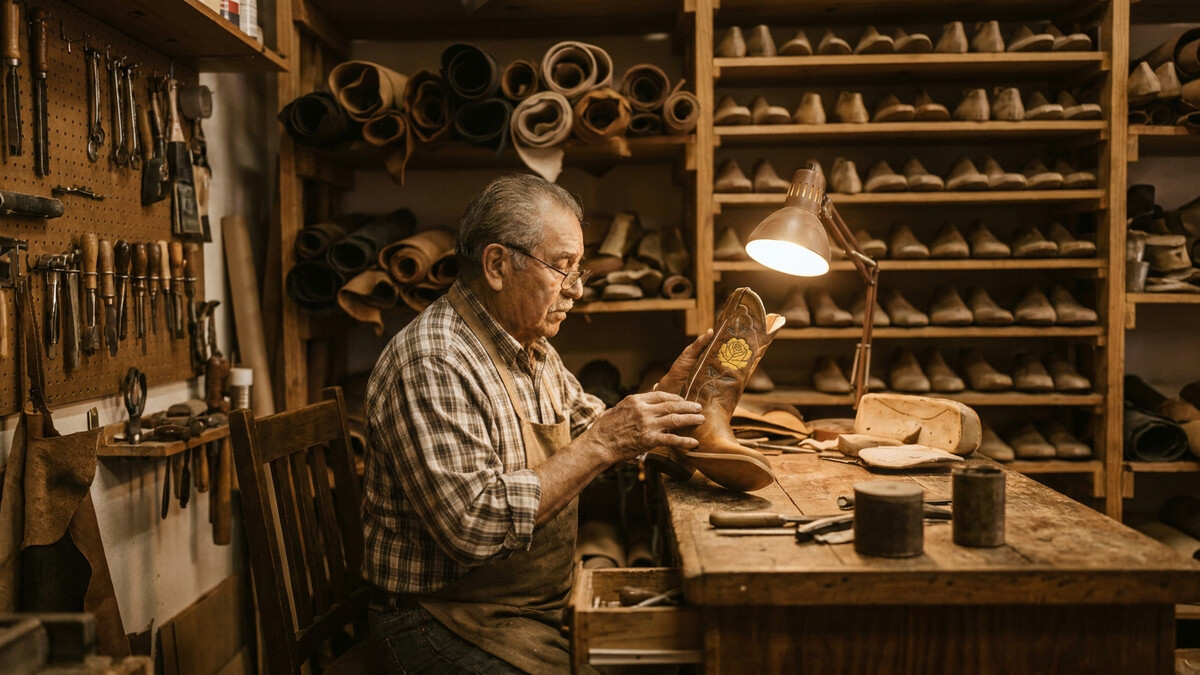
Inside the box, wrapped in yellowed newspaper from November of 1971, were two boot uppers.
Chocolate brown calfskin, with darker brown tops. Unfinished. No soles. No heels. Just the leather, cut and shaped and half-stitched, lying flat in the box like something waiting.
And on the side of each top, in yellow thread, a single stitched rose.
Three of them were finished. Perfect. Every petal.
The fourth was half done. The needle holes were punched along the pattern. The yellow thread stopped partway through a petal, cut off clean.
Travis Whitfield stood very still at the counter and did not touch them.
"I was stitching the last rose," Teodoro said quietly, "the morning his mother came in and told me."
He had never told anybody about the box. Not his wife. Not Marisa. Not anybody.
He had not known what to do with it. He could not finish them. He could not throw them away. He could not sell them to somebody else. So he had wrapped them in that morning's newspaper and put them on the top shelf, behind the pattern books, where he would not have to look at them.
And for fifty-five years, every morning when he came into the shop and turned on the light, he had known they were up there.
"I thought about them," he said. "More than I'd like to say. I thought about them when my own sons went in the Army. I thought about them every Veterans Day." He shook his head. "I thought, someday maybe somebody will come for them. And then I got old, and still not one person came. And I thought, well. That's that."
He looked at Travis.
"And then you walked in," he said.
It took him eleven weeks.
His hands could not do it alone. Not anymore. The stitching on the last rose was the hardest part. The needle holes were fifty-five years old. The yellow thread he had used in 1971 was not made anymore. Marisa found something close at a leather supply in Fort Worth.
So Teodoro did something he had never done in sixty years of making boots.
He let somebody help.
Travis Whitfield drove in from San Angelo every Saturday morning, a hundred and ten miles each way, and sat at the workbench beside the old man while he worked.
He had never held an awl or a needle in his life. He was a high school agriculture teacher. But Teodoro showed him. How to hold the leather taut. How to pull the thread so it lay flat. How to feel the needle holes with your fingertip when your eyes were not good enough to see them.
On the fourth Saturday, Teodoro handed him the needle.
"You finish the rose," he said.
Travis looked at him. "Sir, I can't. I'll ruin it."
"You won't," Teodoro said. "Your father drew this rose on a napkin. You should be the one to close it."
Travis Whitfield stitched the last petal of the last yellow rose on a Saturday afternoon in November, at the workbench, with the old man's crooked hand on his shoulder.
It took him three hours. His stitches were not as small as Teodoro's. They were not as even.
When he tied off the last one, he sat back on the stool and could not say anything for a long time.
Teodoro looked at it through his reading glasses.
"Good," he said. "That's good work."
He did not say that he could not tell which rose was his and which was the boy's. But it was true.
The rest he did himself, slowly, through December and January.
He lasted the uppers over the old wooden forms he had carved in 1971 from Buck's tracings, which were still on the shelf with Buck's name on them. He welted them by hand. He built the heels, layer by layer of leather, the old way. He pegged the soles with wooden pegs. He burnished the edges until they shone like dark glass.
Marisa watched him work and did not say anything about his hands. She brought him coffee and liniment. She drove him home at night when he could not grip the steering wheel.
On the last Saturday in January, he set the boots on the counter.
Travis took off his work boots and stood in his sock feet on the shop floor.
Teodoro handed him the left boot. The quarter-size-bigger one.
He pulled it on. It slid over his high instep and settled around his narrow heel as if it had been waiting fifty-five years for exactly that foot.
He pulled on the right one.
He stood up. He walked across the shop floor, the old boards creaking, to the mirror by the door. He stood looking at himself in it for a long time. A fifty-four-year-old man in a pair of chocolate brown boots with yellow roses on the sides.
"They fit," he said.
"They were always going to fit," Teodoro said. "I measured him."
Travis Whitfield tried to pay. Of course he did. He laid an envelope on the counter. Teodoro pushed it back across the wood with one crooked finger.
"Balance due on delivery," the old man said. "Your father paid twenty dollars down. The balance was eighty." He looked at Travis over his reading glasses. "You worked eleven Saturdays. At my prices, that's paid in full."
He took out his old receipt book. The same kind he had used since 1966. He wrote out a receipt, slowly, in his small, square hand, and tore it off and gave it to him.
Whitfield, R. L. Buck. Boots. Paid in full. Delivered to his son, January 30, 2027.
Travis Whitfield's daughter was married in April, in a little stone church outside San Angelo.
Teodoro went. Marisa drove him. He sat in the third pew in his good suit.
When the doors opened at the back of the church and the music started, a tall, freckled man of fifty-five came down the aisle with his daughter on his arm. She was in white. He was in a dark suit.
And a pair of chocolate brown boots, with a yellow rose stitched on each side.
As they passed the third pew, Travis looked down at the old bootmaker, and nodded once.
Teodoro nodded back.
Then he took out a clean white handkerchief, because he was eighty-five years old now, and he could do what he liked.
The boots were the last pair Teodoro Salinas ever made.
He closed the shop on Main Street in May. Marisa took the long wooden file drawer of measurement cards home with her, all four thousand of them, alphabetical, going back to 1966.
The one for Whitfield, R. L. Buck, is not in it anymore.
It is framed, on the wall of a ranch house outside San Angelo, beside a photograph of a young soldier in a new uniform, and a pencil tracing of two bare feet, and a receipt that says paid in full.