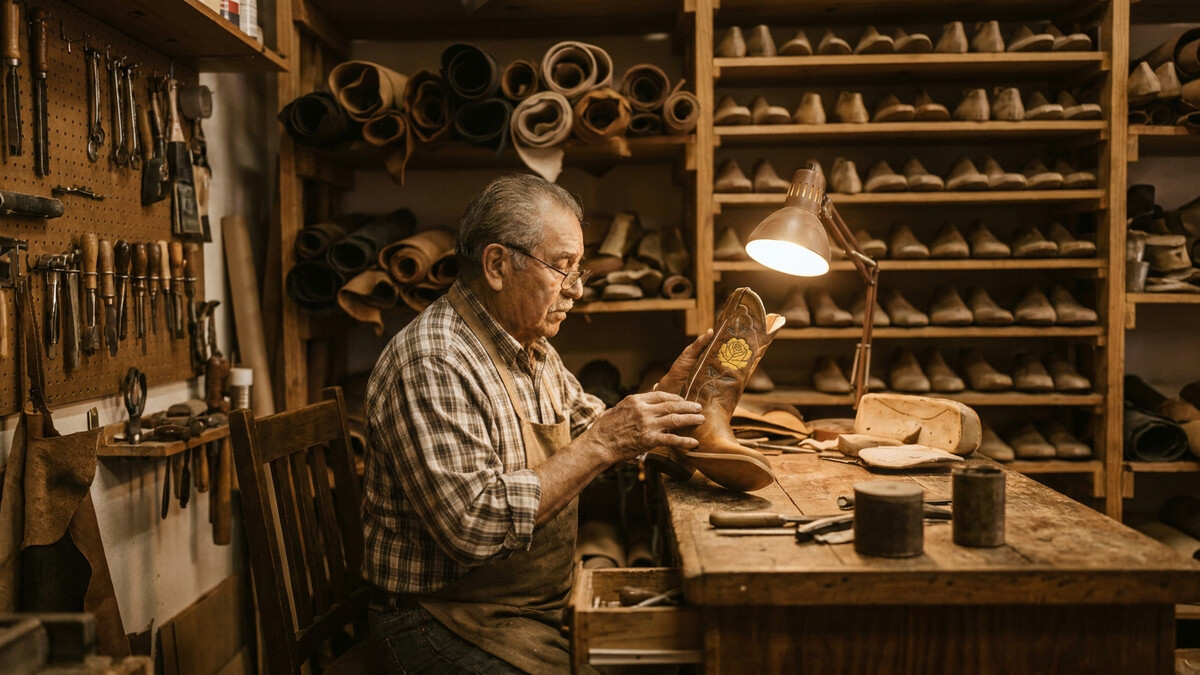
Teodoro Salinas had decided that the pair of boots on his workbench in October would be the last pair he ever made, and he had just told his granddaughter so, when a stranger walked into the shop on Main Street in Mesquite Springs, Texas, and laid a yellowed measurement card on the counter in Teodoro's own handwriting, dated 1971.
"Mr. Salinas," the man said. "I'd like to order a pair of boots. These are the measurements."
Teodoro put on his reading glasses and looked at the card.
Then he took them off, and looked at the man, and put them back on, and looked at the card again.
"Son," he said slowly. "The man these measurements belong to has been dead for fifty-five years."
"Yes, sir," the stranger said. "He was my father."
Teodoro was eighty-four. He had made boots by hand in the same narrow brick shop on Main Street since 1966. Before that, he had learned the trade from his father, who had learned it from his father in San Antonio, in the old days, when every cowboy in South Texas had his boots made to fit.
He had made something like four thousand pairs. Ranchers. Rodeo cowboys. Oilmen. A county judge.
Every pair had started the same way. With a customer standing in his sock feet on a sheet of brown paper while Teodoro traced around each foot with a pencil. Then the measurements. Ball. Waist. Instep. Heel. Calf. Written on a card in his small, square hand, and kept in a long wooden file drawer under the counter, alphabetical, going back sixty years.
His hands were bad now. Arthritis, in every knuckle. He could still cut leather. But the stitching took him three times as long as it used to, and it hurt.
He had told his granddaughter, Marisa, that morning that this pair would be his last. She had cried a little and then hugged him and said it was time.
The card on the counter was one of his. He knew it the moment he saw it. The brown cardstock he had bought by the box from a printer in Abilene. His handwriting, younger and firmer.
Whitfield, R. L. Buck. June 9, 1971.
Below it, the measurements. Both feet. Left a quarter size larger, which was common. High instep. Narrow heel.
And folded inside it, a sheet of brown paper with two pencil tracings of a pair of bare feet.
"Buck Whitfield," Teodoro said softly.
"Yes, sir," the stranger said. "My name's Travis Whitfield. I'm fifty-four. My mother passed in August. She kept this in her Bible for fifty-five years. I found it when I was going through her things." He swallowed. "There was a receipt with it. For a deposit. Twenty dollars. Paid in cash."
He laid a second slip of paper on the counter. A receipt from Salinas Boot Shop. Teodoro's handwriting again.
Deposit received. $20. Balance due on delivery. Pickup when he gets home.
Teodoro remembered.
He remembered it all at once, the way old men remember things that happened fifty years ago more clearly than things that happened last week.
Buck Whitfield had been twenty-two. A tall, skinny, freckled ranch hand from the Whitfield place out on the county road. He had come into the shop in June of 1971 in a brand-new Army uniform, with his crew cut, and a pretty dark-haired girl on his arm.
"Mr. Salinas," he had said. "I'm going to Vietnam on Thursday. When I get home next year, I'm marrying this girl. And I want to be married in a pair of your boots."
He had stood in his Army socks on the brown paper, laughing, while the girl giggled, and Teodoro traced his feet.
He had picked out the leather himself. Chocolate brown calfskin for the foot, and a darker brown for the tops. And a stitch pattern Teodoro had never done before or since, that Buck had drawn himself on a napkin. A single yellow rose, on each side of each boot, for the girl. Her name was Rose.
He had paid twenty dollars down. It was all he had.
"Pickup when he gets home," Teodoro had written.
"He was killed in November of 1971," Travis said quietly. "In a helicopter crash. He'd been there five months. Mama was four months pregnant with me. They had gotten married at the courthouse in September, on his leave. A justice of the peace. No boots. She always said they were going to have the real wedding when he got home."
Teodoro did not say anything.
"I never knew him," Travis said. "I've got eleven photographs. That's all. A uniform. A Bible. A pocketknife. And this card." He looked at the brown paper tracing. "Mama used to take this out sometimes, when I was a boy. She'd set it on the kitchen floor and have me stand next to it. To see if I'd grown into his feet yet."
His voice cracked.
"I grew into them when I was nineteen," he said. "Exactly. Left foot a quarter size bigger. High instep. Narrow heel. Mama cried for a week."
Marisa had come out from the back. She stood behind her grandfather with her hand over her mouth.
"Mr. Salinas," Travis said. "I know you're retiring. The lady at the diner told me. And I know these are fifty-five years old, and I don't even know if you still make boots like that. But my daughter's getting married in April. And I'd like to walk her down the aisle in the boots my father never got to wear." He took a breath. "I'll pay whatever you ask. Whatever it takes."
Teodoro looked at the card for a long time.
Then he said something that made Marisa turn and stare at him.
"There's no charge," he said. "The boots are already paid for."
"Sir, it was twenty dollars. In 1971."
"Twenty dollars down," Teodoro said. "Balance due on delivery." He set down his reading glasses. "I never delivered."
He turned around, slowly, and looked up at the very top shelf behind the workbench.
It ran all the way along the back wall of the shop, close to the ceiling, above the racks of leather and the old cast-iron lasts. It was where he kept things he did not use anymore. Old patterns. Old tools. Boxes that had not been opened in decades.
He went to the corner and got the stepladder.
"Abuelo," Marisa said sharply. "Abuelo, no. Your knees."
Teodoro did not answer. He set the ladder under the far end of the shelf and started to climb. One step. Two. Three. Marisa ran to hold it.
At the top, he reached into the back of the shelf, behind a stack of dusty pattern books, and felt along the wall with his bad hands until he found it.
A boot box. Brown cardboard, gone soft and gray with dust. Tied with a piece of twine.
He brought it down the ladder against his chest, one step at a time.
He set it on the counter in front of Travis Whitfield and untied the twine with his crooked fingers.
"I had already started them," he said.