12 Seconds at Kitty Hawk: The Wright Brothers' First Flight
At 10:35 a.m. on December 17, 1903, Orville Wright flew 120 feet in about 12 seconds. The diary, the five witnesses, the photo, and the telegram home.
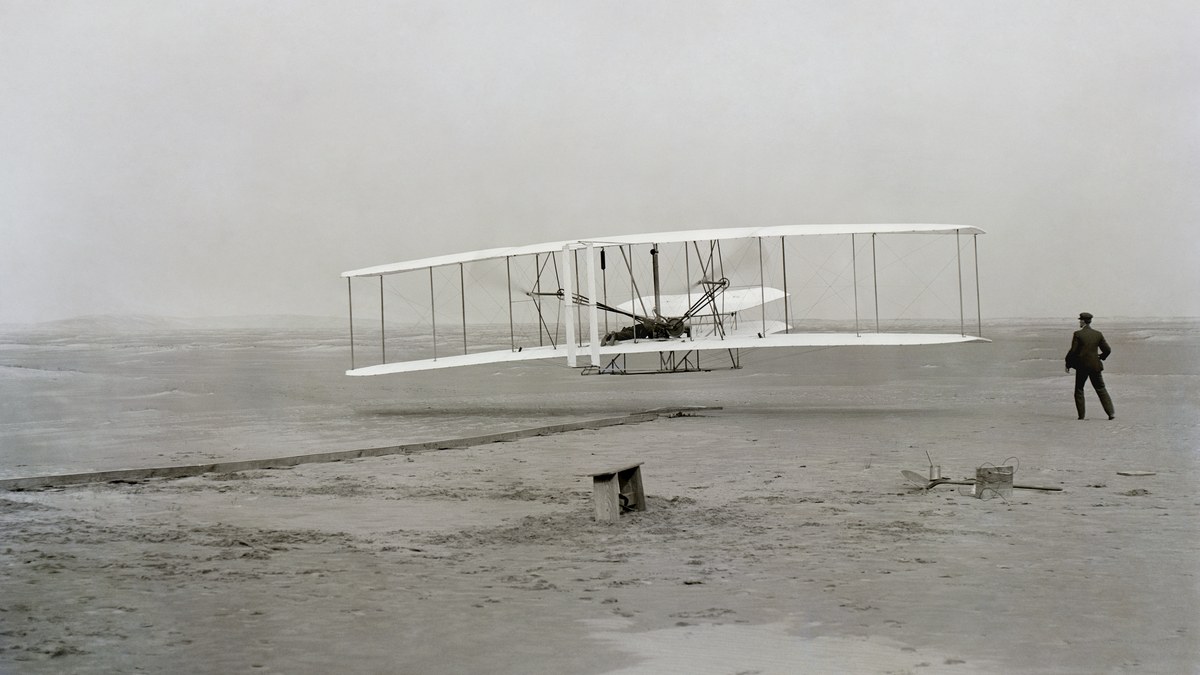
Orville Wright started his diary entry for Thursday, December 17, 1903, with the weather.
"When we got up a wind of between 20 and 25 miles was blowing from the north."
The brothers flew anyway. By noon, they had made four flights, and the last one went 852 feet.
Three days earlier
They had already tried once. On December 14, at their camp near Kill Devil Hills, outside Kitty Hawk, North Carolina, Wilbur and Orville tossed a coin to see who would go first. Wilbur won. The Flyer left the rail, stalled, and crashed, slightly damaging the machine. The Library of Congress notes that the brothers did not count it as a true flight.
More American Memories
Explore Our "Remember When" Archive of Treasured Decades →By the 17th, it was fixed. This time it was Orville's turn.
The witnesses
Five men came out that morning. Orville named them in his diary: John T. Daniels, W.S. Dough, and A.D. Etheridge from the Kill Devil Hills Life-Saving Station, W.C. Brinkley of Manteo, and a man from Nags Head the diary calls Johnny Moore.
Orville set up his camera on a tripod, aimed it at the end of the launching rail, and showed Daniels how and when to trip the shutter.
The Flyer would take off from level ground, running along a 60-foot rail into the wind. No hill, no push. The weather bureau's instrument nearby read 27 miles an hour.
10:35 a.m.
"I got on the machine at 10:35 for the first trial," Orville wrote.
The Flyer ran down the rail with Wilbur alongside and lifted into the air. Daniels tripped the shutter. That is the famous photograph: Orville lying flat at the controls, the machine a few feet off the sand, Wilbur standing to the right.
The flight covered 120 feet. Orville's diary is honest about the time: "Time about 12 seconds (not known exactly as watch was not promptly stopped)."
The National Park Service and the Smithsonian describe it the same way: the first successful powered, controlled flight of a heavier-than-air machine.
Four flights by noon
The brothers took turns. At about 11:20, Wilbur flew about 175 feet. At about 11:40, Orville went again. The Park Service's flight markers record 200 feet in 15 seconds.
At noon, Wilbur made the fourth flight. "The distance over the ground was 852 feet in 59 seconds," Orville wrote.
Then the wind took over. A gust caught the Flyer and turned it over. Daniels was caught up in it. "His escape was miraculous, as he was in with the engine and chains," Orville wrote. Daniels came away with a few bruises. In a later account preserved by the Smithsonian, he called himself the first victim of an airplane crash.
The Flyer was too badly damaged to fly again that year. As the Smithsonian puts it, all of its flying took place on a single chilly December morning.
A telegram home
After lunch, the brothers walked about four miles to Kitty Hawk. The only telegraph there was a government wire at the Weather Bureau office, connected to Norfolk. The operator there, an old correspondent of the brothers, sent a telegram from Orville to their father, Bishop Milton Wright, in Dayton, Ohio.
It reported four flights against a 21-mile wind, an average speed through the air of 31 miles an hour, and "longest 57 seconds." That was one of two mistakes made in sending it. The flight had lasted 59 seconds, and Orville's name came out "Orevelle." The message ended with the plan that mattered most to a family in Dayton: "home Christmas."
It reached Dayton at 5:25 that afternoon. The brothers packed up their broken machine and were home on the evening of December 23.
The press did not do much better. The next day's Virginian-Pilot in Norfolk reported a flight of three miles at a height of 60 feet, and even worked the word "Eureka" into the story. The distance, the height, and the "Eureka" were all wrong.
The machine
The 1903 Flyer had a wingspan of 40 feet 4 inches and weighed 605 pounds empty. Its four-cylinder, 12-horsepower engine was built with the help of their mechanic, Charlie Taylor.
For 20 years, the Flyer was not even in America. Orville was in a long dispute with the Smithsonian, which had put a rebuilt version of its former secretary Samuel Langley's machine on display as the first capable of carrying a man in flight, and was slow to credit the Wrights. In 1928, Orville sent the Flyer to the Science Museum in London instead.
The dispute ended after the Smithsonian, in 1942, published a correction of its Langley claims. The Flyer came home, and on December 17, 1948, the 45th anniversary of the first flight, it went on display in Washington. Orville had died that January and did not see it.
- At Kill Devil Hills, a granite boulder marks the spot where the Flyer left the rail. Four smaller markers show where each flight landed. On top of the big dune where the brothers had tested their gliders stands a 60-foot granite monument, dedicated in 1932.
-
🏛️
Wright Brothers National Memorial, Kill Devil Hills, North Carolina: nps.gov ↗
-
🏛️
The original 1903 Wright Flyer, Smithsonian National Air and Space Museum, Washington, D.C.: airandspace.si.edu ↗
-
🏛️
Dayton Aviation Heritage National Historical Park, including the Wright Cycle Company building, Dayton, Ohio: nps.gov ↗
-
🏛️
Orville's 1903 diary and the telegram, Library of Congress Wright Papers: loc.gov ↗
Join the Conversation
"Do you remember your first airplane ride, and where you were going?"
DailyVibeX American History Community
- National Park Service, "The First Flight": https://www.nps.gov/wrbr/learn/historyculture/thefirstflight.htm ↗
- National Park Service, "Four Powered Flights": https://www.nps.gov/places/3-four-powered-flights.htm ↗
- National Park Service, Wright Brothers National Memorial FAQ: https://www.nps.gov/wrbr/learn/frequently-asked-questions.htm ↗
- National Park Service, Wright Brothers National Memorial management and history: https://www.nps.gov/wrbr/learn/management/index.htm ↗
- National Park Service, Charles E. Taylor: https://www.nps.gov/people/charles-e-taylor.htm ↗
- National Park Service, "The Wright Flyer": https://nps.gov/articles/wrightflyer.htm ↗
- National Park Service, Dayton Aviation Heritage: https://www.nps.gov/daav/planyourvisit/index.htm ↗
- Library of Congress, Today in History, December 17: https://www.loc.gov/item/today-in-history/december-17/ ↗
- Library of Congress, Wright Papers, "First Flight": https://www.loc.gov/collections/wilbur-and-orville-wright-papers/articles-and-essays/collection-highlights/first-flight/ ↗
- Library of Congress, Orville Wright diary, 1903: https://www.loc.gov/item/wright002238/ ↗
- Library of Congress, Wright telegram, December 17, 1903: https://www.loc.gov/item/mcc.061/ ↗
- Library of Congress, first flight photograph: https://www.loc.gov/pictures/item/00652085/ ↗
- Library of Congress blog, "The Wright Brothers: History Takes Wing at the Library": https://blogs.loc.gov/loc/2023/11/the-wright-brothers-history-takes-wing-at-the-library/ ↗
- Smithsonian National Air and Space Museum, 1903 Wright Flyer: https://airandspace.si.edu/collection-objects/1903-wright-flyer/nasm_A19610048000 ↗
- Smithsonian, 1903 Wright Flyer object record: https://www.si.edu/object/1903-wright-flyer%3Anasm_A19610048000 ↗
- Smithsonian National Air and Space Museum, "What Happened to the Original Wright Flyer": https://airandspace.si.edu/stories/editorial/what-happened-original-wright-flyer ↗
- Smithsonian National Air and Space Museum, "The Wright Brothers Made History at Kitty Hawk": https://airandspace.si.edu/stories/editorial/wright-brothers-made-history-kitty-hawk ↗
- Smithsonian Institution Archives, Wright brothers: https://siarchives.si.edu/history/featured-topics/stories/wright-brothers-pioneers-aviation ↗
- Smithsonian Institution Archives, Flyer display record: https://siarchives.si.edu/collections/siris_sic_2423 ↗
- Smithsonian Education, Wright brothers primary-source lesson: https://www.smithsonianeducation.org/educators/lesson_plans/wright/wright.pdf ↗
- Smithsonian Education, the Wrights' statement: https://www.smithsonianeducation.org/educators/lesson_plans/wright/first_flight.html ↗
- Smithsonian Education, Virginian-Pilot story: https://www.smithsonianeducation.org/educators/lesson_plans/wright/virginia_pilot.html ↗
- Smithsonian American Art Museum, Wright Brothers National Memorial record: https://www.si.edu/object/wright-brothers-national-memorial-sculpture%3Asiris_ari_19382 ↗
- Orville Wright's diary, transcription, Wright Brothers Aeroplane Company: https://www.wright-brothers.org/History_Wing/Wright_Story/Inventing_the_Airplane/December_17_1903/Orville_Wrights_Diary.htm ↗
Sponsored Historical & Heritage Features
Step Into Pine Hollow: 20 Complete American Stories
Warm, character-rich tales of small-town resilience, family heirlooms, and neighborly kindness.
Explore All 20 Stories →More Surprising American History
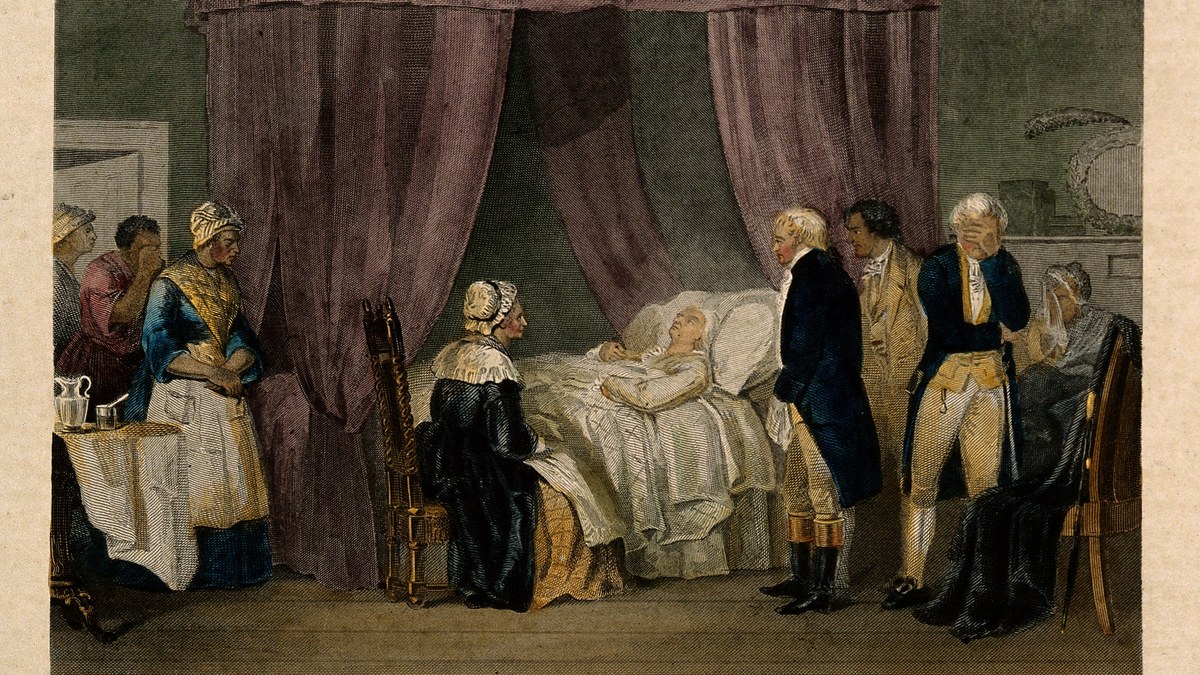
How Did George Washington Die? His Last Day in 1799
A ride in the snow, a sore throat, and less than a day of illness. How George Washington died on December 14, 1799, from the account of the man who sat with him.
Route 66 Turns 100: How the Mother Road Began
Route 66 didn't open with a ribbon. It began with a vote in North Carolina, an argument over a number, and a road that was mostly unpaved.
Did Paul Revere Really Shout "The British Are Coming"?
The line everyone learned isn't in any of Revere's own accounts. What he did that night, in his own words, is a better story than the poem.